Vehicle Hub

Switzerland

Car dealer compliance in Switzerland

The energy efficiency category from your SFOE label with the official graphic on every online advert, consumption and CO2 in German, French and Italian, retail prices in CHF under the PBV and credit examples with the over-indebtedness notice.

  • Cancel anytime
  • No long-term contract
  • 14 days free
Car dealer compliance in Switzerland

The rules for car adverts in Switzerland

5 rules decide what a dealer in Switzerland has to show on the car, in adverts and in financing examples. Each one, and what it asks of you:

  1. CHEnEV

    Energy Efficiency Ordinance (Energieeffizienzverordnung, SR 730.02)

    Authority Swiss Federal Office of Energy (SFOE)

    A new car, meaning up to 2,000 km, needs the energy label in the sales location, created only with the SFOE online tool as an A4 sheet with a QR code to verbrauchskatalog.ch. Adverts, sales listings and configurators state energy consumption and CO2 emissions, for passenger cars also the category, and online they show the SFOE graphic at least 15 x 20 mm and 1 percent of the advert. Intentional breaches can cost up to CHF 100,000, negligent ones up to CHF 20,000 (EnG Art. 70).

  2. CHVEE-PLS

    DETEC Ordinance on energy efficiency categories (Verordnung des UVEK über Angaben auf der Energieetikette), AS 2025 470 for 2026 and AS 2026 379 for 2027

    Authority Federal Department of the Environment, Transport, Energy and Communications (DETEC)

    Sets the category boundaries on the primary energy petrol equivalent and the average CO2 emissions of all new cars sold: 111 g/km for 2026 and 102 g/km for 2027, with unchanged boundaries. The new values and graphics apply from 1 January, without a transition period.

  3. CHPBV

    Price Indication Ordinance (Preisbekanntgabeverordnung, SR 942.211)

    Authority State Secretariat for Economic Affairs (SECO); enforced by the cantons

    Prices to consumers are retail prices in CHF including VAT and every surcharge the buyer cannot choose to leave out, also for leasing and in advertising. A comparison with your own earlier price is allowed only within limits: half as long as the old price applied and at most two months, or without limit if it applied for at least 30 days.

  4. CHUWG

    Federal Act against Unfair Competition (SR 241), public announcements of consumer credit

    Authority Civil and criminal courts; SECO can bring an action for the Confederation

    A financing advert names your firm clearly, the net amount, the total cost and the annual percentage rate; for a car financed by credit also the cash price and the price payable under the credit agreement. It must state that lending is prohibited if it leads to the consumer's over-indebtedness, in German, French or Italian. There is no CCD2 warning in Switzerland.

  5. CHKKG

    Consumer Credit Act (Konsumkreditgesetz, SR 221.214.1) and Consumer Credit Ordinance (KKV)

    Authority Federal Department of Justice and Police (FDJP)

    Covers loans from CHF 500 to 80,000. The maximum annual rate is 10 percent since 1 January 2026, and a contract above it is void. A dealer who arranges financing for his own cars needs no cantonal licence as a credit broker.

Car dealer compliance in Switzerland starts with the energy label of the Energy Efficiency Ordinance (EnEV, Annex 4.1): every new car with up to 2,000 km carries the label created with the SFOE online tool, and every advert or sales listing states energy consumption, CO2 emissions and, for passenger cars, the energy efficiency category A to G, online with the official SFOE graphic. On top come the Price Indication Ordinance (PBV) for retail prices in CHF and the consumer credit rules of the UWG and the KKG, with a notice that lending is prohibited if it leads to over-indebtedness and a maximum interest rate of 10 percent for 2026. Vehicle Hub keeps these Swiss rules as two rule sets, one for passenger cars and one for vans, and applies them in German, French and Italian.

The label at the car is the one thing Vehicle Hub does not print, because the ordinance allows only the SFOE tool. You enter the category from that label once, and Vehicle Hub shows it everywhere else: as the official SFOE graphic on the car's page, built with the Vehicle Hub widgets, and as a letter on the exposé and the price sign, in the language of the page. The checks behind each value are described under car dealer mandatory information, and the car labelling directive by country overview shows how Switzerland differs from its EU neighbours. Vehicle Hub applies the published rules; it does not give legal advice.
What the Swiss energy label and category graphic look like

The energy label at the car is an A4 portrait sheet that you create with the SFOE online tool from the type approval, the data sheet, the VIN or the Swiss Stammnummer; it names the year it is valid for and carries a QR code to verbrauchskatalog.ch. Vehicle Hub does not print it. What it does use is the category you enter from that label: online adverts show the official SFOE graphic A to G in the colours of the SFOE files, in German, French or Italian, and printed outputs show the letter.

  1. A up to 3.23
  2. B 3.23-4.03
  3. C 4.03-4.84
  4. D 4.84-5.65
  5. E 5.65-6.46
  6. F 6.46-7.26
  7. G above 7.26
Energy efficiency categories A to G by primary energy petrol equivalent, set by DETEC; the dealer enters the category from the SFOE label
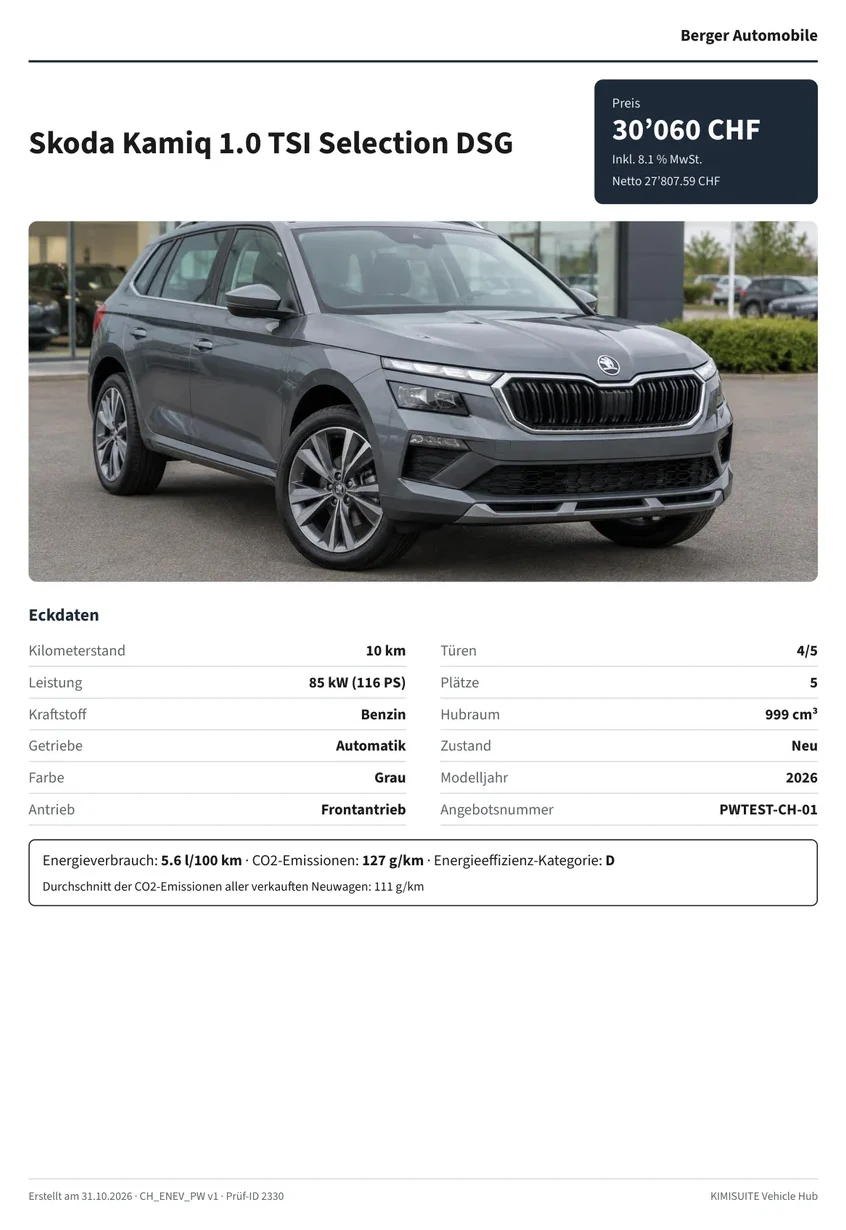
Exposé printed by Vehicle Hub for a Swiss branch: a new petrol Skoda Kamiq with 5.6 l/100 km, 127 g/km and energy efficiency category D, the category taken from the SFOE label, plus the average CO2 of all new cars sold and the price including 8.1 % VAT.

Mandatory details in Switzerland

  • Energy efficiency category A-G for passenger cars, from the SFOE label
  • Energy consumption per 100 km in l, kg, m3 or kWh, to one decimal
  • CO2 emissions in whole g/km
  • Plug-in hybrids: fuel and electricity consumption side by side
  • Vans and light semi-trailers: consumption and CO2, no category, no label at the vehicle
  • Labels of the values in German, French or Italian
  • Average CO2 of all new cars sold, 111 g/km in 2026 (voluntary line)
  • Retail price in CHF including 8.1 percent VAT and transfer costs
  • Firm, net amount, total cost, APR, cash price, price under the credit agreement
  • Notice that lending is prohibited if it leads to over-indebtedness
  • Annual rate no higher than the 10 percent maximum for 2026

What you get

  • The official SFOE graphic, chosen for you

    Vehicle Hub carries the SFOE category files for 2026 and 2027 in German, French and Italian and picks the right one by date and page language. You never upload a graphic per car.

  • Three languages from one car

    Energieverbrauch, consommation d'énergie, consumo di energia: the same values appear with the wording of the page language, on the website and in the exposé.

  • Your category, never a guess

    The category comes from the SFOE label you created, so Vehicle Hub asks you for it instead of computing one. The wizard shows the graphic as soon as you enter it.

  • Cars and vans kept apart

    Passenger cars carry the category, vans and light semi-trailers only consumption and CO2. Cars with more than 2,000 km stay visible as occasions without the duty.

  • Swiss credit examples

    The Loan Calculator prints your firm, the cash price, the price under the credit agreement and the over-indebtedness notice, and keeps the annual rate under the legal maximum. No EU warning appears on a Swiss page.

Enter three categories and look at your website

Take three new cars, enter the categories from their SFOE labels and open their pages on your website in German, French and Italian. The graphic, the values and the price in CHF follow the language.

How to get started

  1. Set up car dealer compliance in Switzerland

    Open Vehicle Hub in your KIMISUITE workspace and choose Switzerland as the main market of your branch. The Swiss rule sets for cars and vans apply from then on.

  2. Bring in your stock

    Import from mobile.de, your dealer system or a CSV or XML feed, or add cars in the wizard. Consumption and CO2 come with the import.

  3. Enter the category from the SFOE label

    Create the energy label with the SFOE tool as before and enter its category in Vehicle Hub. Run 'Check all vehicles' to find any new car still without one.

  4. Publish in your languages

    Place the widgets on your website in German, French or Italian, hand out exposés and, if you advertise financing, enter the lender in the financing settings.

Pricing

The Swiss rule sets, the SFOE graphics in three languages and the Loan Calculator are included in Vehicle Hub, from a fixed monthly price (see pricing) per dealership workspace. The people who sell, photograph and enter the categories all work in that one workspace for that one price.

See all plans

Is it the right fit?

A good fit if

  • Garages and brand representations that sell new cars and occasions in Switzerland
  • Dealers whose customers read German, French or Italian
  • Dealers who already create the energy label with the SFOE tool and want the category on every online advert
  • Dealers who advertise financing and need the Swiss credit notice

Not the right fit if

  • Dealers who expect Vehicle Hub to create the Swiss energy label; only the SFOE tool may do that
  • Dealers who need price lists or an online configurator; Vehicle Hub advertises individual cars
  • Dealers who want Vehicle Hub to publish their stock to AutoScout24 Schweiz; Vehicle Hub publishes only to mobile.de, not to AutoScout24 Schweiz
  • Anyone looking for legal advice; Vehicle Hub applies the rules, your association or lawyer interprets them

Frequently asked questions

What does car dealer compliance in Switzerland ask of my online adverts?

Energy consumption, CO2 emissions and, for passenger cars, the energy efficiency category with the official SFOE graphic, plus a retail price in CHF. Financing adverts add the UWG details and the over-indebtedness notice.

Why does Vehicle Hub not print the Swiss energy label?

Because the EnEV allows only the SFOE online tool to create it. You make the label there as before, enter its category once, and Vehicle Hub uses it on your website, exposés and price signs.

Does an occasion with 2,500 km need the category?

No. The duty applies up to 2,000 km. Above that you may still show the values voluntarily, but then with current data, and Vehicle Hub keeps such cars visible without asking for a category.

What changes on 1 January 2027?

The SFOE graphics carry the new year and the average CO2 of new cars falls from 111 to 102 g/km; the category boundaries stay the same. Vehicle Hub switches graphic and average at midnight Swiss time.

Do Swiss financing adverts need the EU credit warning?

No. Switzerland does not apply the EU Consumer Credit Directive. Your adverts carry the UWG notice that lending is prohibited if it leads to over-indebtedness, and the rate must stay under the 10 percent maximum for 2026.

Who supervises data protection for enquiries from my website?

The Federal Data Protection and Information Commissioner (FDPIC), under the revised Federal Act on Data Protection. Vehicle Hub sends website enquiries to you and to CRM Business Hub; you decide how long you keep them.

Vehicle Hub knows the rules of 33 countries

Every country has its own label, advertising and financing rules. Pick a country to see them one by one.

All countries and their rules at a glance

Ready when you are

Set it up in your own workspace and see how it works with your data.

  • Cancel anytime
  • No long-term contract
  • 14 days free