Vehicle Hub

Netherlands

Car dealer compliance in the Netherlands

The energielabel at every new car, the brand poster, labelled consumption in your adverts, the rijklaar price and the AFM warning on every financing offer: Vehicle Hub prints and checks them from the car's own data, and switches to the 2027 label model on 1 January.

  • Cancel anytime
  • No long-term contract
  • 14 days free
Car dealer compliance in the Netherlands

The rules for car adverts in Netherlands

7 rules decide what a dealer in Netherlands has to show on the car, in adverts and in financing examples. Each one, and what it asks of you:

  1. NLStb. 2000, 475

    Besluit etikettering energiegebruik personenauto's (Decree on the labelling of the energy consumption of passenger cars), text of 2014

    Authority Ministerie van Infrastructuur en Waterstaat; enforcement by the Inspectie Leefomgeving en Transport (ILT)

    Every new passenger car offered for sale or lease at a point of sale, trade fairs included, needs the energielabel on or right next to it, and each brand needs a poster with all its new models. Every piece of printed advertising, from brochures to newspaper ads and billboards, must state the official fuel consumption in l/100 km and km/l and the CO2 emissions in g/km. The ILT can fine a breach up to the second category, 5,500 euros since 1 January 2026.

  2. NLStb. 2026, 165

    Amending decree of 23 June 2026 with the new label model, applying from 1 January 2027

    Authority Ministerie van Infrastructuur en Waterstaat

    From 1 January 2027 the label shows the Energiedrager, adds electricity consumption in kWh/100 km and km/kWh for electric cars and plug-in hybrids, and states the years of application 2027 to 2029. Advertising keeps the same consumption and CO2 values, with natural gas in kg instead of m3. Vehicle Hub holds both label models and changes over on the date itself.

  3. NLStcrt. 2026, 21583

    Regeling relatieve energiezuinigheid personenauto's 2027 (Order on the relative energy efficiency of passenger cars)

    Authority Ministerie van Infrastructuur en Waterstaat; classes published per car by the RDW

    The order sets how the A to G class is found from 2027: a value from CO2 plus electricity and hydrogen use is compared with a reference value from the car's length and width, and each class is a band, from A at more than 15 percent below the reference to G at 35 percent or more above it. The class holds for three calendar years at a time. Dealers take it from the importer label or the RDW register, never from their own sums.

  4. NLBW 6:193e

    Burgerlijk Wetboek Book 6 (material information in an invitation to purchase)

    Authority Autoriteit Consument & Markt (ACM)

    An advert with a price is an invitation to purchase, so the price must include taxes, and leaving out costs the buyer cannot avoid is a misleading omission. The ACM told the motor trade in 2016 that rijklaarmaakkosten, fees, the recycling contribution, btw and BPM belong in the advertised price of new and used cars alike.

  5. NLBgfo

    Besluit Gedragstoezicht financiële ondernemingen Wft (credit advertising)

    Authority Autoriteit Financiële Markten (AFM)

    As soon as a car advert names an interest rate or a figure for the cost of credit, all the standard details must appear together in one table with nothing else in it: borrowing rate and whether it is fixed, total credit, annual percentage rate (JKP), lender or intermediary with address, term, cash price and down payment, total amount payable, and number and size of the instalments. The advert also says where the pre-contractual information is available and how the dealer works as an intermediary.

  6. NLNrgfo

    Nadere regeling gedragstoezicht financiële ondernemingen Wft (credit warning)

    Authority Autoriteit Financiële Markten (AFM)

    Every credit advert, even one without figures, carries the official AFM image "Let op! Geld lenen kost geld". It runs across the full width, takes at least 10 percent of the advert's height, sits at the top online and at the bottom in print, and may never be redesigned. The rule has applied since 1 April 2023 and stays in place after the CCD2 date.

  7. NLBesluit kredietvergoeding

    Besluit kredietvergoeding (Decree on credit charges)

    Authority Autoriteit Financiële Markten (AFM)

    The effective credit charge may not exceed the statutory interest rate plus 8 percentage points, which makes 12 percent while the statutory rate is 4 percent. Dealers confirm the maximum each quarter, and a financing example above it is not shown.

Car dealer compliance in the Netherlands means four things for every new passenger car you sell or lease to a customer: the official energielabel on or right next to the car, a poster per brand in the showroom, the official fuel consumption in l/100 km and km/l plus the CO2 emissions in every printed advert, and a price that already includes btw, BPM and the rijklaarmaakkosten. Offer a car loan and the Wft rules add the krediettabel and the AFM warning "Let op! Geld lenen kost geld". The label rules come from the Besluit etikettering energiegebruik personenauto's, the 2000 decree whose 2014 text applies today and whose new text, adopted in Stb. 2026, 165, takes over on 1 January 2027. Vehicle Hub keeps the values on the car and prints the label, the advert line and the price from them.

The Dutch class from A to G is a relative class: the RDW compares a car's CO2 emissions with a reference value for cars of its size, so a dealer can never work it out alone. Vehicle Hub therefore takes the official class and year from the importer's label or the RDW register and refuses the label while it is missing. Used cars and vans are outside the decree, and a demonstrator counts as new until it has been sold to a customer. The mandatory information per market follows your branch's main market, and the Vehicle Hub widgets show the same labelled values on each car's page. The Netherlands is one of the European markets Vehicle Hub covers rule by rule; the overview of all countries lists the others. Vehicle Hub applies the rules; it does not replace legal advice on a specific case.
What the Dutch energielabel looks like

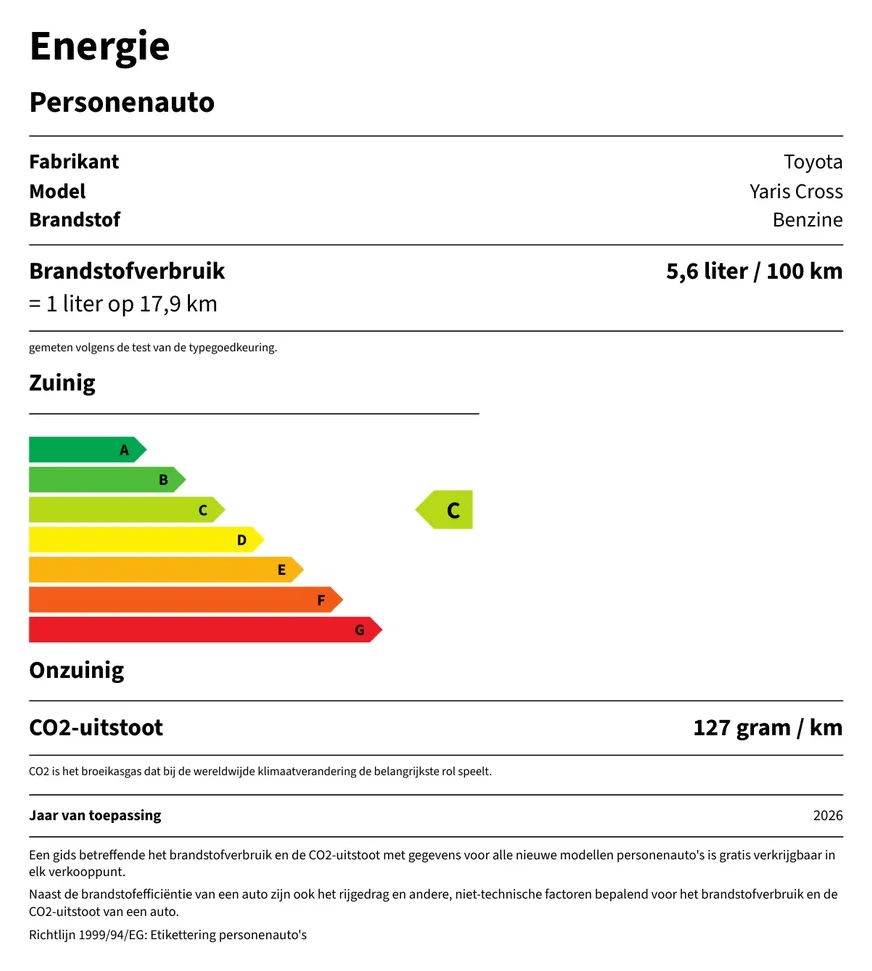
The label is a white A4 sheet with black text in the order of the official model: Energie and Personenauto at the top, then Fabrikant, Model and Brandstof, the consumption in liter / 100 km with "= 1 liter op ... km", seven colored arrows from Zuinig to Onzuinig with the car's class beside them, the CO2 emissions in gram / km and the year of application. Two sentences at the foot point to the free fuel guide at every point of sale and to the influence of driving style. From 1 January 2027 a line for electricity consumption and the years 2027 to 2029 join it.

  1. A more than 15 % below the reference value
  2. B 5 to 15 % below
  3. C within 5 % of the reference value
  4. D 5 to 15 % above
  5. E 15 to 25 % above
  6. F 25 to 35 % above
  7. G 35 % or more above
Relative classes A to G against a reference value for cars of the same size, taken from the importer label or the RDW register.
Energielabel printed by Vehicle Hub for a new Toyota Yaris Cross petrol car: 5,6 liter / 100 km, 1 liter op 17,9 km, 127 gram / km, class C, Jaar van toepassing 2026.

Mandatory details in Netherlands

  • Energielabel A4 in the layout of the official model
  • Official class A to G and year of application, from the importer label or the RDW register
  • Official fuel consumption in l/100 km and km/l, one decimal
  • Official CO2 emissions in g/km, whole number; weighted combined values for plug-in hybrids
  • Labelled advert line Officieel brandstofverbruik / Officiële specifieke CO2-uitstoot, no class
  • Electricity consumption in kWh/100 km and km/kWh for electric cars and plug-in hybrids, from 2027
  • Fuel name as in the RDW register: Benzine, Diesel, LPG, Elektriciteit
  • Brand poster with all new models, grouped by fuel, by rising CO2, with the two Dutch sentences
  • Price including 21 % btw, BPM and afleveringskosten
  • Krediettabel with all standard details, lender and address, intermediary statement
  • AFM warning image Let op! Geld lenen kost geld, at least 10 % of the height
  • Manufacturer, EU responsible person and safety line

What you get

  • The energielabel in the official layout

    Print the A4 label for any new car. Fabrikant, Model, Brandstof, liter per 100 km, km per liter, the colored arrows with the class beside them and the two fixed sentences come out exactly as Bijlage 1 sets them.

  • Ready for the 2027 label

    On 1 January 2027 Vehicle Hub switches to the new model with Energiedrager, kWh per 100 km and the years 2027 to 2029. You print the right version for the date without changing a setting.

  • The official class, never a guess

    Enter the class and year from the importer label or the RDW register once. Without them Vehicle Hub will not print a label, so no car gets a class it was never given.

  • Rijklaar prices on every channel

    Price and delivery costs stay separate on the car, and the total price with 21 % btw is what buyers see on your website, in the exposé and on the price sign.

  • Car loans with the AFM warning built in

    The Loan Calculator lays out the krediettabel, adds the official AFM image at the size the rules ask for and keeps every example under the legal maximum rate.

  • One poster per brand for the showroom

    Vehicle Hub sorts the new models of each make by fuel and by rising CO2, adds the two Dutch poster sentences and prints the list at 70 by 50 cm.

Print your first Dutch energielabel

Look up a new car by its Dutch plate or bring in your stock, enter the official class from the importer label and print the energielabel. Then open the exposé and see the labelled consumption line and the rijklaar price the decree and the ACM ask for.

How to get started

  1. Set your branch's main market to the Netherlands

    Open Vehicle Hub in your KIMISUITE workspace and choose the Netherlands as the main market of the branch. The Dutch rule set then decides which cars need a label and which values go into adverts.

  2. Bring in your stock

    Import from mobile.de, Carix, CXO, Carzilla or a CSV or XML feed from your stock system, look a car up by its Dutch plate, or add it with the creation assistant.

  3. Add what the Netherlands asks for

    Check l/100 km and g/km on the energy tab, enter the official class and year, and put the rijklaarmaakkosten into the delivery costs. Imported values count as confirmed by you.

  4. Print and publish for car dealer compliance in the Netherlands

    Print the energielabel and the brand poster, then publish the car on your website. The car page, the exposé and the price sign carry the same labelled figures.

Pricing

The Dutch rule set, the energielabel in both models, the brand poster, the exposé and the Loan Calculator are part of Vehicle Hub, which starts at a fixed monthly price (see pricing) per dealership workspace. Your whole team works in it for that one price, with no charge per printed label.

See all plans

Is it the right fit?

A good fit if

  • Merkdealers and independent autobedrijven in the Netherlands that sell new or pre-registered cars to consumers
  • Dealers who copy class and consumption from the importer label into every advert by hand today
  • Dealers who want the change to the 2027 label model handled on the day
  • Dealers who arrange car loans and need the krediettabel and the AFM image in the right place

Not the right fit if

  • Dealers who want Vehicle Hub to publish their cars on Marktplaats, AutoTrack or AutoScout24; Vehicle Hub publishes only to mobile.de, not to those portals
  • Dealers whose business is advertising private lease rates; Vehicle Hub shows financing examples for loans, not lease offers
  • Occasion dealers who sell only used cars and never need a label
  • Anyone looking for legal or licensing advice under the Wft; Vehicle Hub applies the rules, your trade association or lawyer answers questions about a specific case

Frequently asked questions

What does car dealer compliance in the Netherlands require for a new car?

A new passenger car needs the energielabel on or next to it, a place on the brand poster, and its official consumption in l/100 km and km/l plus CO2 in g/km in every printed advert. The advertised price must include btw, BPM and the rijklaarmaakkosten. Financing offers add the krediettabel and the AFM warning.

Can I work out the energy class myself?

No. The Dutch class compares a car with a reference value for cars of the same size, and the RDW publishes the result. Take the class and year from the importer label or the RDW register; Vehicle Hub prints no label without them.

What changes on 1 January 2027?

The label gets a new model from Stb. 2026, 165: Energiedrager instead of Brandstof, a line for electricity consumption in kWh/100 km and km/kWh, and the years of application 2027 to 2029. Vehicle Hub prints the 2014 model until 31 December 2026 and the new one from 1 January 2027.

Do my online adverts have to show consumption and CO2?

The decree defines advertising as printed material, so the duty is firm for brochures, newspaper ads, the price sign and the exposé. Vehicle Hub still shows the labelled values on each car's page on your website and flags a car whose values are missing there.

How must a car loan offer look in a Dutch advert?

Any rate or cost figure brings in the full krediettabel, and every credit advert carries the official AFM image "Let op! Geld lenen kost geld", at least a tenth of the advert's height. You also declare whether you work as an exempt intermediary for goods credit, as a tied intermediary or with your own AFM licence. Vehicle Hub shows financing for the Netherlands once KIMISUITE has released the market after checking an example against the law.

Do demonstrators and pre-registered cars need the label?

Yes, as long as the car has not been sold to a customer for use. The Dutch definition of new has no age or mileage limit, so Vehicle Hub treats demonstrators and pre-registered cars as new.

Which authority looks after the personal data in my enquiries?

The Autoriteit Persoonsgegevens supervises the GDPR in the Netherlands. Vehicle Hub stores the consent text a buyer agreed to with each enquiry, so you can show what was accepted.

Can Vehicle Hub look up a car by its Dutch plate?

Yes. Quick create reads model, color, masses, power and the WLTP CO2 and consumption values from the RDW. The energy class itself is not taken over, so you enter it from the importer label.

Vehicle Hub knows the rules of 33 countries

Every country has its own label, advertising and financing rules. Pick a country to see them one by one.

All countries and their rules at a glance

Ready when you are

Set it up in your own workspace and see how it works with your data.

  • Cancel anytime
  • No long-term contract
  • 14 days free