Vehicle Hub

France

Car dealer compliance in France

The A to G CO2 label at every new car, the class graphic in your adverts, the message de mobilité with #SeDéplacerMoinsPolluer, the brand poster with the CNIT, and credit adverts with the right warning and your ORIAS details: Vehicle Hub prints and checks them from the car's own data.

  • Cancel anytime
  • No long-term contract
  • 14 days free
Car dealer compliance in France

The rules for car adverts in France

6 rules decide what a dealer in France has to show on the car, in adverts and in financing examples. Each one, and what it asks of you:

  1. FRDécret n° 2002-1508

    Décret n° 2002-1508 du 23 décembre 2002 on consumer information on fuel consumption and CO2 emissions of new passenger cars

    Authority ADEME publishes the guide; breaches are a contravention de 3e classe

    New passenger cars offered for sale or financial leasing need a label on or near each car at the point of sale, a poster per brand, and the official consumption and CO2 values in all printed advertising: brochures, technical manuals, press ads and billboards. Short-term rental is outside the decree. The label may not carry other, confusing figures on consumption or CO2.

  2. FRArrêté du 10 avril 2003

    Arrêté du 10 avril 2003 relatif à l'information sur la consommation de carburant et les émissions de CO2 des voitures particulières neuves (annexes as amended on 10 November 2005)

    Authority ADEME (fuel consumption and CO2 guide)

    The arrêté sets the CO2 classes, A at 100 g/km or less up to G above 250 g/km, the elements of the A4 label and the poster: models grouped by brand and energy, ranked by rising CO2, each with its commercial name, CNIT type code, CO2, mixed consumption and class, updated every six months or every three months on a screen. Consumption has one decimal and CO2 whole numbers.

  3. FRCode de l'environnement

    Code de l'environnement with the Arrêté du 28 décembre 2021 (NOR TRER2127194A) on the CO2 class graphic in car advertising

    Authority DGCCRF

    Every advert for a new passenger car in print, online, on television or in cinemas shows the CO2 class as seven colored arrows with the car's class arrow and its value in gCO2/km, in the official geometry and colors. Radio is exempt. Fines reach 20,000 euros for a person and 100,000 euros for a company, or up to the amount spent on the advertising, and double on a repeat.

  4. FRCode de la route

    Code de la route with the Arrêté du 28 décembre 2021 (NOR TRER2009038A) on the mobility message in vehicle advertising

    Authority Ministry in charge of transport (fines under R.328-4)

    Every advert for selling or long-term leasing a passenger car, new or used, a passenger-type van or a two- or three-wheeler carries one of three messages word for word: "Pour les trajets courts, privilégiez la marche ou le vélo", "Pensez à covoiturer" or "Au quotidien, prenez les transports en commun", plus #SeDéplacerMoinsPolluer except on radio. The three messages rotate evenly across a campaign. After a formal notice a breach can cost up to 50,000 euros per broadcast and 100,000 euros on a repeat.

  5. FRCode de la consommation

    Code de la consommation, consumer credit advertising, with Ordonnance n° 2025-880 du 3 septembre 2025 from 20 November 2026

    Authority DGCCRF; usury thresholds published by the Banque de France

    A car advert with a rate or a cost figure gives a representative example with borrowing rate and type, total credit, TAEG, term, cash price and down payment, total amount due and instalments, and the TAEG, rate type, total, instalment and warning stand in a larger type than any other financing detail. Until 19 November 2026 the warning reads "Un crédit vous engage et doit être remboursé. Vérifiez vos capacités de remboursement avant de vous engager."; from 20 November 2026 it is "Attention ! Un crédit coûte de l'argent et doit être remboursé.", on radio too.

  6. FRCode monétaire et financier

    Code monétaire et financier, articles L519-1, R519-2, R519-4 and R519-24 (intermediaries in banking operations, IOBSP)

    Authority ORIAS

    A dealer who regularly presents car loans for a commission is an intermediary in banking operations and must register with ORIAS, unless he stays below 20 operations and 200,000 euros of credit a year as a side activity. A registered dealer shows his name, address, ORIAS number and category in every advert, and every intermediary states whether he works exclusively for one lender or for several, as L322-3 of the Code de la consommation asks.

Car dealer compliance in France goes further than in most of Europe: every new passenger car at your point of sale needs the CO2 label with its class from A to G, every brand needs a poster, and almost every advert, online included, must show the car's CO2 class as the official arrow graphic. On top of that, every advert for selling or leasing a car, new or used, carries one of three mobility messages such as "Pensez à covoiturer" with the hashtag #SeDéplacerMoinsPolluer. The label comes from Décret n° 2002-1508 and the Arrêté du 10 avril 2003, the class graphic from the Code de l'environnement and the Arrêté du 28 décembre 2021, and the mobility message from the Code de la route. Vehicle Hub keeps the values on the car and prints the label, the graphic and the message from them.

Each channel gets what the law names for it: consumption, CO2 and class on the label, the poster, the exposé and the price sign; CO2 and class online, where the consumption figure is not required. Vehicle Hub rounds CO2 to whole grams before it sets the class, so a car at 120.4 g/km stays in B. Finance adds its own layer: the representative example of the Code de la consommation, a warning that changes on 20 November 2026, and your ORIAS details when you are registered. The mandatory information per market follows your branch's main market, and the Vehicle Hub widgets show the arrow and the message on each car's page. France is one of the European markets Vehicle Hub covers rule by rule; the overview of all countries lists the others. Vehicle Hub applies the rules; it does not replace legal advice on a specific case.
What the French étiquette CO2 looks like

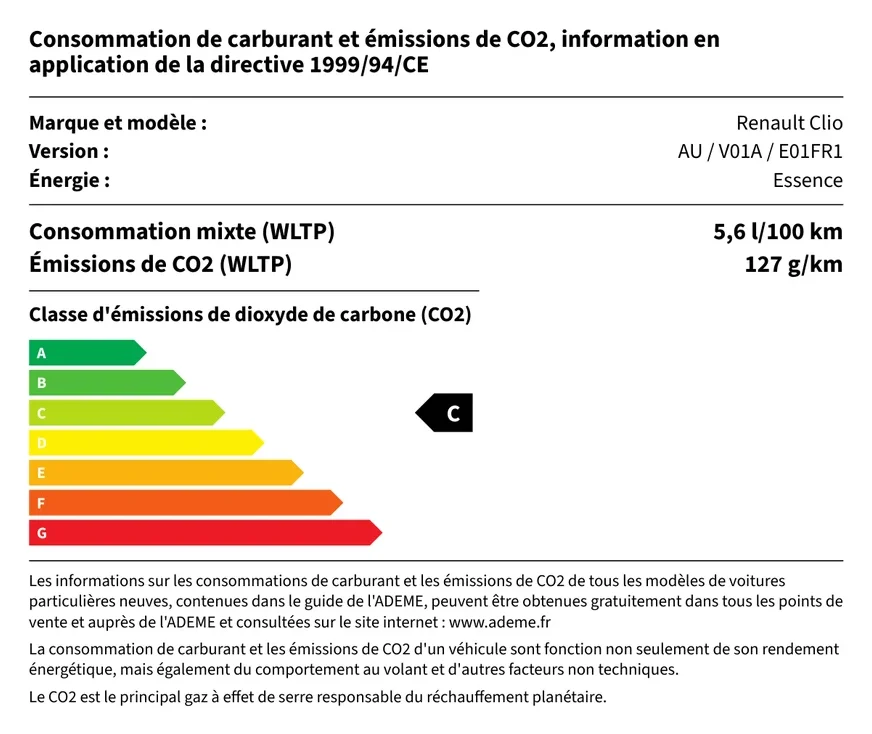
The label is an A4 sheet with the title Consommation de carburant et émissions de CO2, information en application de la directive 1999/94/CE, then make and model, version, energy, the mixed consumption and the CO2 emissions by WLTP. Below sit the seven class arrows from A to G with the car's class marked, the sentence pointing to the ADEME guide and two standard sentences on driving style and CO2. In adverts the class appears as its own arrow graphic, with the car's arrow carrying its value in gCO2/km.

  1. A 100 or less
  2. B 101-120
  3. C 121-140
  4. D 141-160
  5. E 161-200
  6. F 201-250
  7. G over 250
CO2 classes A to G by WLTP CO2 emissions, in whole g/km.
Étiquette CO2 printed by Vehicle Hub for a new Renault Clio petrol car: Essence, 5,6 l/100 km, 127 g/km, class C.

Mandatory details in France

  • Étiquette CO2 A4 with the elements of annexe I
  • CO2 class A to G from whole g/km; weighted value for plug-in hybrids
  • Class graphic: seven arrows, own arrow with gCO2/km, official colors and geometry
  • Mixed consumption in l/100 km, one decimal; m3/100 km for natural gas
  • One of the three mobility messages, word for word, plus #SeDéplacerMoinsPolluer
  • Energy name as on the label: Essence, Diesel, GPL, Gaz naturel, Hydrogène, Électricité
  • Brand poster by energy and rising CO2, with CNIT type code and class
  • Price including 20 % VAT
  • Representative example with TAEG, total and instalment in the largest type, and the warning
  • Intermediary statement; ORIAS number and category if registered
  • TAEG below the usury threshold of the loan amount
  • Manufacturer, EU responsible person and safety line

What you get

  • The étiquette CO2 for every energy

    Print the A4 label for petrol, diesel, LPG, hybrid, plug-in hybrid, natural gas, hydrogen and electric cars. Each version carries the elements of annexe I, with the right unit and class A for an electric car.

  • The class arrow, drawn to the arrêté

    Your exposé, price sign and car pages show the seven arrows with the car's own arrow and its gCO2/km, in the colors and proportions the Arrêté du 28 décembre 2021 sets.

  • Mobility messages that rotate by themselves

    Each car gets one of the three messages, always the same one in every channel, and your stock carries all three in roughly equal shares, followed by #SeDéplacerMoinsPolluer.

  • The brand poster with the CNIT

    Vehicle Hub groups the new models of each make by energy, sorts them by rising CO2, prints the CNIT and the class for each and adds the two sentences at 70 by 50 cm.

  • ORIAS details in every finance advert

    Declare once whether you are registered with ORIAS and in which category. Registered dealers get name, address, number and category in every example; others confirm they stay below the threshold.

  • The new credit warning on the right day

    On 20 November 2026 at midnight, Paris time, the warning switches to "Attention ! Un crédit coûte de l'argent et doit être remboursé." in every example, with no change on your side.

Print your first étiquette CO2

Bring in a few new cars, check the CO2 and mixed consumption on the energy tab and print the label. Then open the exposé and see the class arrow, the mobility message and the hashtag that every French advert needs.

How to get started

  1. Set your branch's main market to France

    Open Vehicle Hub in your KIMISUITE workspace and choose France as the main market of the branch. The French rule sets then decide the label, the class graphic and the mobility message for each car.

  2. Bring in your stock

    Import from mobile.de, Carix, CXO, Carzilla or a CSV or XML feed from your logiciel de gestion VO, or add a car with the creation assistant. Energy, condition and vehicle class decide what each car needs.

  3. Add what France asks for

    Check CO2 and mixed consumption on the energy tab and enter the CNIT from the carte grise for the brand poster. Imported values count as confirmed by you, so correct anything that looks wrong.

  4. Print and publish for car dealer compliance in France

    Print the étiquette CO2 and the brand poster, then publish the car on your website. The car page, the exposé and the price sign carry the class arrow and the mobility message.

Pricing

The French rule sets, the étiquette CO2 for every energy, the class graphic, the mobility messages, the brand poster, the exposé and the Loan Calculator are part of Vehicle Hub, which starts at a fixed monthly price (see pricing) per dealership workspace. Your whole team works in it for that one price, with no charge per printed label.

See all plans

Is it the right fit?

A good fit if

  • Concessionnaires and agents de marque in France who sell new and demonstration cars to consumers
  • Négociants VO who need the mobility message on every used-car advert
  • Dealers who place the class arrow and the hashtag into each advert by hand today
  • Dealers who arrange car loans, with or without an ORIAS registration, and want the example, the warning and the usury limit handled

Not the right fit if

  • Dealers who want Vehicle Hub to publish their cars on La Centrale, leboncoin or L'argus; Vehicle Hub publishes only to mobile.de, not to these portals
  • Dealers who need the 7 percent band of the mobility message drawn into their own print and poster campaigns; Vehicle Hub sets the message in its own block on its outputs, your agency lays out the rest
  • Dealers whose business is short-term rental, which neither the label rules nor the mobility message cover
  • Anyone looking for legal advice or help with an ORIAS registration; Vehicle Hub applies the rules, your trade body or lawyer answers questions about a specific case

Frequently asked questions

What does car dealer compliance in France mean for my adverts?

Every advert for a new car shows the CO2 class arrow, every advert for a car you sell or lease long term, new or used, carries a mobility message with #SeDéplacerMoinsPolluer, and printed adverts also give the mixed consumption and CO2. At the point of sale come the étiquette CO2 and the brand poster.

Do used cars need the CO2 class graphic?

No. The class graphic and the label follow the rules for new cars, and the ARPP confirms that used vehicles are outside them. The mobility message, however, applies to used cars as well, so Vehicle Hub prints it on every car advert.

Which of the three mobility messages should I use?

All three, in turn: the law asks for one message per advert, used in equal shares across a campaign. Vehicle Hub picks one per car from its data, keeps it the same on the website, the exposé and the price sign, and spreads the three across your stock.

Why does the brand poster ask for the CNIT?

Annexe II of the Arrêté du 10 avril 2003 lists the désignation de type (CNIT) for every model on the poster. Vehicle Hub shows the CNIT field only to branches that serve France; take the code from the carte grise or the manufacturer's papers.

What must a car credit advert show in France?

A representative example with TAEG, the rate type, the total due and the instalment in the largest type, the statutory warning, your role as intermediary and, if you are registered, your ORIAS number and category. The TAEG must stay below the usury threshold. Vehicle Hub shows financing for France once KIMISUITE has released the market after checking an example against the law.

Do vans and motorhomes need the mobility message?

Only vans used as passenger vehicles: a pick-up with five seats or more, or a van with three seat rows. Other vans and motorhomes are not covered. Where the vehicle data does not settle the question, Vehicle Hub shows the message, which is never wrong.

Who supervises the personal data from my enquiries in France?

The Commission nationale de l'informatique et des libertés (CNIL). Vehicle Hub stores the consent text each buyer accepted with the enquiry, so you can show what was agreed.

Is a CO2 advertising ban coming for new cars?

The Code de l'environnement plans a ban on advertising certain high-emission new cars from 1 January 2028, but the decree with the list of vehicles has not been published. Until it is, the class graphic and the mobility message are the rules that apply.

Vehicle Hub knows the rules of 33 countries

Every country has its own label, advertising and financing rules. Pick a country to see them one by one.

All countries and their rules at a glance

Ready when you are

Set it up in your own workspace and see how it works with your data.

  • Cancel anytime
  • No long-term contract
  • 14 days free