
Vehicle Hub

Bulgaria

Car dealer compliance in Bulgaria

Vehicle Hub prints the A4 fuel and CO2 label the Bulgarian labelling ordinance of 2006 asks for, with the class against 153.5 g/km and the octane grade, builds the poster for each brand and keeps your adverts and finance examples in line with Bulgarian law.

  • Cancel anytime
  • No long-term contract
  • 14 days free
Car dealer compliance in Bulgaria

The rules for car adverts in Bulgaria

8 rules decide what a dealer in Bulgaria has to show on the car, in adverts and in financing examples. Each one, and what it asks of you:

  1. BGOrdinance on labelling new passenger cars (Council of Ministers Decree 237/2006)

    Ordinance on the requirements for labelling new passenger cars and for providing information on fuel consumption and carbon dioxide emissions

    Authority Commission for Consumer Protection (KZP); Ministry of Economy and Industry

    Every new passenger car (M1) offered for sale or rent at a point of sale, trade fairs included, carries an A4 label on or next to it. The label shows the vehicle data, the CO2 class from A to G against the reference value of 153.5 g/km, the combined consumption and CO2 emissions, and two mandatory texts. A car counts as new until it has been sold for a purpose other than resale.

  2. BGLabelling Ordinance

    Fuel designation with the octane number of petrol

    Authority Commission for Consumer Protection (KZP)

    The label names the fuel the car uses, and for petrol it adds the octane number. Vehicle Hub takes it from the petrol grade of the car, Normal 91, Super 95 or Super Plus 98, petrol hybrids included. Without the grade, that car gets no label.

  3. BGLabelling Ordinance

    Poster or screen with the fuel and CO2 data of every model of a brand

    Authority Commission for Consumer Protection (KZP)

    At each point of sale, every brand you sell needs a poster of at least 70 x 50 cm or a screen of at least 25 x 32 cm (17 inch). Models are grouped by fuel and sorted from the lowest CO2 emissions up, with both mandatory texts at the bottom. A printed poster is updated at least every six months, a screen at least every three.

  4. BGLabelling Ordinance

    Fuel consumption and CO2 emissions in advertising

    Authority Commission for Consumer Protection (KZP)

    Every printed advert for a specific model, from brochures and technical manuals to newspaper ads and posters, states the combined fuel consumption in l/100 km and the CO2 emissions in g/km. The figures must be clear and no less visible than the main information of the ad. Other media follow the rule where appropriate, and pure brand advertising without consumption figures is exempt.

  5. BGConsumer Protection Act (ZZP)

    Consumer Protection Act, penalties for breaching the labelling rules

    Authority Commission for Consumer Protection (KZP)

    A missing or wrong label or poster can cost a natural person 200 to 1,000 EUR and a company 300 to 1,000 EUR. A repeat within a year doubles the fine, and ignoring an order of the KZP is fined separately.

  6. BGConsumer Credit Act (ZPK)

    Consumer Credit Act, advertising of consumer credit

    Authority Commission for Consumer Protection (KZP)

    An advert that names an interest rate or any figure on the cost of credit must give a representative example: borrowing rate fixed or variable, total credit amount, annual percentage rate (APR), term, cash price and down payment, total amount payable and the instalment. Rate, APR, total amount and the fixed or variable note appear in the same font size, type and format. A compulsory ancillary service such as insurance has to be named.

  7. BGConsumer Credit Act (ZPK)

    Consumer Credit Act, advertising by a credit intermediary

    Authority Commission for Consumer Protection (KZP)

    A dealer who arranges a loan acts as a credit intermediary, and every finance advert states the extent of his powers: whether he works with one lender, with several, or as an independent broker. Bulgaria asks for no registration number here.

  8. BGConsumer Credit Act (ZPK)

    Consumer Credit Act, legal maximum of the annual percentage rate

    Authority Commission for Consumer Protection (KZP)

    The APR may not exceed five times the statutory default interest in euro, which is the ECB main refinancing rate plus eight percentage points, set every six months. Contract terms above that cap are void, so a finance example above it has no place in an advert.

Car dealer compliance in Bulgaria starts with one regulation: every new passenger car you display, sell or rent out needs an A4 fuel and CO2 label at or next to the car, each brand needs a poster in the showroom, and every printed advert needs the combined consumption and CO2 values. The rules come from the Ordinance on labelling new passenger cars, adopted with Council of Ministers Decree No. 237 in 2006 under the Consumer Protection Act (ZZP), and the Commission for Consumer Protection (KZP) checks them at the point of sale. Vehicle Hub keeps the values on each car and prints the label from them, with the class worked out against the Bulgarian reference value of 153.5 g/km and, for petrol cars, the octane grade the regulation asks for. Bulgaria is one of the markets on our car labelling directive by country overview.

The same data runs through everything else a buyer sees. The mandatory information goes onto the exposé, the price sign and the car's page on your own website, built with the Vehicle Hub widgets. Your stock comes in from mobile.de, your dealer system or a CSV or XML feed, so a used-car dealership (avtokashta) with a yard full of imported cars types nothing twice. If you advertise a monthly instalment, the financing example follows the Bulgarian Consumer Credit Act (ZPK). Vehicle Hub applies these rules; it is not legal advice.

What the Bulgarian fuel and CO2 label looks like

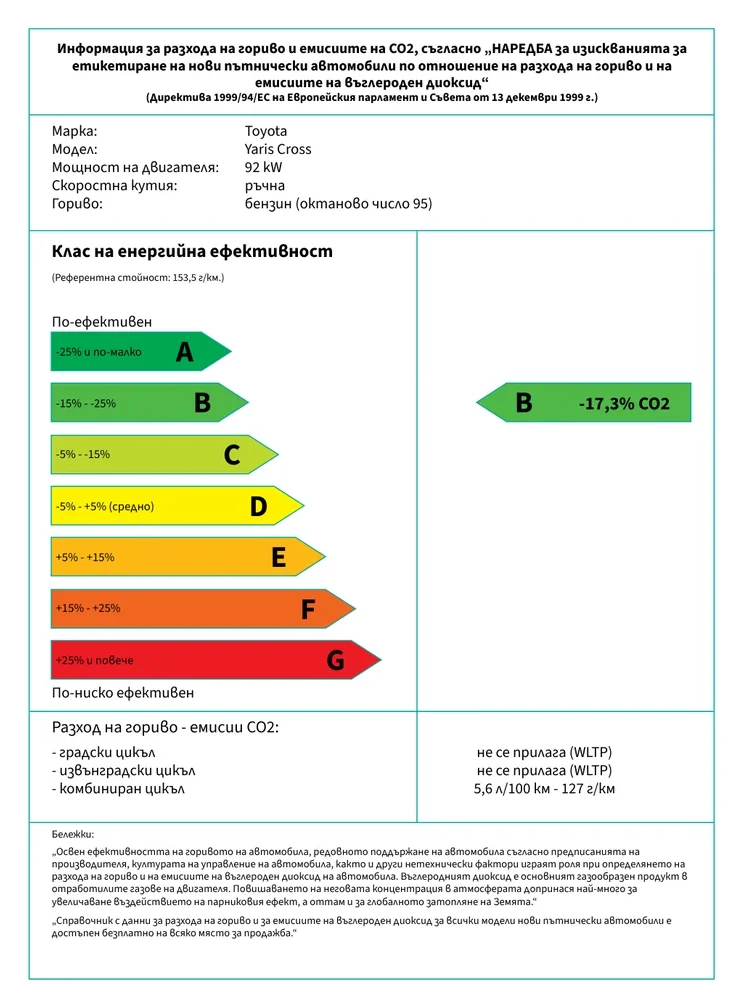
The label is an A4 sheet with black text on white, laid out in five fields after the drawing in Annex 1 of the Ordinance. Field I lists make, model, engine power, gearbox and fuel, with the octane number for petrol. Beside it, seven coloured arrows from A to G show the bands as a percentage below or above the reference value of 153.5 g/km, and the car's own arrow carries its class and deviation. Below come the consumption and CO2 lines: under WLTP the city and extra-urban lines read 'not applicable (WLTP)' (printed in Bulgarian on the real label), the combined line carries the value, and the two mandatory texts on non-technical factors and on the free guide at every point of sale close the sheet.

  1. A 0-115 (25 % or more below)
  2. B 116-130 (15 to 25 % below)
  3. C 131-146 (5 to 15 % below)
  4. D 147-161 (within 5 %, average)
  5. E 162-176 (5 to 15 % above)
  6. F 177-191 (15 to 25 % above)
  7. G 192 or more (25 % or more above)
CO2 classes A to G by deviation of the combined CO2 emissions from 153.5 g/km
The Bulgarian label as Vehicle Hub prints it: a petrol car running on Super 95 in class B, 17.3 % below the reference value, with 5.6 l/100 km and 127 g/km combined.

Mandatory details in Bulgaria

  • Make, model, engine power, gearbox and fuel
  • Octane number for petrol cars and petrol hybrids (Normal 91, Super 95, Super Plus 98)
  • CO2 class A to G with the deviation from 153.5 g/km
  • Combined fuel consumption (l/100 km, one decimal) and CO2 emissions (g/km)
  • Weighted combined values for plug-in hybrids
  • The two mandatory texts: non-technical factors and the free guide at the point of sale
  • All models of a brand by fuel, sorted by CO2
  • Labelled consumption and CO2 line in the advert
  • Representative example with APR, total amount and instalment
  • Extent of your powers as credit intermediary
  • Manufacturer and EU responsible person (product safety)

What you get

  • The A4 label, field by field

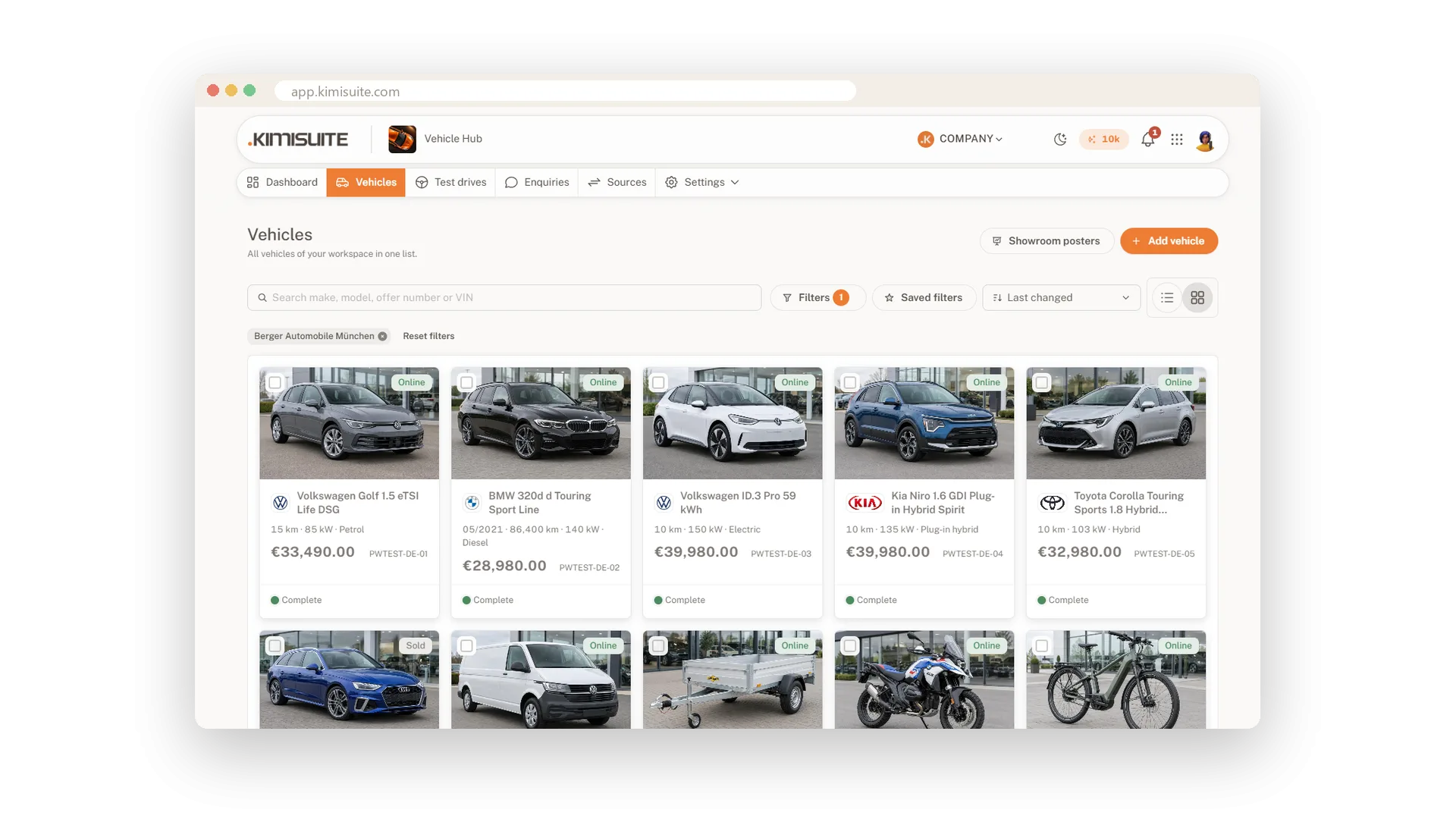
    Vehicle Hub prints the Bulgarian label the way Annex 1 draws it: vehicle data, the seven arrows with their percentage bands, your car's arrow and both mandatory texts. You open the car and print.

  • Octane grade asked for up front

    For petrol cars and petrol hybrids, Vehicle Hub asks for Normal 91, Super 95 or Super Plus 98 before the label. A car without the grade gets no label, so no half-filled sheet ends up behind the windscreen.

  • The brand poster without a spreadsheet

    Vehicle Hub builds the poster for each brand from your stock: grouped by fuel, from petrol and diesel to LPG, natural gas and the electrified groups, lowest CO2 at the top and both texts below. It also shows you when the six-month update is due.

  • The class while you type

    Enter the CO2 value and Vehicle Hub shows the Bulgarian class straight away, worked out against 153.5 g/km. A diesel at 161 g/km lands in D, just as the percentage bands of the regulation say.

  • Finance examples the Consumer Credit Act accepts

    The Loan Calculator gives the representative example with APR, total amount and instalment in the same type, adds your intermediary sentence and checks the legal maximum rate. The price sign never carries finance figures.

  • The same values on your website

    Each car page shows the labelled consumption, CO2 and class lines in Bulgarian, with a link to the label PDF, so your forecourt and your website tell one story.

Print your first Bulgarian label

Set your branch to Bulgaria, import a few new cars or add one by hand, choose the petrol grade and print the label. If a value is missing, Vehicle Hub tells you which one before anything reaches the stand.

How to get started

  1. Set the main market of your branch to Bulgaria

    Open Vehicle Hub in your KIMISUITE workspace and choose Bulgaria as the main market of the branch. The Bulgarian rule set then decides which cars need a label and which values go on it.

  2. Bring in your stock

    Import your cars from mobile.de, your dealer system or a CSV or XML feed, or add them with the creation assistant. Fuel, drive and sale history decide whether a car counts as new.

  3. Check what Bulgaria asks for

    Look over the energy values of every new car and set the petrol grade for petrol cars and petrol hybrids. Vehicle Hub shows the class as you type and lists what a complete label still lacks.

  4. Print the label and the poster, then publish

    Print the A4 label for each car on the forecourt and the poster for each brand, then put the cars on your website with the widgets. The car pages carry the same values as the paper.

Pricing

The Bulgarian rule set, the label, the brand poster, the exposé and the Loan Calculator are part of Vehicle Hub, which starts at a fixed monthly price (see pricing) per dealership workspace. Everyone in the dealership works in it for that one price, and there is no charge per printed label.

See all plans

Is it the right fit?

A good fit if

  • Official brand dealers in Bulgaria who sell new cars and need a label and a brand poster for every model
  • A used-car dealership (avtokashta) that also sells new, never-sold imported cars and wants the label to come from the car's own data
  • Dealers with petrol hybrids and plug-in hybrids in stock, where the octane grade and the weighted values are easy to miss
  • Dealers who advertise monthly instalments and want the representative example the Consumer Credit Act (ZPK) asks for

Not the right fit if

  • Dealers who want Vehicle Hub to publish their cars on mobile.bg, cars.bg or OLX.bg; Vehicle Hub imports stock, it does not post listings there
  • Dealers who need the annual model guide written for them; the label points to it, but the guide itself stays with you
  • Dealers who sell only used cars that have already had an owner and never need a label
  • Anyone looking for legal advice on a specific case; for that, ask the KZP or a lawyer

Frequently asked questions

What does car dealer compliance in Bulgaria involve for a new car?

A new car on your forecourt needs the A4 fuel and CO2 label of the 2006 Labelling Ordinance, its brand needs a poster or screen with all models, and your printed adverts need the combined consumption and CO2 values. If you advertise finance, the Consumer Credit Act (ZPK) adds a representative example. Vehicle Hub covers all four from the data of the car.

Why does Vehicle Hub ask me for the petrol grade?

Because the Bulgarian label has to name the octane number for petrol, and the grade the car needs is that number. Choose Normal 91, Super 95 or Super Plus 98 once per car. Until you do, Vehicle Hub does not print the label for a petrol car or a petrol hybrid.

How is the Bulgarian CO2 class worked out?

From the deviation of the car's combined CO2 emissions from a fixed reference value of 153.5 g/km, in seven bands from A to G. Up to 115 g/km is A, 147 to 161 g/km is D, and from 192 g/km it is G. Electric cars with 0 g/km are always A.

Do demonstration cars need the label?

Yes, as long as they have never been sold to an end customer. The Ordinance treats a car as new until it has been sold for a purpose other than resale, so a demonstration car on your site still carries the label, and Vehicle Hub treats it the same way.

Can I advertise a monthly instalment for a car in Bulgaria?

Yes, with the full representative example the Consumer Credit Act (ZPK) asks for: APR, total credit amount, term, cash price, down payment, total amount payable and the instalment, with the key figures in the same type. Bulgaria has no statutory credit warning yet. Vehicle Hub shows financing for Bulgaria once KIMISUITE has released the market, and from 20 November 2026 it pauses the examples until the new consumer credit law that transposes the EU directive has been checked.

Who supervises the label rules, and what does a breach cost?

The Commission for Consumer Protection (KZP) and its regional units check them. Under the Consumer Protection Act a breach costs a natural person 200 to 1,000 EUR and a company 300 to 1,000 EUR, and a repeat within a year doubles the fine.

Which authority looks after the customer data in my enquiries?

The Commission for Personal Data Protection, under the GDPR and the Bulgarian Personal Data Protection Act. Enquiries from your website reach you by email and in CRM Business Hub with the car named, inside your own workspace.

Can Vehicle Hub put my cars on mobile.bg or cars.bg?

No. Many dealers in Bulgaria advertise on mobile.bg, cars.bg and OLX.bg, and Vehicle Hub does not post listings there. It brings your stock in from mobile.de, dealer systems and feeds, and puts it on your own website with the labelled values.

Vehicle Hub knows the rules of 33 countries

Every country has its own label, advertising and financing rules. Pick a country to see them one by one.

All countries and their rules at a glance

Ready when you are

Set it up in your own workspace and see how it works with your data.

  • Cancel anytime
  • No long-term contract
  • 14 days free