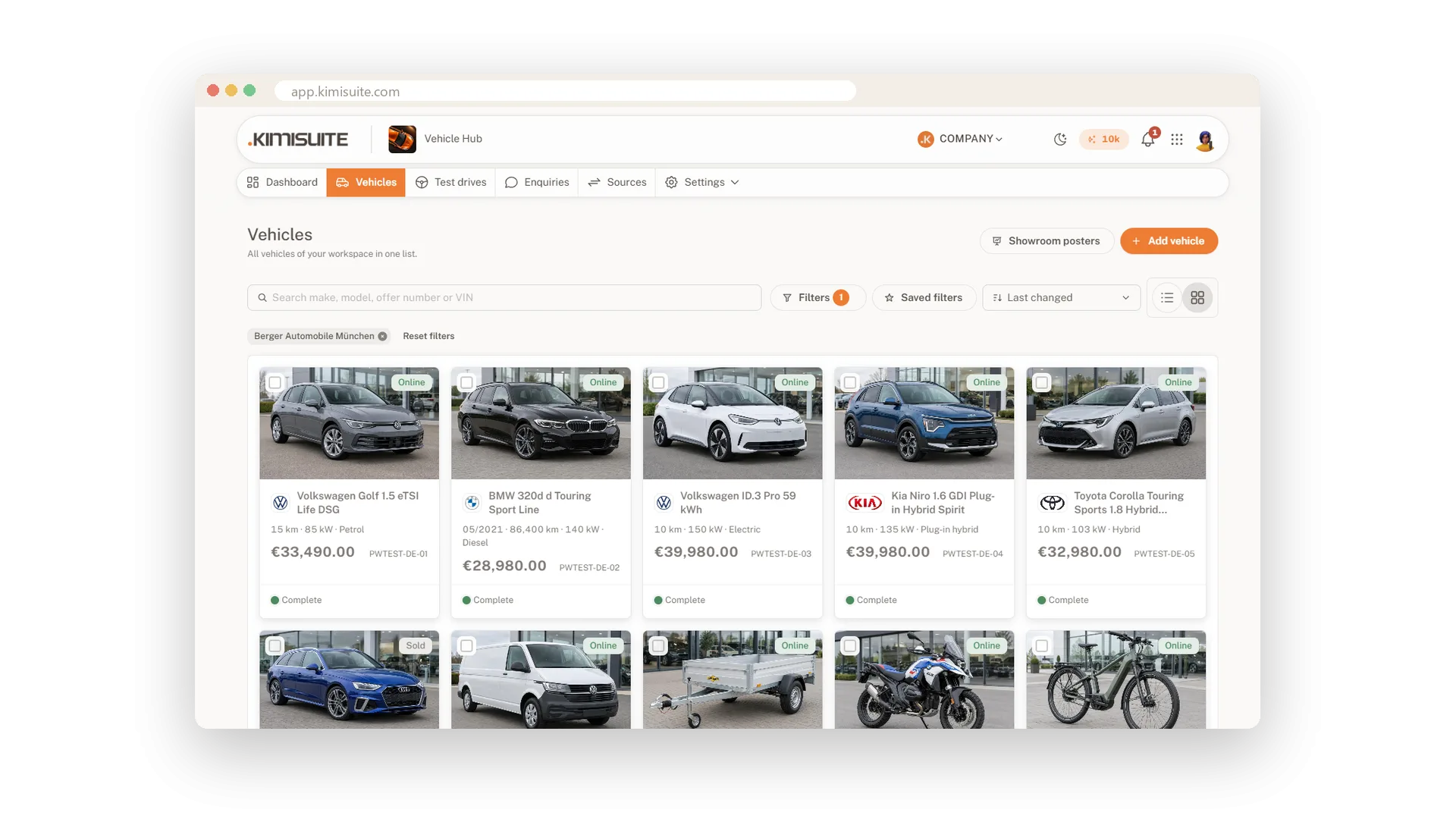
Vehicle Hub

Germany

Car dealer compliance in Germany

The Pkw-EnVKV label and showroom poster, the CO2 class in every advert, the total price with transfer costs under the PAngV and a financing example that carries the new credit warning from 20 November 2026, all from the data of each car.

  • Cancel anytime
  • No long-term contract
  • 14 days free
Car dealer compliance in Germany

The rules for car adverts in Germany

6 rules decide what a dealer in Germany has to show on the car, in adverts and in financing examples. Each one, and what it asks of you:

  1. DEPkw-EnVKV

    Passenger Car Energy Consumption Labelling Ordinance (Pkw-Energieverbrauchskennzeichnungsverordnung)

    Authority Federal Ministry for Economic Affairs and Energy (BMWE)

    Every new passenger car you display, offer for sale or advertise needs the energy label on or next to it, and every advert, online and social media included, must state the combined energy consumption, the combined CO2 emissions and the CO2 class. Each sales location needs a poster of all models on offer, and the label shows energy costs, CO2 costs at three prices and the annual vehicle tax under the KraftStG. The version in force is BGBl. 2026 I No. 55 of 2 March 2026, with the BMWE price sets for 2026 applying to all labels from 1 October 2026.

  2. DEPAngV

    Price Indication Ordinance (Preisangabenverordnung), total price

    Authority Federal Ministry for Economic Affairs and Energy (BMWE); enforced by the authorities of the federal states

    Any price you quote to consumers must be the total price including VAT and every unavoidable component. Transfer costs (Überführungskosten) are part of that total price and may not be added in a footnote or at the counter.

  3. DEPAngV

    Price Indication Ordinance, advertising for consumer credit

    Authority Federal Ministry for Economic Affairs and Energy (BMWE); enforced by the authorities of the federal states

    As soon as an advert names an interest rate or any figure on the cost of a loan, it needs a representative example with the net loan amount, the borrowing rate (fixed or variable) and the annual percentage rate, shown at least as prominently as any other rate. Until 19 November 2026 the example also names the lender and the number of instalments; from 20 November 2026 the new version (BGBl. 2026 I No. 139) asks for term, total amount and instalment where they apply, and for deferred payment the cash price and the down payment.

  4. DEUWG

    Act against Unfair Competition, blacklist item 23e (credit warning), CCD2 transposition

    Authority Enforced under civil law by competitors and qualified associations

    From 20 November 2026, 00:00 German time, every advert for a consumer loan or financial help must carry a clear and conspicuous warning; the law gives the wording 'Achtung! Kreditaufnahme kostet Geld' or an equivalent. It comes from the German transposition of the EU Consumer Credit Directive (EU) 2023/2225, the Act of 12 May 2026.

  5. DEEGBGB

    Introductory Act to the Civil Code, information by credit intermediaries

    Authority Federal Ministry of Justice and Consumer Protection (BMJV)

    A dealer who arranges the bank's loan for a commission is a credit intermediary and must say in his advertising whether he works exclusively for one lender, for several named lenders or independently. The duty applies today and stays after 20 November 2026.

  6. DEGPSR

    General Product Safety Regulation (EU) 2023/988, information in distance sales

    Authority European Commission; in Germany the market surveillance authorities of the federal states

    An offer made to consumers online must name the manufacturer with postal and electronic address, for manufacturers outside the EU the responsible person in the EU, the product and any warnings or safety information.

Car dealer compliance in Germany means that every new passenger car you show or advertise carries the Pkw-EnVKV energy information, every price you quote is the total price including transfer costs, and every financing example follows the credit advertising rules, which change on 20 November 2026. On the forecourt that is the A4 label with the CO2 class from A to G and a 70 x 50 cm poster of all models on offer; online and in print it is the combined consumption, CO2 emissions and CO2 class next to the first engine data; in the financing box it is the representative example, and from 20 November the warning 'Achtung! Kreditaufnahme kostet Geld'. Vehicle Hub knows each of these German rules as a rule set of its own. Set your branch's main market to Germany and it decides car by car which values are required, prints label, poster and exposé from the car's own data, and holds back a car whose required values are missing.

The same values reach every channel you control. The car's page on your website, built with the Vehicle Hub widgets, shows the CO2 class and energy values, the price with transfer costs and, for dealers who advertise financing, the representative example with the German wording. Plug-in hybrids get both classes, electric cars the line 'befristet steuerbefreit', and a car with preliminary WLTP values gets the '(vorläufig)' heading. What Vehicle Hub checks for each German detail is listed under car dealer mandatory information; how Germany compares with the other 32 markets is on the car labelling directive by country overview. Vehicle Hub applies the rules as published; it does not replace legal advice on a specific case.
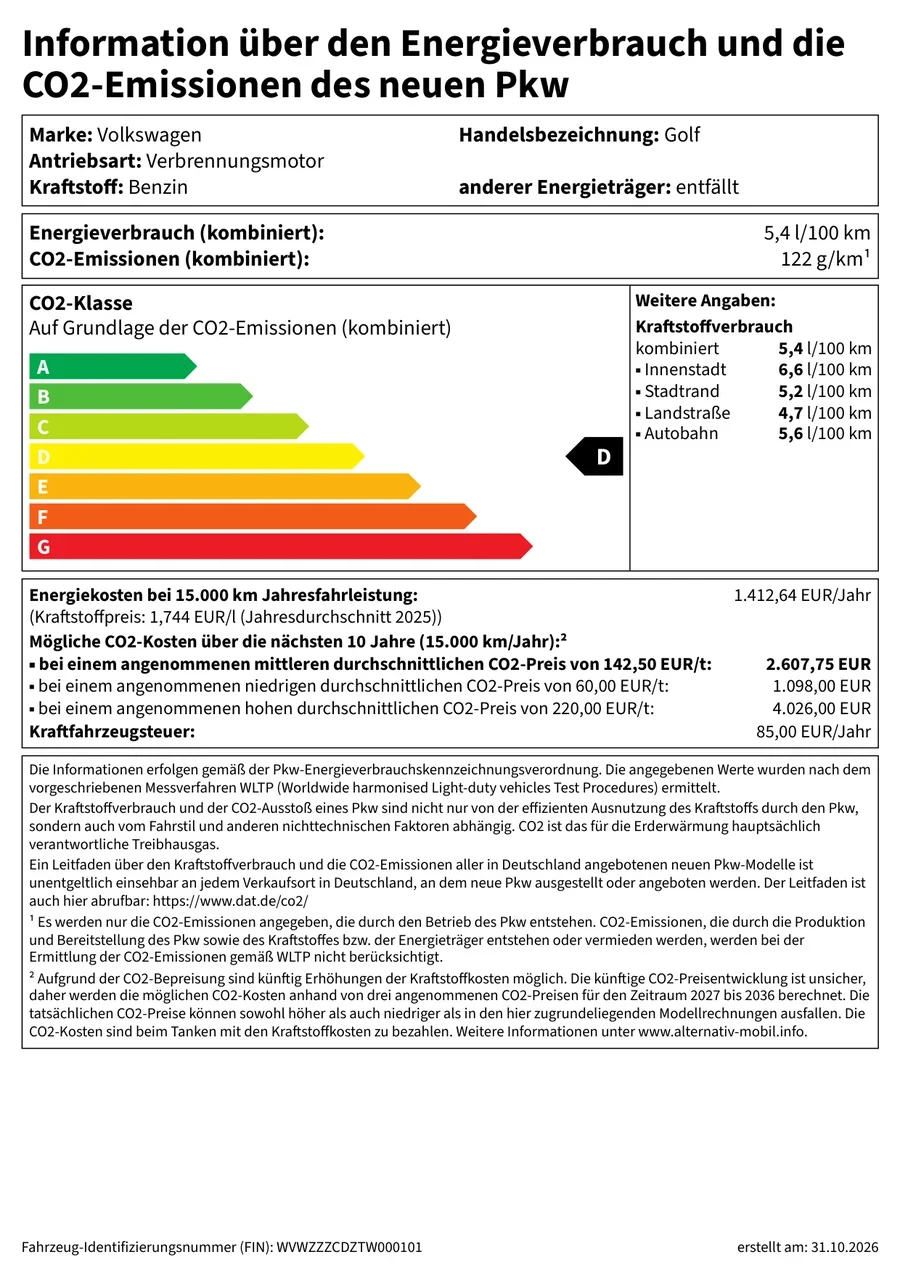
What the Pkw-EnVKV label looks like

The label is an A4 sheet in black on white with five framed boxes; only the CO2 class scale is in colour. It names make, model, drive type and fuel, the combined consumption and CO2 emissions, the arrow on the A to G scale, the values for city, suburban, rural road and motorway, energy costs for 15,000 km a year, three possible CO2 cost figures for the next ten years and the annual vehicle tax. At the foot the VIN stands on the left and the creation date on the right. Plug-in hybrids carry two arrows, weighted combined and with a discharged battery.

  1. A 0
  2. B 1-95
  3. C 96-115
  4. D 116-135
  5. E 136-155
  6. F 156-175
  7. G 176 and above
CO2 classes A to G by WLTP combined CO2 emissions in g/km; plug-in hybrids get a second class with a discharged battery
Pkw-EnVKV label printed by Vehicle Hub for a new petrol Volkswagen Golf: 5.4 l/100 km, 122 g/km, CO2 class D, energy costs 1,412.64 EUR a year and vehicle tax 85 EUR


Mandatory details in Germany

  • CO2 class A-G, two classes for plug-in hybrids
  • Combined energy consumption and CO2 emissions, weighted combined for plug-in hybrids
  • Values for city, suburban, rural road and motorway; plug-in hybrids in two groups
  • Energy costs at 15,000 km a year and CO2 costs at 60, 142.50 and 220 EUR per tonne
  • Annual vehicle tax, or 'befristet steuerbefreit' for electric and fuel cell cars
  • Drive type and fuel in the wording of the ordinance (Benzin, Diesel, LPG, Erdgas, Strom, Wasserstoff)
  • Poster of all models per sales location, 70 x 50 cm, grouped by fuel and sorted by CO2; plug-in hybrids with combustion and electric power
  • Total price including VAT and transfer costs
  • Representative example: net loan amount, borrowing rate, APR, term, instalment, total amount, lender
  • Warning 'Achtung! Kreditaufnahme kostet Geld' from 20 November 2026
  • Sentence on the dealer's role as credit intermediary
  • Manufacturer, EU responsible person and safety note

What you get

  • Label and poster from one set of values

    Enter or import the energy values once. Vehicle Hub prints the A4 label for the car and the 70 x 50 cm poster per make for the wall, both with the fuel words the ordinance prescribes.

  • See the class while you type

    In the energy step of the wizard the A to G scale marks the car as soon as the CO2 value is in, with energy costs, CO2 costs and vehicle tax, and a list of what a complete label still lacks.

  • Plug-in hybrids done right

    Weighted combined values, a second class with a discharged battery, the phase values in two groups and, for the poster, the power of the combustion engine and the electric motor.

  • Total price with transfer costs

    Transfer costs go into the price you show, and the exposé says how much of it they are. The buyer reads one figure, the one the PAngV asks for.

  • Financing ads ready for 20 November

    The Loan Calculator prints the representative example with the lender, your intermediary sentence and, from midnight German time on 20 November 2026, the credit warning. Older shared exposés are withdrawn automatically.

  • Nothing incomplete goes public

    A new car without its required values stays off your website and gets no label. Used cars are only held back when they still count as new.

Check your German stock in one afternoon

Import your cars, set the branch to Germany and run 'Check all vehicles'. Vehicle Hub lists every car that misses a value, and the first labels and the poster are printed before closing time.

How to get started

  1. Set up car dealer compliance in Germany

    Open Vehicle Hub in your KIMISUITE workspace and choose Germany as the main market of your branch. The German rule set now decides what each car needs.

  2. Bring in your stock

    Import from mobile.de, your dealer system or a CSV or XML feed, or add cars with the creation assistant. Energy values come with the import and count as confirmed by you.

  3. Check the German values

    Run 'Check all vehicles' and fill the gaps the status list shows. If you advertise financing, enter lender, address and your intermediary role in the financing settings.

  4. Print and publish

    Print the labels and the poster, place the widgets on your website and hand out exposés. Each one carries the same values and the same total price.

Pricing

The German rule set, label, showroom poster, exposé and Loan Calculator are part of Vehicle Hub, which starts at a fixed monthly price (see pricing) per dealership workspace. Your sales team, your photographer and whoever prints the labels all work in that one workspace.

See all plans

Is it the right fit?

A good fit if

  • Autohäuser and franchised dealers who sell new, pre-registered and demonstrator cars in Germany
  • Independent multi-brand dealers who copy energy values into labels and adverts by hand today
  • Dealers who advertise financing and need the CCD2 warning in place by 20 November 2026
  • Dealers with plug-in hybrids and electric cars on the forecourt

Not the right fit if

  • Dealers who want Vehicle Hub to publish their stock to Kleinanzeigen; Vehicle Hub publishes only to mobile.de, not to Kleinanzeigen
  • Dealers who advertise leasing offers; Vehicle Hub never publishes a leasing example
  • Anyone looking for legal advice on a specific case; Vehicle Hub applies the rules, your association or lawyer interprets them

Frequently asked questions

What does car dealer compliance in Germany cover for my adverts?

Four things: the Pkw-EnVKV energy information for new cars, the total price under the PAngV, the credit advertising rules for any financing example, and the GPSR product information in online offers. Vehicle Hub keeps a German rule set for each of them and checks every car against it.

Do pre-registered cars and demonstrators need the full energy information?

Yes, as long as they still count as new. A car first registered no more than eight months ago or with 1,000 km or less is presumed new. Vehicle Hub keeps the new-car duties for a car you declare as a demonstrator even beyond those marks, which is the cautious reading.

What changes in my financing ads on 20 November 2026?

Every consumer credit advert then needs the warning 'Achtung! Kreditaufnahme kostet Geld'. Vehicle Hub adds it at midnight German time, drops the duties that end with the old version and withdraws exposés with a financing example that were shared before the date, so no old copy circulates without the warning.

Must transfer costs be in the advertised price?

Yes. Under the PAngV the price you quote is the total price, and transfer costs are part of it. Vehicle Hub adds them to the price on your website, the price sign and the exposé, and the exposé shows the amount included.

Is a showroom poster still needed when every car has a label?

Yes. The Pkw-EnVKV asks for both: a label at each new car and a poster of all models on offer at each sales location, at least 70 x 50 cm or a screen of at least 17 inches. Vehicle Hub prints the poster per make from the cars in your branch.

Who supervises data protection for enquiries my dealership receives?

The data protection authority of the federal state where your dealership is based, for example the BayLDA in Bavaria, under the GDPR and the BDSG. Vehicle Hub sends enquiries from your website to you and to CRM Business Hub; what you do with them afterwards is your responsibility under those laws.

Does Vehicle Hub print the GPSR information for cars?

Yes, for offers to consumers in EU markets. The vehicle page and the exposé name the manufacturer, the EU responsible person where the maker is outside the EU, and a safety note; if data is missing, Vehicle Hub shows a hint instead of blocking the car.

Vehicle Hub knows the rules of 33 countries

Every country has its own label, advertising and financing rules. Pick a country to see them one by one.

All countries and their rules at a glance

Ready when you are

Set it up in your own workspace and see how it works with your data.

  • Cancel anytime
  • No long-term contract
  • 14 days free