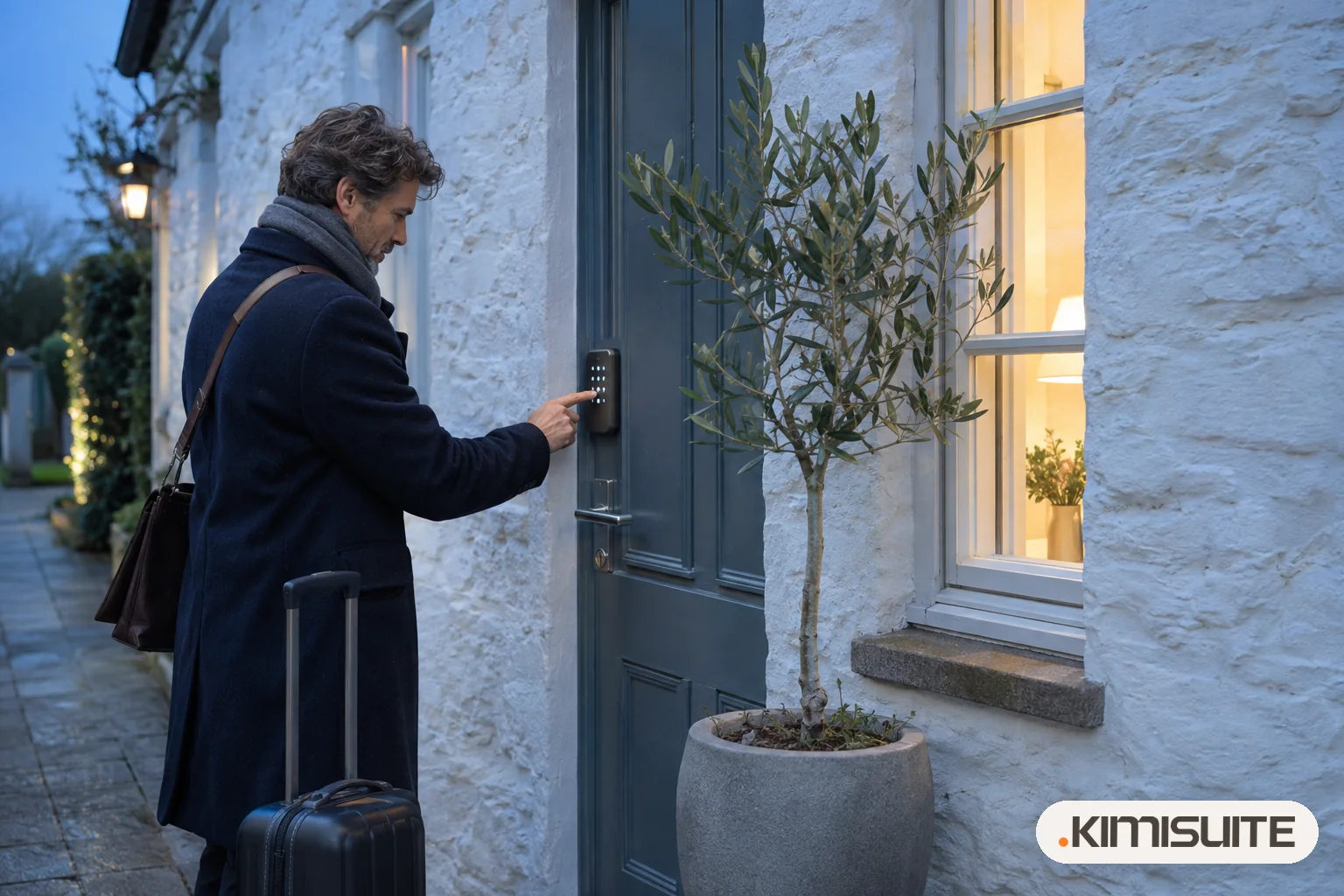
A good pre-arrival message tells guests how to find you, when and how they can check in, what they still need to bring or pay, and how to reach you. Send it a few days before arrival, keep it short, and write it in the guest's language. Guests who self check in get a second, more detailed message close to the arrival day with their room and door code. Done this way, it saves the front desk phone calls and saves guests a confused arrival.

What guests need to know before they arrive
Most questions guests ask in the last days before a stay are the same ones. Answer them before they are asked:
- Their booking: dates, room type, number of guests and booking number, so they know the details are right.
- Check-in time: when the room is ready, until when someone is at the desk, and what happens if they arrive earlier or very late.
- Getting there: the address as it appears in map apps, the right entrance, parking, and the nearest public transport stop.
- What to bring: ID or passport if you register guests at arrival, and the payment card if you take payment on site.
- What is still open: the balance due and the payment methods you accept at the property.
- How to reach you: one phone number that is answered and one written channel.
- Changes and cancellation: a short line and a link to your policy. If yours still needs work, start from a hotel cancellation policy template.
What to leave out
A pre-arrival message is not a brochure. Long lists of house rules, a full spa menu, three upsell offers and a newsletter sign-up bury the information guests open it for. Pick at most one extra, such as parking or breakfast, if most guests actually ask about it. Rules that matter on arrival, such as quiet hours in an apartment building, belong in one sentence, not in a paragraph.

Booking Hub
Hotel Booking System Built for Direct Growth
When to send it: a simple timeline
| When | Message | Content |
|---|---|---|
| At booking | Confirmation | Dates, room, price, payment, policy |
| 7 to 3 days before arrival | Pre-arrival message | Directions, check-in time, what to bring, contact |
| Day before or day of arrival | Check-in details | Room number, door code and room directions, for self check-in only |
| During the stay | Open chat | Answers to questions, requests |
For bookings made within the last few days, combine the confirmation and the pre-arrival message into one. A guest who books on Thursday for Friday does not need three emails in 24 hours.
A template you can adapt
Here is a plain example you can change for your property. The words in brackets are filled in per guest.
Hello [first name],
We look forward to welcoming you on [arrival date]. Your room is ready from [check-in time], and our front desk is open until [desk closing time]. If you arrive later, reply to this message and we will make arrangements.
How to find us: [address]. Parking is [parking information]. From [station or airport], [short directions].
Please bring the ID or passport of every adult guest. [Balance due] is payable at arrival by [payment methods].
If you have any questions, reply here or call [phone number].
See you soon,
[Name] from [property]
Keep the tone friendly and direct. Guests read this on a phone, often while traveling, so short paragraphs work better than long ones.
Ask one or two questions, not ten
The pre-arrival message is also the moment to learn what you need for a smooth arrival. Ask only what changes how you prepare:
- Expected arrival time, so you can staff the desk or plan the room for an early guest.
- Special requests, such as a cot, an extra bed, a parking space or a ground-floor room.
Every extra question lowers the chance of getting an answer to the important ones.
Language, tone and channel
Write in the language the guest booked in. A guest who booked in German and receives directions only in English has to translate them first, and directions are the part that must be followed exactly.
Email works for the first message because it lands next to the confirmation. Questions then go better in a chat, because a reply in a few minutes matters more than a long, perfect email the next day. Whatever channel you use, someone has to answer it, including in the evening, when many guests are on the road.
Self check-in arrivals need more detail
When guests let themselves in, the message replaces the front desk. It needs the entrance, the floor, the exact door, how the code works and whom to call if something fails. Send the door code close to arrival rather than weeks ahead, so it is not lost in an inbox and codes can be changed between stays. Write these directions per room, because "second floor, end of the hallway on the right" is different for every room.
Where Booking Hub fits
In Booking Hub, every confirmation email has a link through which guests open their booking with an access code, without an account. There they see the stay, the price and what is still owed, and can write to you in a chat. An automatic welcome message with placeholders for the guest's name, check-in, check-out and your property name opens each chat, and you can switch it off. Messages arrive in an inbox with one thread per booking, and an unread message turns into an email after a delay you set. For self check-in, each room carries its own written directions in every language you offer, and you send them with the room number and PIN from the booking, after picking the guest's language and previewing the email. The confirmation email itself is a fixed template. More on self check-in.
The video shows Booking Hub from the booking overview to self check-in in about two minutes.