A New Year's Eve gala dinner is the one night a restaurant or hotel sells as a complete package: a seat at a table, a set menu, drinks, music and the countdown at midnight, all for one price paid in advance. Plan it like a small event, not a busy Saturday: a few decisions made now decide whether the room is full on December 31 and whether the night earns money.
Here they are in the order you need them, with a worked pricing example. If you are reading this in late October or November, there is still time; the timeline counts back from the night itself.
Decide the format first
Most venues end up with one of three formats:
- Dinner only. A long set menu, home after midnight. Simple to run, limited by your seats.
- Dinner and dance. The gala dinner, then the tables move back and a band or DJ plays until late. The usual choice for hotels and larger restaurants.
- Dinner plus party-only tickets. Dinner guests are seated first; from around 10:30 or 11 p.m. a second group arrives for the party only. This fills the room again once the kitchen is done.
The format decides your ticket types: a dinner ticket and a later party ticket are two products with two prices, so nobody turns up at 8 p.m. with a party ticket.
Work out what a seat has to cost
A gala ticket carries two kinds of cost:
- Fixed costs for the night: band or DJ, decoration and flowers, extra staff, security, the sparkling wine at midnight.
- Costs per guest: the menu, the drinks package, the welcome drink, a late-night snack.
An example for a room of 20 tables of ten. Fixed costs are 4,500 EUR (band 2,000, DJ after midnight 600, decoration 700, extra staff 1,200). Food and drinks cost 60 EUR per guest. You plan with 90 % of the 200 seats sold, which is 180 guests, and 3 % payment fees.
- Each guest covers 4,500 / 180 = 25 EUR of fixed costs plus 60 EUR for food and drinks: 85 EUR.
- After 3 % payment fees, 97 cents of every euro stay with you, so the break-even price is 85 / 0.97 = 87.63 EUR.
- If you want the night to earn 3,000 EUR, the price goes to 104.81 EUR.
- At a planned price of 120 EUR, you break even after 80 tickets, 40 % of the room.
VAT is left out here so the arithmetic stays visible. In the event ticket price calculator, add the VAT rate that applies to your tickets (ask your tax adviser) and your real payment fee, and the result moves with them.
On the most expensive ticket night of the year, a percentage fee per ticket hurts more than usual; the ticket fee calculator shows what fees add up to for your guest numbers.
Seats or whole tables?
Couples and groups of friends book New Year's Eve, and few want to share a table of ten with strangers. Three options:
- Sell per seat. Most flexible, but you end up with tables of three, four and three that you have to combine.
- Sell whole tables. Easy to plan, but a couple cannot book.
- Both, with a minimum. Large tables sell whole or per seat with a minimum number of seats per booking, and a few tables for two stay in the plan for couples.
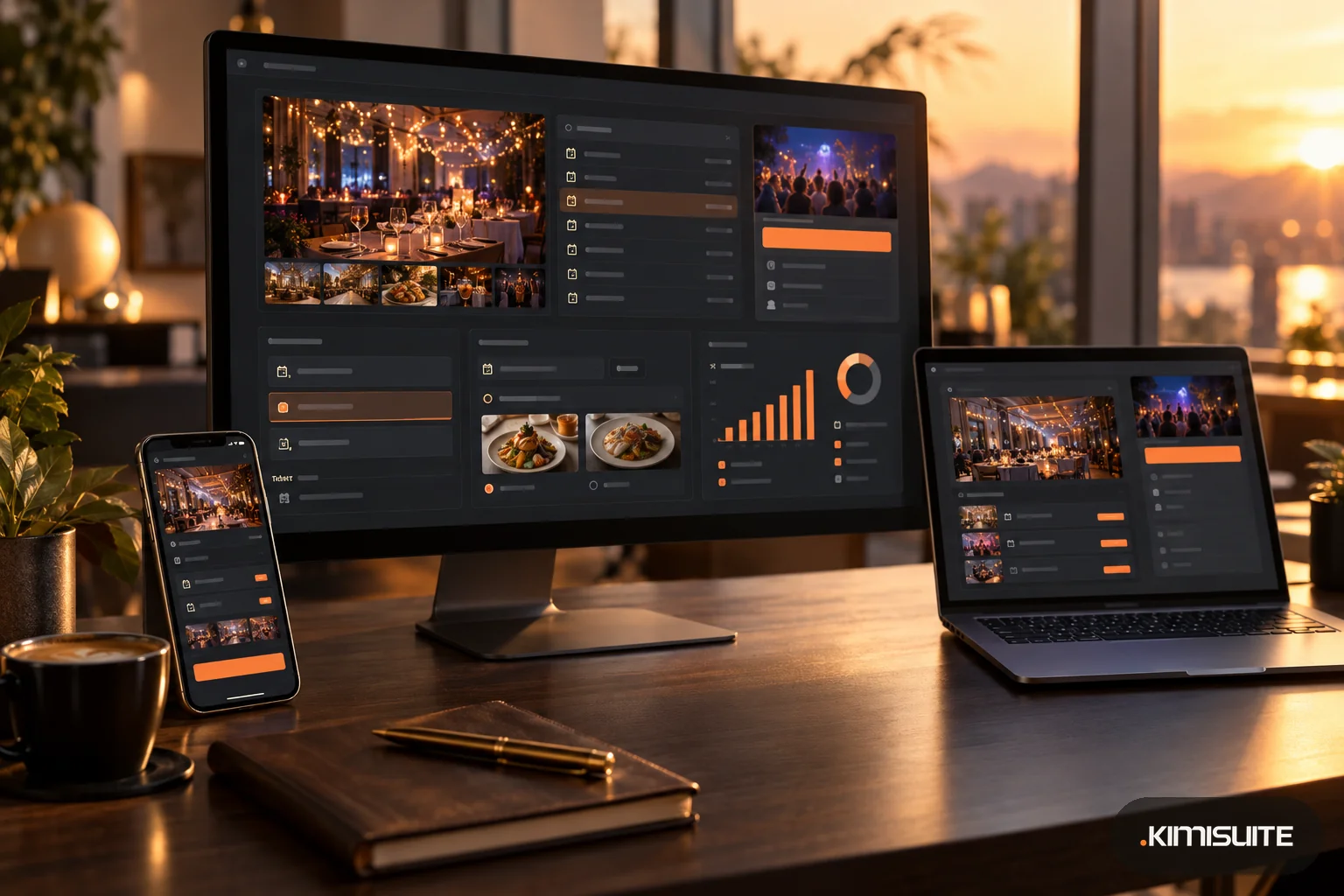
In Event Ticket Hub, the ticketing app in KIMISUITE, you draw the room from the restaurant template with round or square tables. For each table you decide whether it sells per seat, as a whole table or both, with a minimum booking, and guests pick their table in the plan themselves. More on drawing a room in reserved seating online.
Menu choices and dietary needs
A set menu for 180 guests needs exact numbers. Collect them when guests book, not by phone in late December:
- one required question per ticket for allergies and diets
- a selection question if you offer a choice of main course
- a clear deadline after which the menu is fixed
In Event Ticket Hub, booking questions can be asked per order or per ticket and made required. The answers appear in the order and in the attendee list, which you print or export to Excel for the kitchen.
A drinks package or a parking space can be added as an extra while guests book. Extras are never sold on their own, so nobody ends up with parking and no dinner.
A timeline that still works now
- Eight to ten weeks before: set the format and price, draw the room, open sales. If there is time for an early-booking price, give that ticket its own sales window so the normal price takes over by itself, or let the price step up after a number of tickets sold.
- Six to eight weeks before: tell your regulars first. A voucher code can unlock a hidden ticket that only they, or your hotel guests, can see.
- Three weeks before: close menu choices, send the kitchen its numbers, plan staff.
- The last week: take phone bookings by hand. Event Ticket Hub lets you create an order yourself, marked as paid or with payment still open, and the tickets go out by email at once.
- December 31: check guests in with phones, sell the last party tickets at the door.
Payment and cancellations
With Event Ticket Hub, guests pay through your own Stripe, PayPal or Bankart account or by bank transfer, so the money goes straight to your account. KIMISUITE takes no fee per ticket. If you add your own booking fee, it is always included in the price guests see.
Companies booking a table enter their company details for the invoice at checkout. If they pay by bank transfer, your bank details go out with the booking, and the seats stay held until the payment is due.
Write your cancellation rules into your terms before you open sales, including whether names on tickets may change. With personalized tickets, guests change the name themselves until a deadline you set. If the night sells out, a waiting list offers returned tickets to the people who asked to be notified, in the order they signed up.
For hotels: dinner with an overnight stay
Guests often look for a gala dinner with an overnight stay. The room night stays in your hotel system; the dinner can still be sold as a ticket. One clean way is a hidden dinner ticket that only opens with a voucher code you give to guests who booked a room. You keep one table plan and one kitchen list for everybody.
The night itself
The Event Ticket Hub scanner checks signed QR codes even when the Wi-Fi gives up, and the box office sells the last party tickets for cash or card and closes the shift with a Z report. More in the box office guide.
Checklist
- Format and ticket types decided, price checked in the calculator
- Room drawn: per seat, whole table or both
- Allergy and menu questions required per ticket
- Terms published, menu deadline set
- Door phones paired the day before