Since September 2026, Booking.com no longer looks at the prices a hotel shows on its own website when it decides who gets Booking Sponsored Benefit. Parity is not a condition for Genius, Preferred or Preferred Plus either, and external prices play no part in the default ranking. The European Commission confirmed all of this on 28 September 2026 under the Digital Markets Act. It applies to every property in the European Economic Area.
In plain words: your website is allowed to be the cheapest place to book your hotel. Officially, without a side effect on Booking.com.
The rule is one thing. Your software is the other. If your system knows only one price per room, the new freedom stays on paper. In Booking Hub, the price on your website and the price on the OTAs are two separate settings. Two pricing policies, one calendar.
Most hotels will read the news, nod, and change nothing. This article is for the ones who want to move first.
What exactly changed
The Digital Markets Act (DMA) is the EU law for the largest online platforms, the so-called gatekeepers. Article 5(3) says a gatekeeper cannot stop businesses from offering the same service through other channels at different prices or conditions. Booking.com has been a gatekeeper since 2024. What September added is the part hotels actually felt every day.
| When | What happened |
|---|---|
| May 2024 | The Commission designates Booking Holdings as a gatekeeper under the DMA |
| July 2024 | Booking.com removes parity clauses from its General Delivery Terms |
| 14 November 2024 | The DMA obligations start to apply to Booking.com |
| September 2026 | Prices outside Booking.com no longer count for Booking Sponsored Benefit. The "competitive" and "non-competitive" labels disappear from the Extranet. The Partner Hub explains programmes and ranking more clearly |
| 28 September 2026 | The Commission publishes its factsheet on the measures |
The contract clause was already gone in 2024. In June we wrote about the end of rate parity and what it means for your direct channel. What was left was pressure without a clause: labels in the Extranet, programme conditions, and a discount mechanism that reacted to your prices elsewhere. That pressure is what September removed.
Why Booking Sponsored Benefit mattered so much
Booking Sponsored Benefit (BSB) works like this. Booking.com shows the guest a lower price than the one you set and pays the difference itself. You still receive your full rate, minus your usual commission.
Sounds harmless. It is not. The guest compares, sees your hotel cheaper on Booking.com than on your own website, and books there. You pay commission on a booking that might have come to you directly. And your website looks like the expensive option for your own rooms.
The numbers from HOTREC's European Hotel Distribution Study, published on 15 September 2026 with data from 2,713 hotels:
| Finding | Value |
|---|---|
| Hotels that see OTAs undercut their rates, frequently or occasionally | 51 % |
| Of those, hotels that never agreed to the lower price | 80 % |
| Share of all bookings made directly with the hotel | 51.3 % |
| Share of bookings through online travel agencies | 29.9 % |
| Booking Holdings' share of those OTA bookings | 68.8 % |
Until September, the prices you showed elsewhere played a part in whether BSB was applied to your property. Hotels saw it as parity through the back door: price lower on your own website, and Booking.com could close the gap on its side. That link is now cut.
What this means for your hotel
| Before | Now |
|---|---|
| A lower price on your website could affect BSB eligibility | Your external prices are no longer a factor for BSB |
| Genius and Preferred came with parity conditions | Parity is no longer a condition for these programmes |
| The Extranet labelled you "non-competitive" | The labels are gone |
| Nobody was quite sure what counts for ranking | Booking.com confirms external prices are not used for its default ranking |
| "Book direct and save" felt like a risk | It is your call, and only yours |
Three things stay the same, and you should know them:
- The commission stays. Booking.com still charges on every booking that comes through it. This change does not make Booking.com cheaper. It makes your own channel freer.
- It covers the EEA. That is the 27 EU countries plus Iceland, Liechtenstein and Norway. If your property is outside, for example in North Macedonia, Serbia or Switzerland, these specific measures do not apply to you. Check your own Extranet terms.
- Freedom is not yet a booking. A better price on a website that cannot take a reservation is just a phone number with a discount. The advantage only counts if guests can book you directly, in a few clicks, at any hour.
HOTREC has said it will keep watching how this works in practice. Fair enough. But you don't have to wait for them to start.
The math: what a direct guest is worth
Let's take a 25-room city hotel. It sells 1,200 room nights a year through Booking.com at an average rate of €120, with a typical commission of 15 %.
| Booking.com revenue | €144,000 |
| Commission at 15 % | €21,600 per year |
Now the hotel prices its own website 5 % below Booking.com and moves 30 % of those guests to direct:
| Room nights moved to direct | 360 |
| Commission no longer paid | €6,480 |
| Cost of the 5 % lower direct price | €2,160 |
| Left in your till | €4,320 per year |
And the guest still feels they got the better deal, because they did. Put in your own numbers with our booking commission calculator. The full story behind the percentages is in Booking.com commissions explained.
Five ways to make direct the better deal
A good direct offer is not only cheaper. It is cheaper, easier, richer and fairer. Here is how each one works in Booking Hub, the hotel system in your KIMISUITE workspace.
1. Cheaper: one price for your website, another for the OTAs
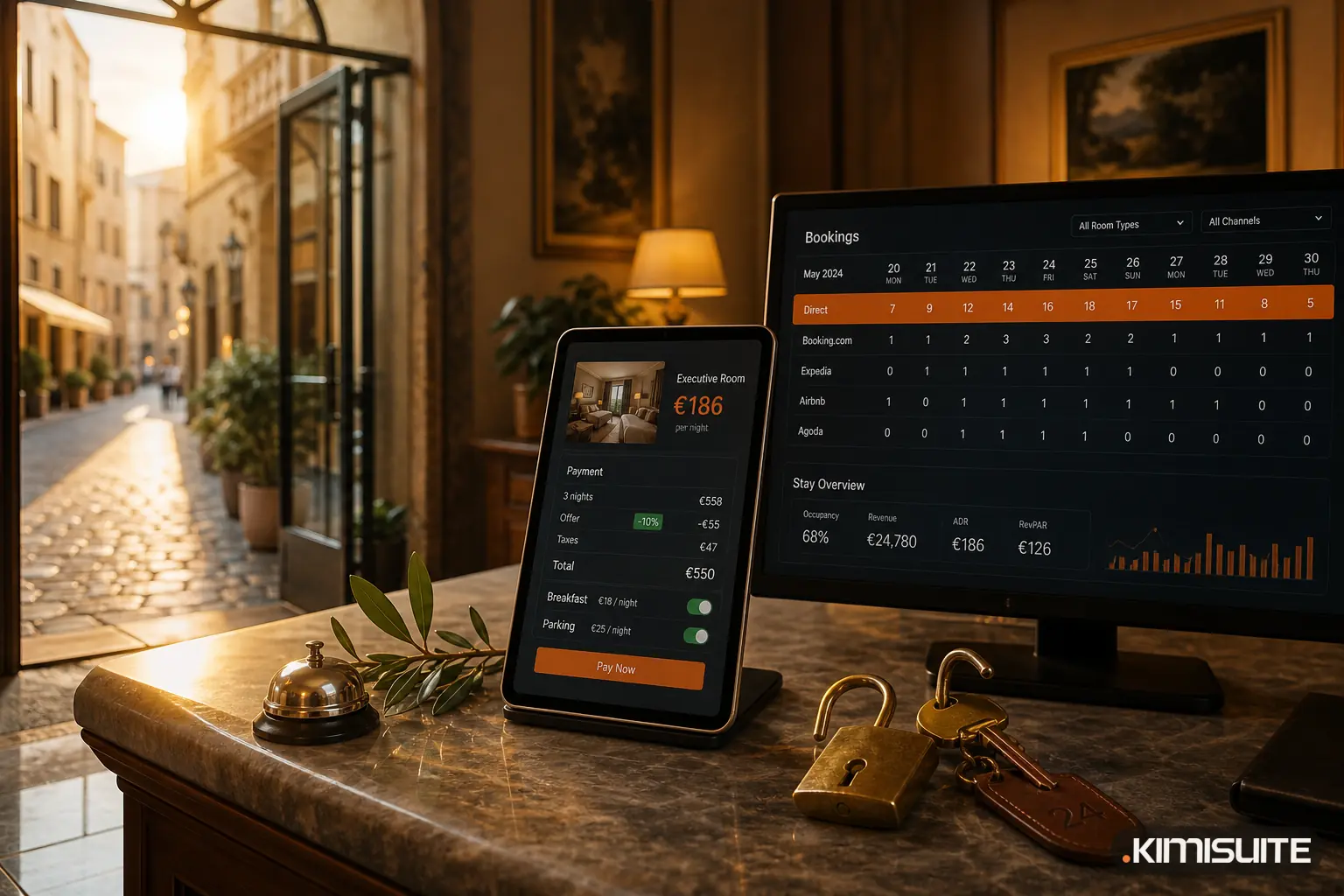
This is the heart of it. In Booking Hub you set the prices for your own website and the prices for Booking.com, Airbnb, Expedia and the other OTAs separately. Two pricing policies, side by side, for the same rooms.
What you do with that is your strategy:
- Website below OTA. Your website is always the cheapest place to book you. The guest who compares finds the best price where you want them to book.
- Commission on top. Keep your direct price where it is and price the OTAs higher, so the commission is covered by the channel that charges it.
- Seasonal mix. Tight in high season, aggressive on your website in low season. You decide per date, not once a year.
On top of that, your checkout can give a discount per payment method, for example 5 % off for paying on arrival. Guests see it as a badge on the payment step and as a clear line on the bill.
2. Easier: shorter stays for direct guests
With minimum stay by channel, you ask for two nights on Booking.com and still accept a one-night stay on your own website. Your channel becomes not just the cheapest, but the most flexible one to book.
3. Richer: breakfast, parking and more, right in checkout
Meal plans, parking, transfers, spa, cribs and extra beds are set up once and appear as simple switches in the checkout. Parking even has its own inventory per night, so you never promise a space you don't have. Want to treat direct guests? A parking reservation can be set to €0 and marked complimentary. A gift that costs you little and is worth a lot to the guest.
4. Fairer: your own terms
Your direct booking engine carries your own cancellation policy, with a deadline you choose for guests to cancel by themselves. After booking, guests get a confirmation with an itemised bill and a "View my booking" page, no account needed. They can message you there. You build the relationship, not a platform.
5. In sync: one calendar for every channel
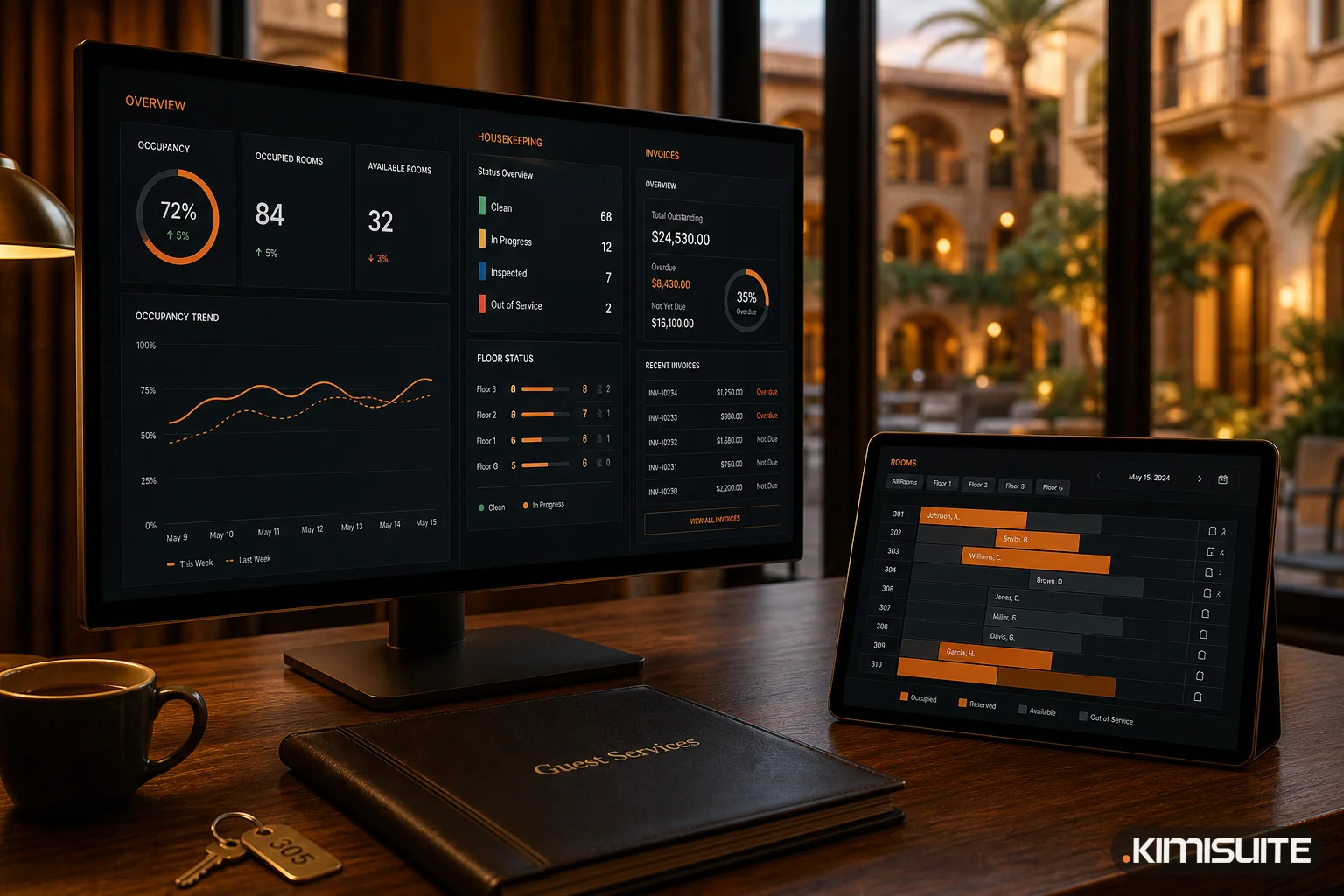
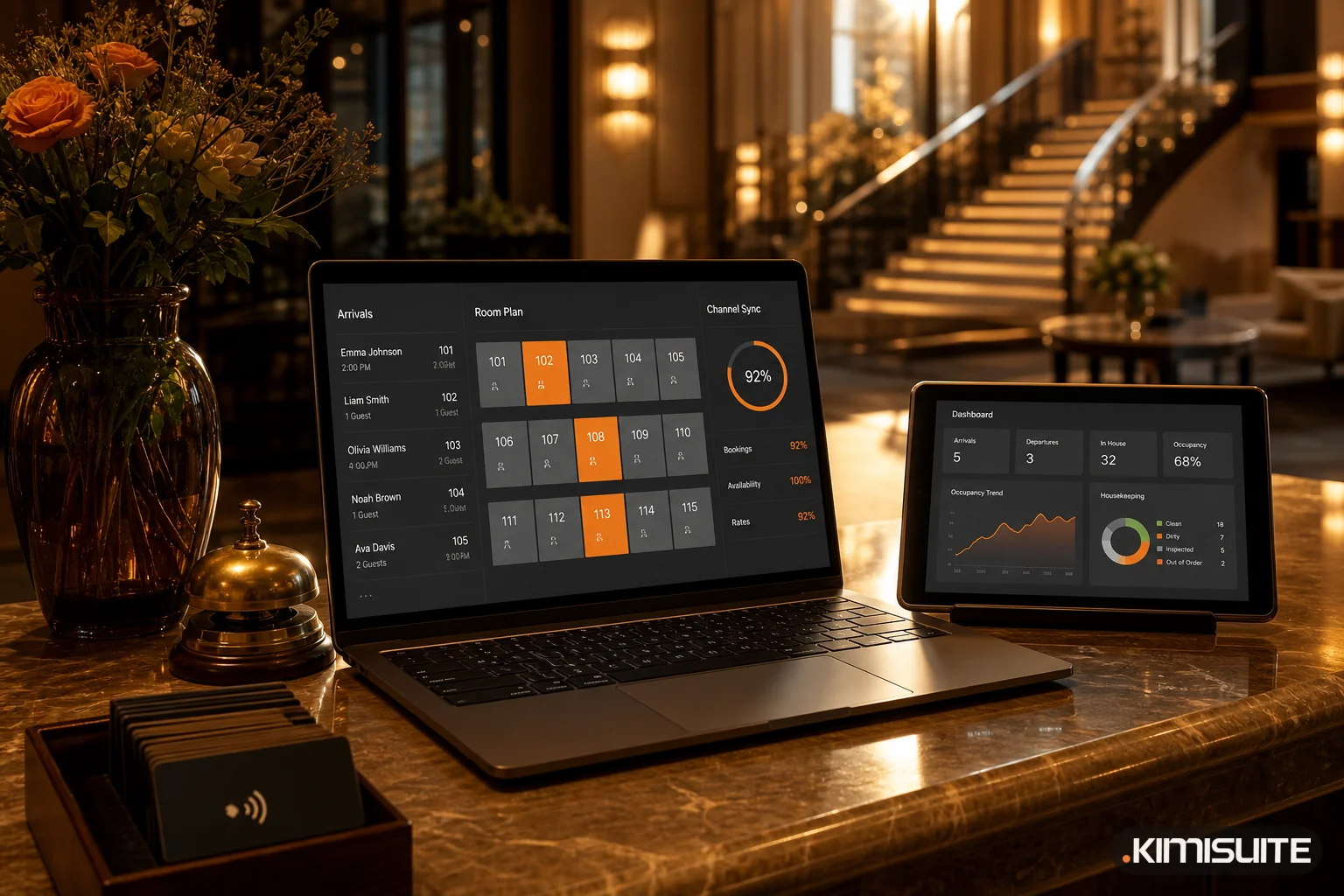
Better direct offers only work if your availability is right everywhere. With Channel Manager - Live Sync, prices, availability, minimum stays and closures run both ways with Booking.com, Airbnb, Expedia, Agoda and more. Every reservation shows where it came from, and for OTA bookings, what it cost you in commission. You see in black and white what each channel really earns you.
Why a whole workspace beats a pile of tools
Many hotels already have a PMS, a booking engine, a channel manager and an invoicing tool. Four logins, four contracts, four places where data gets lost.
KIMISUITE works differently. You open a free workspace, and Booking Hub lives inside it next to the apps your hotel needs anyway: CRM Business Hub for real invoices, where each stay arrives line by line, room, meals and extras, each with its own VAT rate. The AI Website Builder for hotels that still need a proper website. Restaurant Hub for the breakfast room and the restaurant. Showroom TV for the screens in your lobby.
And you pay per workspace, not per user. Your front desk, housekeeping and accounting are in one place, without every new colleague raising the bill.
The booking engine is included in Booking Hub. No commission on your direct bookings. Not 3 %, not 1 %. Zero. And because website and OTA prices are separate, you decide how much of that saving you pass on to the guest.
Your next 30 days
- Check your Extranet. See which programmes you are in and what the conditions say today.
- Calculate your commission. One honest number for last year. Most hotels underestimate it.
- Set two price lists. One for your website, one for the OTAs. Decide the gap, and what you add on top: shorter stays, breakfast, parking, fairer terms.
- Make your website bookable. A booking engine on every page, not just a contact form.
- Say it out loud. "Book direct: 5 % off and free parking" on your homepage, in your confirmation emails and on the card at reception.
- Bring OTA guests back. A guest who found you on Booking.com this year can book you directly next year. Make sure they know why they should.
Come and take your prices back
For years, the cheapest place to book a hotel was rarely the hotel itself. Since September, in the whole EEA, it can be. The rules are on your side now. What is missing is a system that turns that freedom into bookings.
Start with Booking Hub — property management, separate prices for your website and the OTAs, a commission-free booking engine and channel sync in one workspace. Or first see what direct bookings would bring you.
Cancel anytime · No minimum term · 14 days free
This article reflects the situation as of 1 October 2026 and is not legal advice.