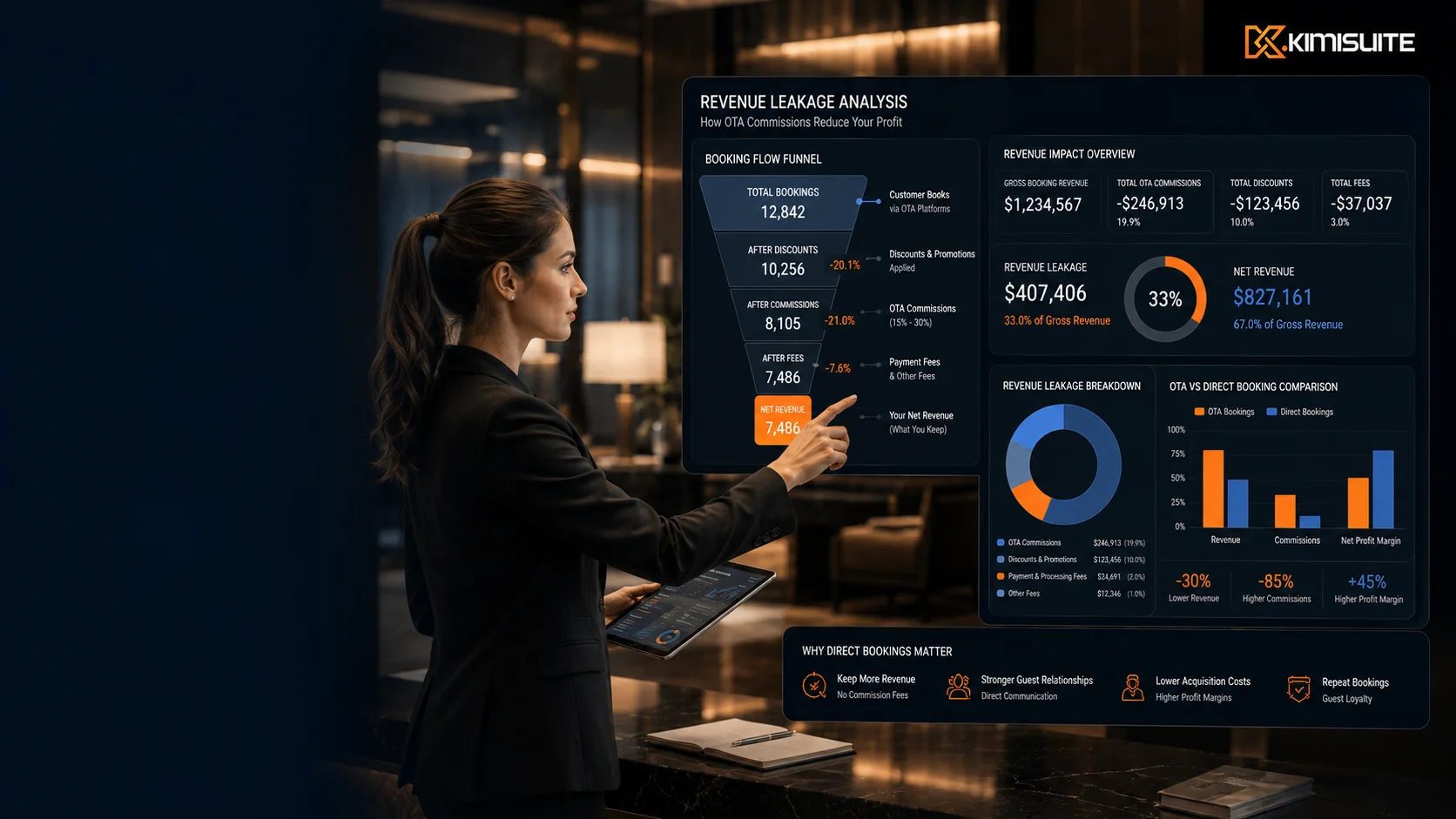
"Booking.com takes 15%" is one of the most repeated, and one of the most misleading, sentences in hospitality. The headline number is real, but it is only the entrance fee. The full Booking.com commissions structure is a stack of optional and semi-optional layers, and most hotels end up paying a meaningfully higher effective rate than they think.
This article unpacks the stack one layer at a time, with concrete examples and rough numbers. If you want the broader cost breakdown including hidden expenses, see our companion piece on the real cost of Booking.com reservations.
Layer 1: The base commission
Across most European markets, Booking.com's base commission for independent hotels is 15%. In a few markets it can be 12% or 17%. Apartments and short-term rentals sometimes sit on a different schedule. Chains negotiate corporate rates.
The base commission is what shows up in your monthly invoice and what your accounting tags as "OTA commission". It is what most hotels report when asked.
Layer 2: Genius — the discount you absorb
Genius is Booking.com's tiered loyalty programme. Members get:
- Genius 1: 10% off
- Genius 2: 15% off + perks like free breakfast or early check-in
- Genius 3: 20% off + bigger perks
Two critical facts about Genius:
- The discount comes from the hotel's revenue, not from Booking.com. Booking.com is the marketing channel; the hotel funds the loyalty.
- The base commission is calculated on the discounted ADR, which means you absorb the discount and still pay commission on the lower number.
Worked example on a €100 room:
| Programme stack | Guest pays | Hotel receives (after 15% commission) |
|---|---|---|
| No Genius | €100 | €85 |
| Genius 1 (10% off) | €90 | €76.50 |
| Genius 2 (15% off) | €85 | €72.25 |
| Genius 3 (20% off) | €80 | €68 |
A Genius 2 guest costs the hotel €27.75 in effective margin on a €100 published rate. That is 27.75% acquisition cost on what looks like a 15% commission. Most hoteliers never actually run this calculation.
Layer 3: Preferred Partner Programme — visibility for 3% more
The Preferred Partner Programme is Booking.com's "this hotel is recommended" badge. You get:
- A thumbs-up icon in search results
- Higher placement in unfiltered searches
- Priority in some recommendation feeds
You pay 3 percentage points on top of base commission. The programme is invitation-based and tied to performance metrics (review score, content completeness, conversion rate). Hotels that drop below the bar lose the badge.
Effective combined commission with Preferred Partner: 18% base + Genius discounts on top.
Layer 4: Visibility Booster — the auction layer
The Visibility Booster lets you bid for additional impressions during periods when you want to fill rooms. You set the extra commission percentage you are willing to pay (typically 5%-30%) — Booking.com's algorithm then weighs your bid against other properties competing for the same impression.
Critical to understand: the boost is per night or per date range you select, and you pay the extra commission only on bookings that originated from a boosted impression. So a 10% boost on a slow Tuesday means commission climbs to 25-28% on those Tuesday bookings, but only on those.
Used carefully, the booster is a legitimate yield tool. Used carelessly — set and forgotten — it silently eats margin during periods when the hotel was going to fill anyway.
Layer 5: Sponsored Listings — pay per click
Sponsored Listings are CPC-style ads inside Booking.com search results. You pay per click rather than per booking. Useful for new properties trying to gather initial reviews, but generally worse value than the Visibility Booster for properties that already have traffic.
Layer 6: Reduced-rate programmes (Mobile Rates, Country Rates, etc.)
Booking.com occasionally invites properties into programmes that target specific guest segments at reduced rates:
- Mobile Rates — 10% off for mobile bookings
- Country Rates — discounts targeted at specific source markets
- Last-Minute Deals — same-day or 24h-window discounts
These are technically opt-in. Realistically they are heavily nudged, and properties that decline see their visibility decay over weeks.
Putting the stack together
Here is what a typical "fully opted-in" Preferred Partner hotel actually pays on a €100 published rate, sold to a Genius 2 guest during a Visibility Booster period:
- Published rate: €100
- Genius 2 discount: -€15 → guest pays €85
- Base commission (15% of €85): €12.75
- Preferred Partner (3% of €85): €2.55
- Visibility Booster (10% of €85): €8.50
- Hotel receives: €61.20
- Effective acquisition cost: 38.8%
This is not the worst case. This is the typical case at a mid-sized European hotel during shoulder season.
How this compares to direct
A direct booking processed through your own booking engine costs:
- Payment processing: 1.5-2.5%
- Booking engine subscription: small fixed cost amortised across all bookings (typically 0.5-1% effective)
- Effective acquisition cost on direct: 2-3.5%
The 35-percentage-point gap between OTA and direct is exactly the size of the prize. Closing it is what direct-booking strategy is about.
What hotels are doing
Smart hoteliers do not "leave Booking.com" — the discovery layer matters and walk-aways rarely beat a balanced channel mix. Instead they:
- Audit their actual effective Booking.com commission per quarter
- Quantify the gap between OTA and direct
- Invest some of that gap into direct-booking infrastructure (booking engine, loyalty, retargeting)
- Watch the mix shift over 12-18 months
KIMISUITE Booking Hub is the direct-booking infrastructure. Live booking engine, integrated loyalty, direct-booker discounts, member rates, automated guest comms — all on one bill, all sharing the same customer record. You keep the Booking.com listings; you stop being captive to them.
Start a 14-day free trial of KIMISUITE Booking Hub →
Related reading
- The End of Rate Parity? How Hotels Can Increase Direct Bookings and Reduce OTA Costs — the regulatory backdrop.
- How Much Does a Booking.com Reservation Really Cost? — the full cost picture including hidden expenses.
- 15 Proven Ways to Increase Direct Hotel Bookings in 2026 — concrete tactics to shift the mix.
- Hotel Website vs OTA: Where Do Guests Prefer to Book? — the guest behaviour side.
- Revenue Management After Rate Parity — pricing strategy in the new world.
Own your guest relationship. Book a 15-minute demo of KIMISUITE Booking Hub or start a free trial.