There is a persistent industry myth that guests "prefer to book on Booking.com". They do not. What guests prefer is a fast, trustworthy, frictionless booking experience — and historically the OTAs delivered that better than hotel websites did.
The good news for hoteliers: that gap is closing, and in many cases it is already closed. The hotel website vs OTA comparison in 2026 looks very different from 2018.
Why guests visit OTAs in the first place
Three reasons, in order of importance:
- Discovery. They don't know which hotel to book yet. The OTA is a comparison tool.
- Trust shorthand. Guest reviews on a single platform are easier to evaluate than reviews scattered across TripAdvisor, Google, and the hotel's own site.
- Familiarity. They have used the OTA before. Their card is stored. The flow is predictable.
None of these reasons are about price. Most guests assume the price is the same everywhere (the rate parity assumption, even as parity itself fades — see our piece on the end of rate parity).
Why guests visit hotel websites
Guests come directly to a hotel website when they:
- Already know the hotel (returning guest, recommendation, advertising)
- Want to verify what they saw on the OTA (better photos, more detail, room types)
- Are looking for something specific (a suite type, a package, an event venue)
- Have a brand loyalty preference
Critically: guests who land on a hotel website have higher intent than guests browsing the OTA. They are closer to the booking. They just need a reason to convert with you instead of bouncing back to Booking.com.
The conversion factors that actually matter
Studies and real hotel A/B data converge on five things that drive conversion on a direct site:
1. Speed
A booking engine that takes more than 2 seconds to display rates is losing 30%+ of visitors before they even see a price. Mobile networks make this worse. The fix is mechanical, not creative: a modern booking engine and a CDN.
2. Mobile-first design
70%+ of hotel research is mobile. If your booking engine renders a horizontally-scrolling rate grid on a phone, you lose the visitor. KIMISUITE Booking Hub is built mobile-first; many older engines still render desktop-first and squeeze.
3. Trust signals on the booking page itself
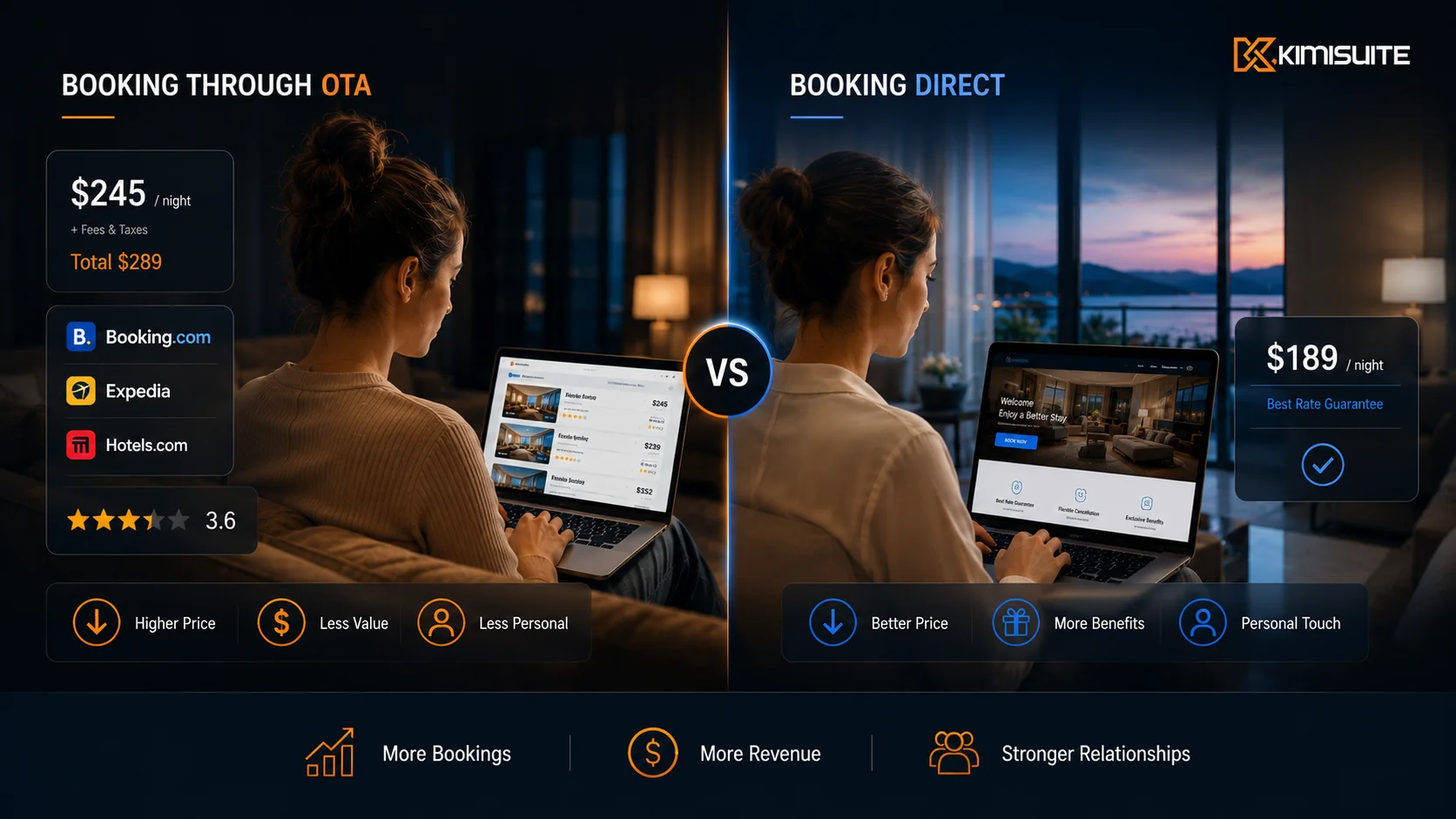
The OTA shows: 4.7 score, 1,234 reviews, "Booked 18 times in the last 24 hours". Your site shows: rate, room photo, button. Guess which converts better.
Trust signals you can add without making the page noisy:
- Top 3 review highlights from real guests, with source attribution
- Aggregate score with review count
- A "best rate guaranteed" badge if you offer one
- Direct-booker perks listed concisely ("Free breakfast on direct bookings")
4. A booking flow shorter than the OTA's
If your direct booking takes more clicks than Booking.com's, you have already lost. Three pages maximum: rate + room → guest details → payment. Skip the survey questions, skip the upsell wall, get them through the gate.
You can upsell after confirmation. Many hotels do this and convert at higher rates than the all-in-one bloated flow.
5. Genuinely better photos than the OTA
The OTA shows a default 4-photo strip. Your site can show 30 photos, 360° tours, room layout sketches and video. Use this asymmetry. Hotels that invest in serious photography see direct conversion lifts of 15-25%.
Mobile booking behaviour, specifically
Mobile bookings differ from desktop in important ways:
- Sessions are shorter. Three minutes versus seven.
- Decisions are faster. Visitors compare 2-3 hotels, not 8-10.
- Cart abandonment is higher. A clunky payment step on mobile loses ~40% of started bookings.
The fix is to use Apple Pay / Google Pay buttons at the payment step. One tap. No card form. Conversion lift on mobile bookings: routinely 10-20%.
What hotels can borrow from OTAs (and what they should not)
Borrow:
- Clear photos at the top
- Aggregate review score visible above the fold
- Specific recent-activity signals ("booked 5 times today")
- Map view if the location is selling itself
- Price comparison ("Cheaper here than on Booking.com" — when true)
- Persistent floating "Book now" CTA on mobile
Skip:
- High-pressure "only 1 room left at this price!" countdowns that look spammy
- Pop-ups that block the screen
- Locked-in surcharges and resort fees revealed only at checkout
- Forced account creation before checkout
The OTAs do some of those poorly because they have to support millions of properties. You do not. Use that advantage.
The winning equation
Hotel-website-versus-OTA is not a fair fight if the website is from 2015 and the OTA is from this year. It becomes a fair fight when:
- Your booking engine matches the OTA's speed
- Your reviews and trust signals are visible on the booking page
- Your photography is genuinely better
- Your direct booker gets something tangible the OTA cannot match (a perk, a loyalty point, a guaranteed best rate, breakfast)
- Your flow is shorter, not longer, than the OTA's
When those things are true, direct conversion rates routinely exceed OTA conversion rates on the same visitor. The visitor was always yours to win. The infrastructure just had to be there.
KIMISUITE Booking Hub is built so most of this is configuration, not engineering. Speed: solved by the platform. Mobile-first: default. Trust signals: configurable per property. Direct booker incentives: a switch. Apple Pay / Google Pay at checkout: built in.
Try KIMISUITE Booking Hub free for 14 days →
Related reading
- The End of Rate Parity? How Hotels Can Increase Direct Bookings and Reduce OTA Costs — the regulatory frame.
- How Much Does a Booking.com Reservation Really Cost? — the size of the prize.
- Booking.com Commissions Explained: What Hotels Really Pay — the commission stack in detail.
- 15 Proven Ways to Increase Direct Hotel Bookings in 2026 — concrete tactics.
- Revenue Management After Rate Parity — pricing in the new era.
Turn website visitors into direct bookings. Start a 14-day free trial or book a 15-minute demo with our team.