Most hoteliers can quote their Booking.com commission cost off the top of their head — usually somewhere between 15% and 18%. But ask them what their effective cost per reservation actually is, and the answer is rarely the same number.
Once you stack Genius discounts, Preferred Partner fees, Visibility Booster bids and the seasonal rate races that the OTA quietly nudges you into, the true acquisition cost of a Booking.com guest can land anywhere between 22% and 35% of the room revenue. Knowing the real number is the first step to running a healthier distribution mix — and a more profitable hotel.
This article breaks the cost down line by line.
1. The headline commission is just the entrance fee
Every hotel that signs with Booking.com starts on a base commission, typically 15% in Europe. That number is what appears on the invoice and what most P&L spreadsheets capture.
But the base commission is the minimum you pay. It is the price of being visible on the platform at all. Everything else is layered on top.
2. The Genius programme: 10% off, taken from your margin
The Genius programme is Booking.com's loyalty layer. Genius Level 1 members get a 10% discount on participating properties. Level 2 adds free breakfast or early check-in. Level 3 unlocks even bigger perks.
Here is the catch: the discount comes out of the hotel's pocket, not Booking.com's. A €100 room sold to a Genius guest becomes a €90 room — and the 15% commission is still calculated on the discounted rate, not the original ADR.
Effective impact on a €100 room:
- ADR after Genius discount: €90
- Commission (15%): €13.50
- Hotel receives: €76.50
- Effective acquisition cost: 23.5%
And Genius opt-in is not really optional. Properties that decline lose visibility, rank lower in search results, and often watch their bookings volume fall by 30-50% within weeks. Most hoteliers turn it back on within a quarter.
3. Preferred Partner: another 3% on top
The Preferred Partner Programme adds a flat 3% on top of base commission in exchange for higher visibility, a thumbs-up badge in search, and priority placement in some filters. Most hotels with healthy occupancy are nudged into the programme, sometimes implicitly through performance dialogues with the local market manager.
On a Preferred Partner hotel that also runs Genius:
- Base 15% + Preferred 3% = 18% commission
- On a Genius-discounted ADR
- Effective acquisition cost on a €100 published rate: ~26%
4. Visibility Booster and Sponsored Listings: the auction layer
The Visibility Booster is a CPC-style auction — pay an extra 5-30% commission on bookings that originated from a boosted impression. Sponsored Listings work similarly but are pay-per-click rather than pay-per-conversion.
Few hotels run these year-round. But during shoulder seasons or in saturated markets, they get switched on, and the effective commission can climb to 30-35% of room revenue on those reservations.
The painful part: the booster is set per night, and Booking.com decides which impressions get boosted. The auction is opaque.
5. The hidden costs nobody invoices you for
Beyond programme fees, two more cost categories quietly erode your margin:
- Cancellation losses. Booking.com's free-cancellation defaults mean a meaningful share of bookings get cancelled within 48 hours of arrival, often after you have already turned away a walk-in.
- Channel manager + PMS fees. Maintaining inventory parity across OTAs requires software you would not need for direct bookings alone. Budget €100-300/month per property minimum.
- Lost CRM data. Booking.com does not pass through the guest's real email address. You cannot re-market, you cannot run loyalty, you cannot rebook a happy guest directly next year. That guest is their guest, not yours.
The real cost, summarised
| Component | Typical % of room revenue |
|---|---|
| Base commission | 15% |
| Genius discount (margin you absorb) | +6-8% effective |
| Preferred Partner | +3% |
| Visibility Booster (if active) | +5-15% |
| Effective cost per Booking.com reservation | 22-35% |
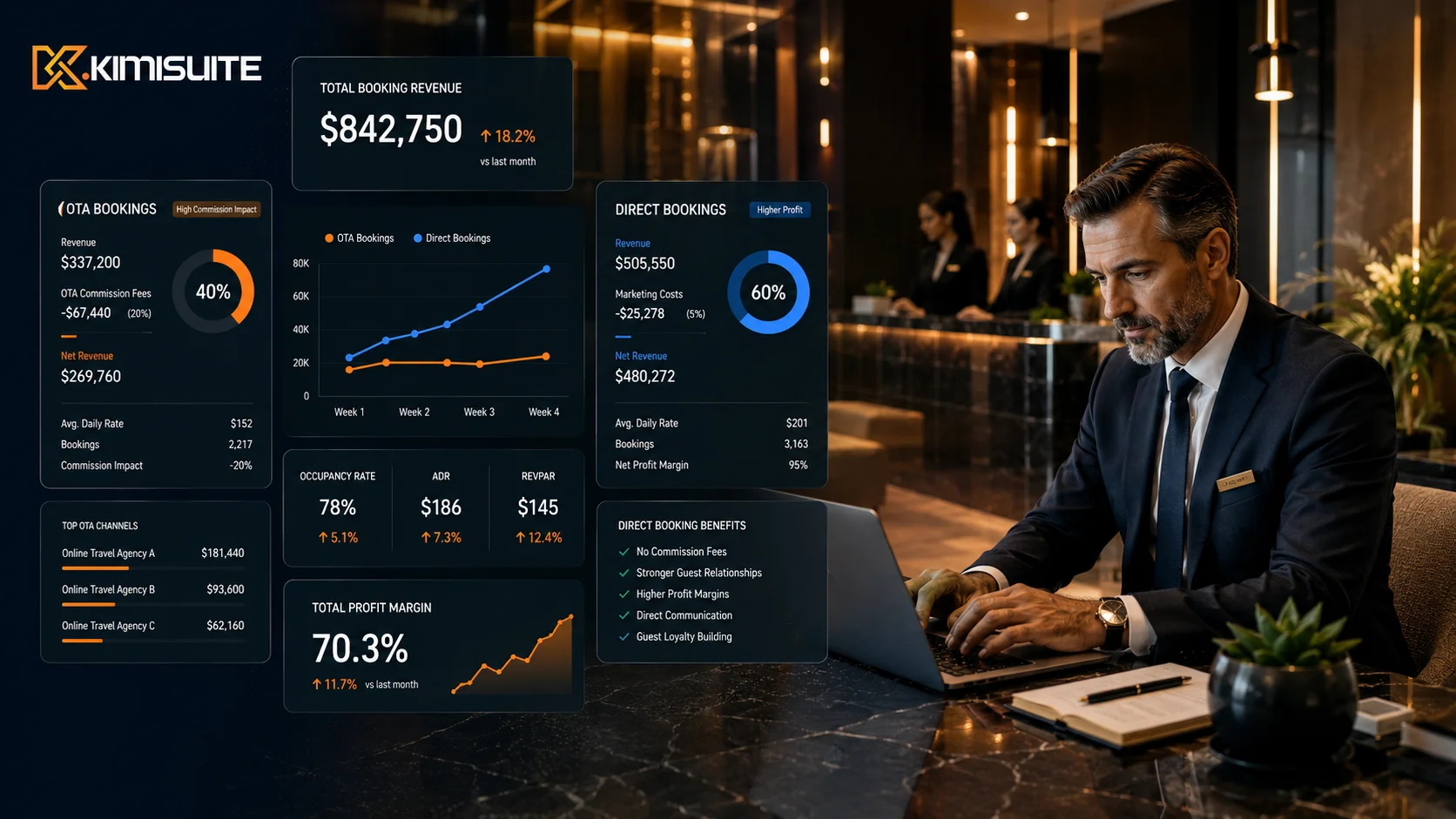
A direct booking, by contrast, costs you whatever your booking engine and payment processor charge — typically 1-3%. Sometimes less.
The arithmetic is not subtle. A direct guest is worth roughly 25 percentage points more than an OTA guest on the same room rate. Over a year, on a 30-room hotel running at 70% occupancy, that gap is six figures.
What hotels do about it
You will not (and probably should not) walk away from Booking.com — the discovery layer matters. But every hotelier should be running a parallel direct-booking strategy that gradually shifts the mix.
KIMISUITE Booking Hub is built for exactly this: a booking engine that lives on your own website, payment processing at 1-3%, guest CRM that you own, and direct-booking incentives (member rates, free breakfast, parking, loyalty points) that you can configure without a developer.
Start a 14-day free trial of KIMISUITE Booking Hub →
Related reading
- The End of Rate Parity? How Hotels Can Increase Direct Bookings and Reduce OTA Costs — the main pillar that ties this cluster together.
- Booking.com Commissions Explained: What Hotels Really Pay — a deeper dive into the commission structure.
- Hotel Website vs OTA: Where Do Guests Prefer to Book? — what actually drives booking decisions.
- 15 Proven Ways to Increase Direct Hotel Bookings in 2026 — practical tactics.
- Revenue Management After Rate Parity: A New Strategy for Hotels — pricing in the post-parity era.
Ready to reduce OTA dependency? Try KIMISUITE Booking Hub free for 14 days or book a 15-minute demo with our team.