Ten years ago the job of a hotel PMS was easy to describe. It held the reservations, the room plan and the rates. Everything else — the website, the invoice, the housekeeping list, the restaurant, the spa — lived somewhere else, usually on paper, and that was normal.
It is not normal anymore, and the reason is not that hotels became more demanding. It is that the guest journey moved online end to end, and the software mostly did not follow.
Today the reservation is the middle of the story, not the beginning and definitely not the end. Which means the interesting question about hotel software is no longer "does it manage bookings well?" but "where does it stop, and who pays for the gap?"
The real cost of software is the gap between the tools
Take an ordinary sequence and count the systems involved at a property that bought each part separately.
A guest finds the hotel on Google and lands on the website. (Website tool.) They check availability and book. (Booking engine.) The availability has to disappear from the OTAs. (Channel manager.) The reservation appears at reception. (PMS.) The room needs cleaning before arrival. (Spreadsheet, or paper.) The guest is a company and needs a proper invoice. (Accounting tool.) At check-in they ask about dinner. (Restaurant system, or a phone call.) And about a massage on Saturday. (A notebook at the spa desk.)
Eight touchpoints. Even if every single tool is good, look at what happens between them:
- The guest name is typed at least three times, and spelled differently at least once
- Somebody exports a list every morning to make another list
- The invoice address exists in two places and matches in neither
- The dinner booking is not connected to the room, so nobody knows the guest checked out early
- The spa appointment collides with a treatment room already taken by another guest
None of these is a disaster. All of them are a small tax on every single arrival, paid by staff, every day, forever. That is the real cost of hotel software, and it never appears on any invoice from a vendor.
Errors are not accidents, they are structural
The overbooking that ruins a Saturday is rarely somebody being careless. It is two systems that were not talking at the moment it mattered — a rate updated in one place, a channel that syncs on a schedule, a room sold twice in the gap.
The same is true of the smaller failures: the guest charged the wrong rate because the offer lived in an email; the arrival nobody prepared for because the reservation came in through a channel someone checks less often; the invoice reissued twice because the company details were entered by hand at 22:00.
You cannot train these away. They are properties of the architecture, not of the staff. The only structural fix is to reduce the number of places the same fact is stored.
What a hotel system has to cover now
If you map the actual journey rather than the software categories, a property needs all of this connected:
Before the stay
- A website that can take a direct booking, not just display a phone number
- A booking engine with real availability, embedded in that website
- Channel synchronisation so the OTAs and the direct engine never sell the same room
- Rates, seasons and restrictions in one place
During the stay
- The front desk: arrivals, departures, room moves, extensions, walk-ins
- Housekeeping: who cleans what, in what order, and what is ready
- Everything the guest asks for while they are standing there
Around the stay
- Restaurant service, if you have one
- Appointment-based services — spa, massage, treatments, tours, the seminar room
- Offers and invoicing, with the right company details and tax treatment
- The guest record, which should be the same record every time
That is not a wish list. That is a Tuesday at a mid-sized hotel.
What "one ecosystem" actually means in practice
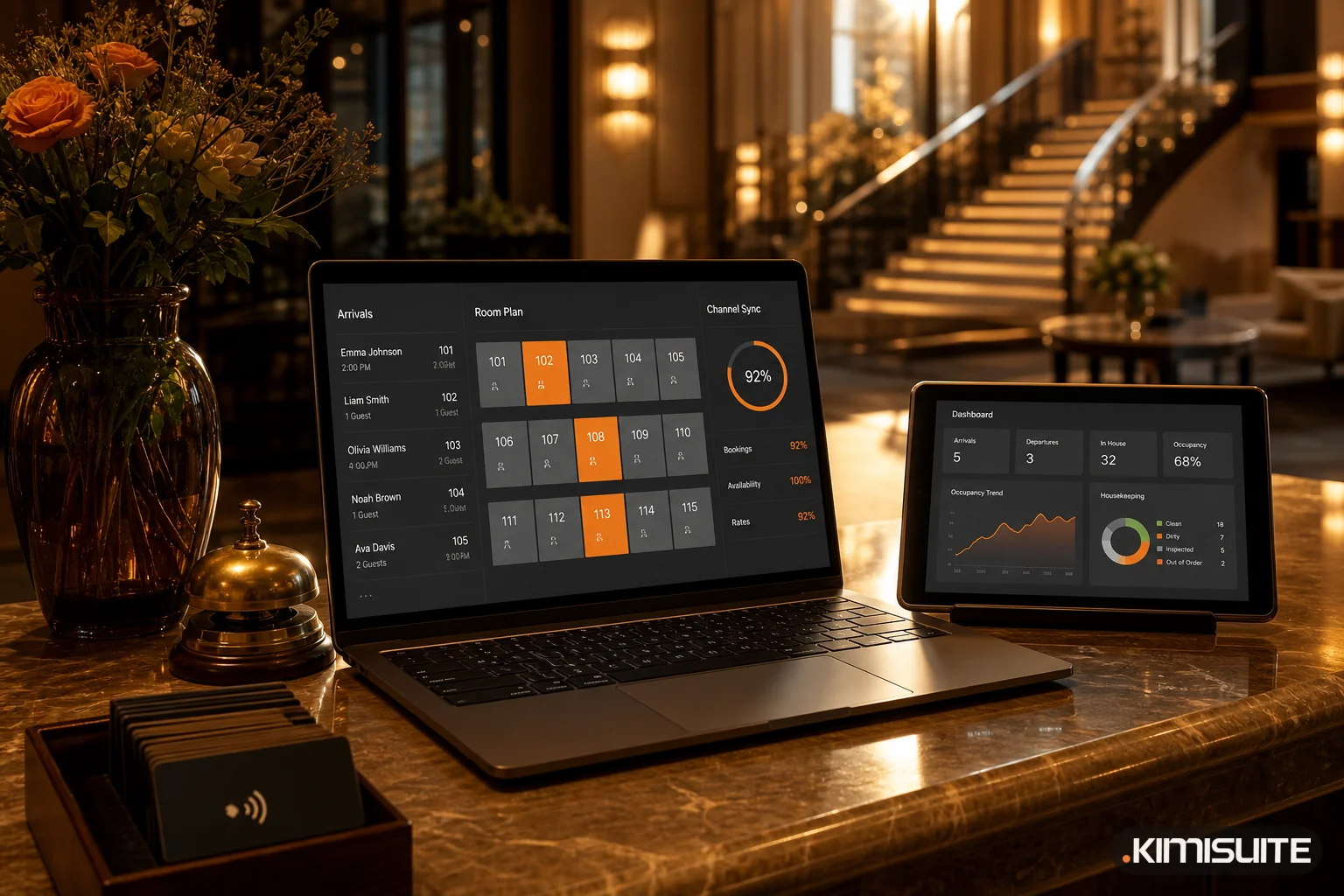
KIMISUITE covers that journey in one workspace, and the point is not the number of modules. It is that the guest, the reservation, the invoice and the task are the same records everywhere.
Concretely, at a property running on KIMISUITE:
- The website carries booking widgets — slider, listing or search — so a direct booking starts on your own domain and pays no commission.
- Booking Hub holds the reservation, the room plan, the rates and the guest profile, and keeps availability synchronised with the OTAs in real time.
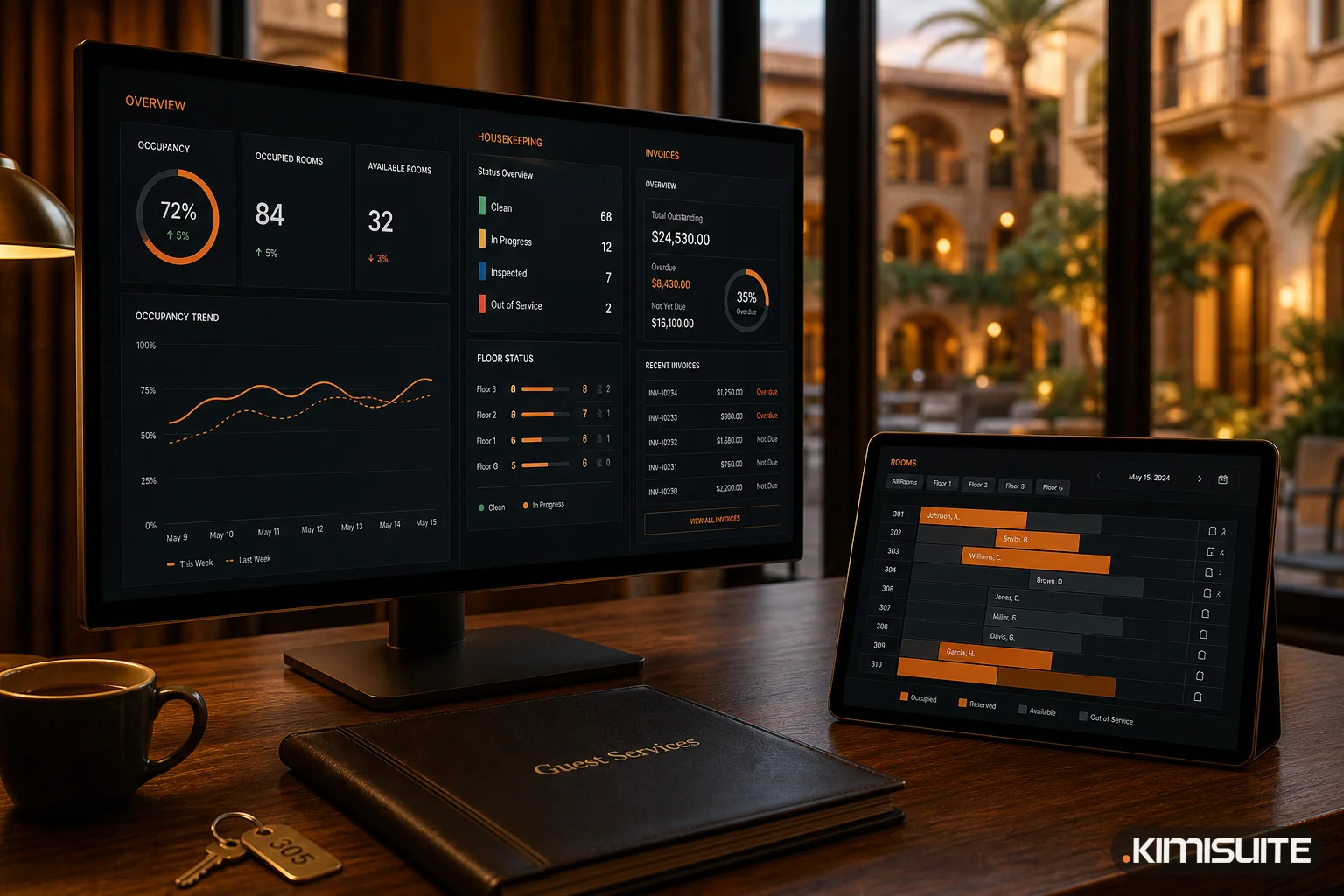
- Cleaning organisation lives in the same system as the reservation: housekeeping tasks are assigned, room status is tracked and the daily workflow is visible, because the system already knows who is arriving and who is leaving.
- CRM Business Hub issues the offer for the corporate booking, converts it into an invoice, applies the VAT rules and chases the payment — against the same customer record, with e-invoicing where it is required.
- Service Manager handles the spa treatment, the massage, the tour and the seminar room, with the therapist and the treatment room as real resources that can only be booked once.
- Gastro POS Hub runs the restaurant, connected to the same workspace rather than to a separate island.
- Task Hub turns things that happen into things that get done — a confirmed reservation can automatically create the "prepare welcome basket" card, due 24 hours before arrival.
The result is not that any single tool is dramatically better than a specialised one. It is that the seams are gone. Nobody retypes a guest name. The invoice knows the reservation. The spa knows the checkout date. The welcome basket task exists because the booking confirmed itself into it.
The honest counter-argument
A dedicated single-purpose tool will sometimes have more depth in its narrow area than the equivalent module in a connected suite. That is a real trade-off and it is worth naming rather than pretending otherwise.
The question is which problem is actually costing you more: the feature you do not have in the specialist tool, or the six seams between eight tools that every arrival has to cross.
For a large chain with a dedicated IT team and an integration budget, the specialist stack can be the right answer. For a property where the person choosing the software is also the person covering reception on Sunday, it usually is not.
How to think about the decision
Stop comparing PMS to PMS. Compare the whole journey instead:
- Draw your guest journey from the first Google search to the final invoice.
- Mark every point where data is retyped or exported from one place to another.
- Count the logins your team needs across a normal shift.
- Add up the monthly cost of every tool involved, including the ones nobody remembers.
- Then ask how much of that a single connected workspace would remove.
That number — not the monthly price of a PMS — is what the software actually costs you today.
Booking Hub is priced per room type rather than per room, and because the rest of the journey lives in the same workspace, the second and third tools do not arrive with their own subscriptions, their own logins and their own version of your guest's name.
A hotel PMS has not been just a PMS for a while now. The systems that still behave like one are quietly charging you for the difference.
See what Booking Hub covers — or read how to choose a hotel system you can trust if you are in the middle of the decision.