Choosing a system for your property is one of those decisions that looks like a software purchase and behaves like a hiring decision. You are not buying features. You are choosing something that will sit in the middle of every shift, every arrival and every invoice for the next five years.
Which is why the usual way of choosing — a feature comparison table, a demo, a discount — tends to produce regret. Feature lists are written by the people selling the software. Demos show the happy path. The discount lasts twelve months and the migration lasts forever.
Here is a more honest way to run the decision.
Start with your Tuesday, not with a feature list
Before you look at any system, write down what actually happens on an ordinary Tuesday at your property. Not the strategy, the sequence:
- Who checks the arrivals list, and when?
- What happens when a walk-in wants a room for one night?
- How does housekeeping learn which rooms need cleaning first?
- What happens when a guest wants to extend by a day?
- Who fixes it when two channels sell the same room?
- How does a company guest get an invoice with the right VAT and the right address?
- What happens to the spa booking that guest asked about at check-in?
That list is your specification. Every one of those moments either gets easier with the new system, or it does not. Everything else on a feature grid is noise.
The reason this works: software is easy to evaluate against an imagined future and very hard to evaluate against a real Tuesday. Bring the Tuesday.
The five questions that actually predict regret
After enough conversations with hoteliers about systems they later replaced, the same five gaps come up.
1. What happens when it goes wrong at 23:00?
Not "is there support" — everyone has support. Ask precisely:
- Who answers outside office hours, and in which language?
- What is the realistic response time for "the channel manager has stopped syncing", as opposed to "how do I change a rate"?
- Is there a person who knows your property, or a queue?
A system that is excellent for eleven months and unreachable during your one crisis is not an excellent system.
2. Who owns your data, and can you get it out?
Ask for the export before you sign, not after. Reservations, guests, invoices, rates. In a format you can actually open.
If getting your own data out is difficult, everything else in the relationship is negotiated from a weak position. This is also a GDPR question: where the data is hosted, who processes it and what happens to it when you leave. KIMISUITE is EU-hosted with GDPR handling by default — for European properties that is not a feature, it is a precondition.
3. What does it cost when you grow?
The monthly price is the easy part. The questions that decide the real cost:
- Does the price change when you add rooms, room types, a second property or another user?
- Is the channel manager included, or a separate line?
- Are payment providers included, or per-transaction?
- What does the next module cost when you need it in year two?
KIMISUITE Booking Hub is priced per room type, not per room. A property with 35 rooms across four room types pays for four types. If most of your inventory is repeated — and in most hotels it is — that difference compounds every month. To be fair about it: for a very small property with only a handful of rooms, per-room pricing elsewhere can work out similar. The gap opens as you grow.
4. Does it fit the shape of your property, or a generic hotel?
A 12-room guesthouse, a 60-room city hotel and an operator with four apartment buildings do not have the same problems. Multi-property support, multi-unit handling, cleaning workflows and rate structures either match your shape or you spend years working around them.
Ask to see your own scenario configured. Not a demo property — yours. Two room types you actually sell, a rate you actually offer.
5. Where does the system end?
This is the question almost nobody asks during selection, and the one that causes the most pain later.
A reservation system that ends at the reservation leaves you to solve everything downstream: the invoice, the housekeeping list, the restaurant, the spa appointment, the guest record. Each gap becomes another tool, another login, another export, another place a guest name is spelled differently.
We wrote about that specific problem separately, because it deserves the space: a hotel PMS is not just a PMS anymore.
Why Booking Hub looks the way it does
Booking Hub was not designed from a specification document. It grew out of daily hotel work and a long queue of hotelier requests, and it is still being extended that way.
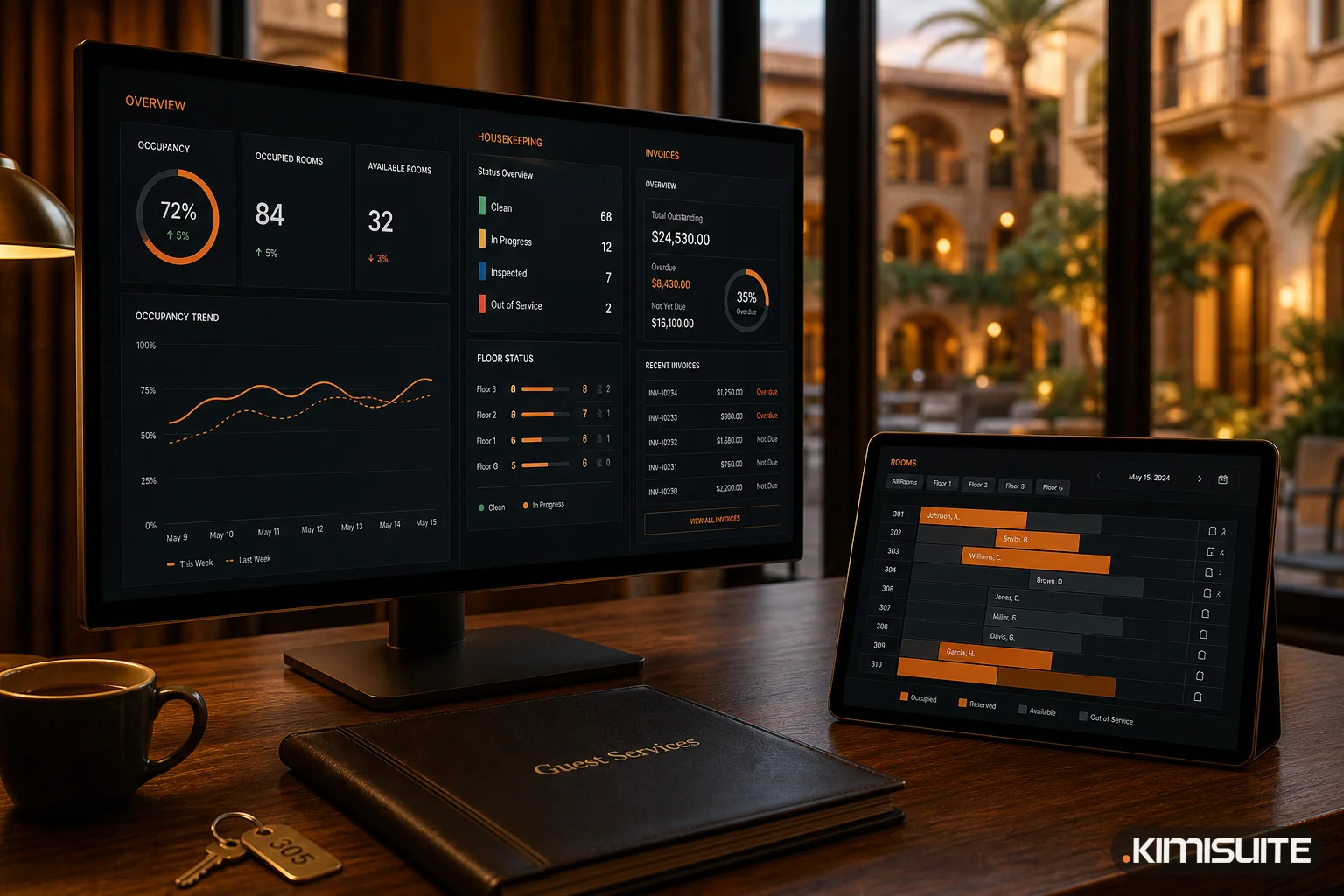
You can see it in what is in the product. Cleaning service organisation is in there — assigning housekeeping tasks, tracking room cleaning status, managing the daily service workflow. That is not a feature anyone puts on a comparison grid. It is in there because housekeeping is a real part of a real day and someone asked for it.
The same goes for the parts that are unglamorous but constant:
- Real-time availability sync across OTAs, because an overbooking costs more than a month of software
- Direct booking widgets — slider, listing and search — that embed into the website you already have
- Rate and pricing control with seasonal rates and restrictions
- Multi-property support from one account
- Guest profiles with booking history and communication
- Multiple payment providers for commission-free direct bookings
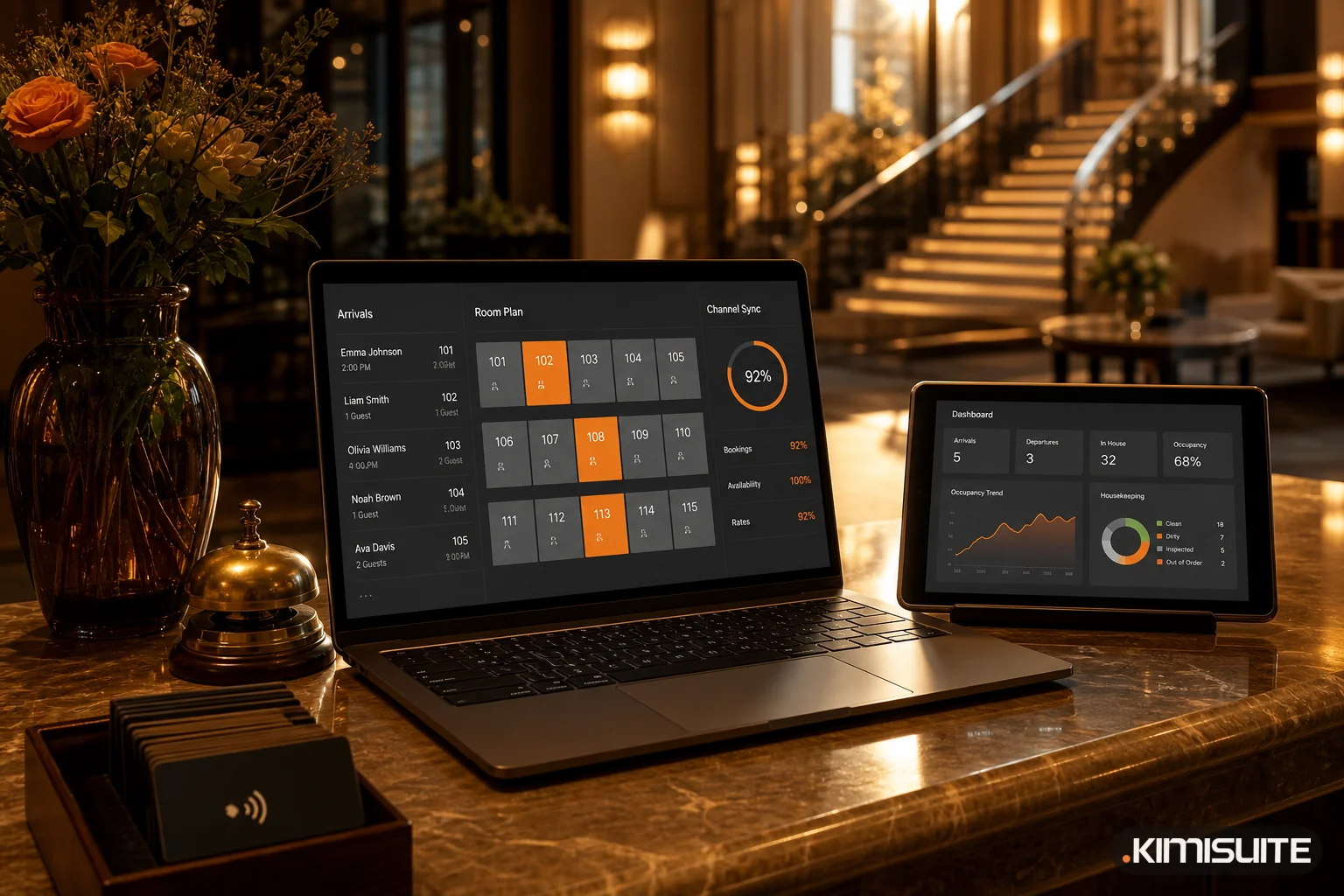
The channel manager and the booking engine are in the same system as the reservations, which is why availability does not have to be reconciled between two vendors who each blame the other.
What to do in the demo
Three things, and they take fifteen minutes:
1. Make them build your Tuesday. Ask them to configure two of your real room types and walk through an arrival, a room change and an extension. Watch how many clicks it takes and how many screens they visit.
2. Break something on purpose. Ask what happens if a guest cancels a booking that came from an OTA after you already assigned the room. Watch whether the answer is a workflow or an apology.
3. Ask what it does not do. Any honest answer here tells you more than the entire feature list. A vendor who cannot name a limitation has either not thought about it or is not going to tell you.
The decision is not really about software
The property that switches systems every two years is not unlucky. It keeps choosing on the wrong criteria: the demo that looked nicest, the price that looked lowest, the feature list that looked longest.
The properties that stay chose on a duller basis. Does it handle my actual Tuesday? Can I get my data out? Does the price still make sense at twice my size? Is somebody reachable when it breaks? And does it stop at the reservation, or does it follow the guest through the whole stay?
Answer those five honestly and the shortlist gets very short.
See how Booking Hub works — PMS, channel manager and commission-free direct booking in one system.