A late payment reminder is a message that tells a customer an invoice is due or overdue; the timing that works best is a short notice a few days before the due date, a first reminder within three days after it, and firmer follow-ups at fixed intervals up to a final notice at around day 30.
Most small businesses get the wording roughly right and the timing badly wrong. The first reminder goes out when someone finally notices, often weeks late, and by then the invoice has moved from "forgotten" to "difficult". At a 10% profit margin, one written-off invoice of €6,000 wipes out the profit of €60,000 in normal sales, as the numbers in what happens when an invoice goes unpaid show. The reminder schedule is where that loss is prevented.
A reminder schedule that works
The schedule below is for business customers on net 30 terms. Shift it for shorter or longer terms, but keep the rhythm.
| When | Stage | Tone | Channel |
|---|---|---|---|
| 3 to 5 days before the due date | Courtesy notice | Neutral, service-like | |
| 1 to 3 days after the due date | First reminder | Friendly, assumes an oversight | |
| 10 to 14 days after | Second reminder | Clear, asks for a payment date | E-mail and a phone call |
| 21 to 30 days after | Final notice | Firm, states consequences and a deadline | E-mail, and a letter if you want a paper trail |
| After the final deadline | Next step | Decided in advance | Collection agency, court order procedure or a payment plan |
Two principles behind the table:
- Early and regular beats late and angry. A reminder on day 2 reads as good administration. The same reminder on day 40 reads as a complaint.
- Every stage has a date. If the stages depend on someone's mood or workload, customers learn that your due date is a suggestion.
To work out the due date and the reminder dates for a specific invoice, the payment due date calculator gives you the due date from the invoice date and the terms; the rest of the schedule follows from it.
Why the first message goes out before the due date
The courtesy notice is the most effective message in the whole sequence, and the one most businesses skip. It catches the problems that would otherwise surface only after the due date:
- The invoice went to a general inbox that nobody reads.
- The customer's accounts team needs a purchase order number that is missing.
- The address, the tax number or the amount is wrong, and the invoice is sitting in someone's "to query" pile.
Each of these costs days to fix after the due date. Before it, they cost one reply.
What to say at each stage
Keep every message short. The customer needs four facts: invoice number, amount, due date, how to pay. Attach the invoice or link to it, every time, so nobody has to search.
Courtesy notice (before the due date)
Subject: Invoice INV-2026-0148 due on 2 October
Hello Ms Novak,
A quick note that invoice INV-2026-0148 for €2,450.00 is due on 2 October 2026. The invoice is attached again for convenience, with our bank details. If anything on it needs correcting, just reply to this e-mail.
Kind regards
First reminder (1 to 3 days after)
Subject: Reminder: invoice INV-2026-0148, due 2 October
Hello Ms Novak,
Our records show invoice INV-2026-0148 for €2,450.00, due on 2 October, as still open. If you have already paid, thank you, and please ignore this message. Otherwise, we would be grateful for payment in the next few days. The invoice is attached.
Second reminder (10 to 14 days after)
Subject: Second reminder: invoice INV-2026-0148, now 12 days overdue
Hello Ms Novak,
Invoice INV-2026-0148 for €2,450.00 was due on 2 October and is still unpaid. Could you let us know by Friday when we can expect payment? If there is a problem with the invoice or the work, please tell us, and we will sort it out quickly.
Follow the second reminder with a phone call. A call gets an answer the e-mail did not: a reason, a name and a date.
Final notice (21 to 30 days after)
Subject: Final notice: invoice INV-2026-0148
Hello Ms Novak,
Invoice INV-2026-0148 for €2,450.00 has been overdue since 2 October despite two reminders. Please pay the full amount by 30 October 2026. If payment has not arrived by then, we will [pass the claim to a collection agency / charge statutory interest and the fixed recovery fee / pause further work] as set out in our terms.
Name only the consequence you will actually carry out. A threat that never happens teaches the customer to wait for the next one.
Tone rules that hold at every stage
| Do | Don't |
|---|---|
| State facts: number, amount, date | Apologise for asking to be paid |
| Ask one clear question ("when can we expect payment?") | Write long explanations about your own cash flow |
| Offer to fix errors quickly | Accuse the customer of anything in the first two messages |
| Keep the same sender and the same subject line pattern | Switch between people and channels at random |
| Put the deadline as a date | Write "as soon as possible" |
Interest and fees in the final notice
For business customers in the EU, the Late Payment Directive (2011/7/EU) entitles you to statutory interest of at least the reference rate plus 8 percentage points, and a fixed €40 per late invoice for recovery costs, from the day after the agreed due date, without having to send a reminder first. National law can go further: in Germany the B2B rate is 9 percentage points above the base rate.
Whether you actually charge it is a business decision. Many companies mention it only in the final notice, as the reason the deadline is serious. Consumers are protected differently in every country: before you add interest or fees to a private customer's reminder, check what your national law allows.
The mistakes that damage the relationship
- Reminding a customer who has already paid. The most common and the most irritating error. Check the bank before each reminder goes out, or better, match payments to invoices before the reminder run.
- Reminding a customer in the middle of a dispute. If the work is being discussed, pause the reminders for that invoice until it is settled.
- Reminding in the wrong language. A reminder in the language of the customer's documents gets read and forwarded. One in the wrong language gets set aside.
- No reminder at all for "good" customers. Reliable customers are usually the ones who appreciate the courtesy notice most, because it saves their accounts team a query.
Letting the schedule run itself
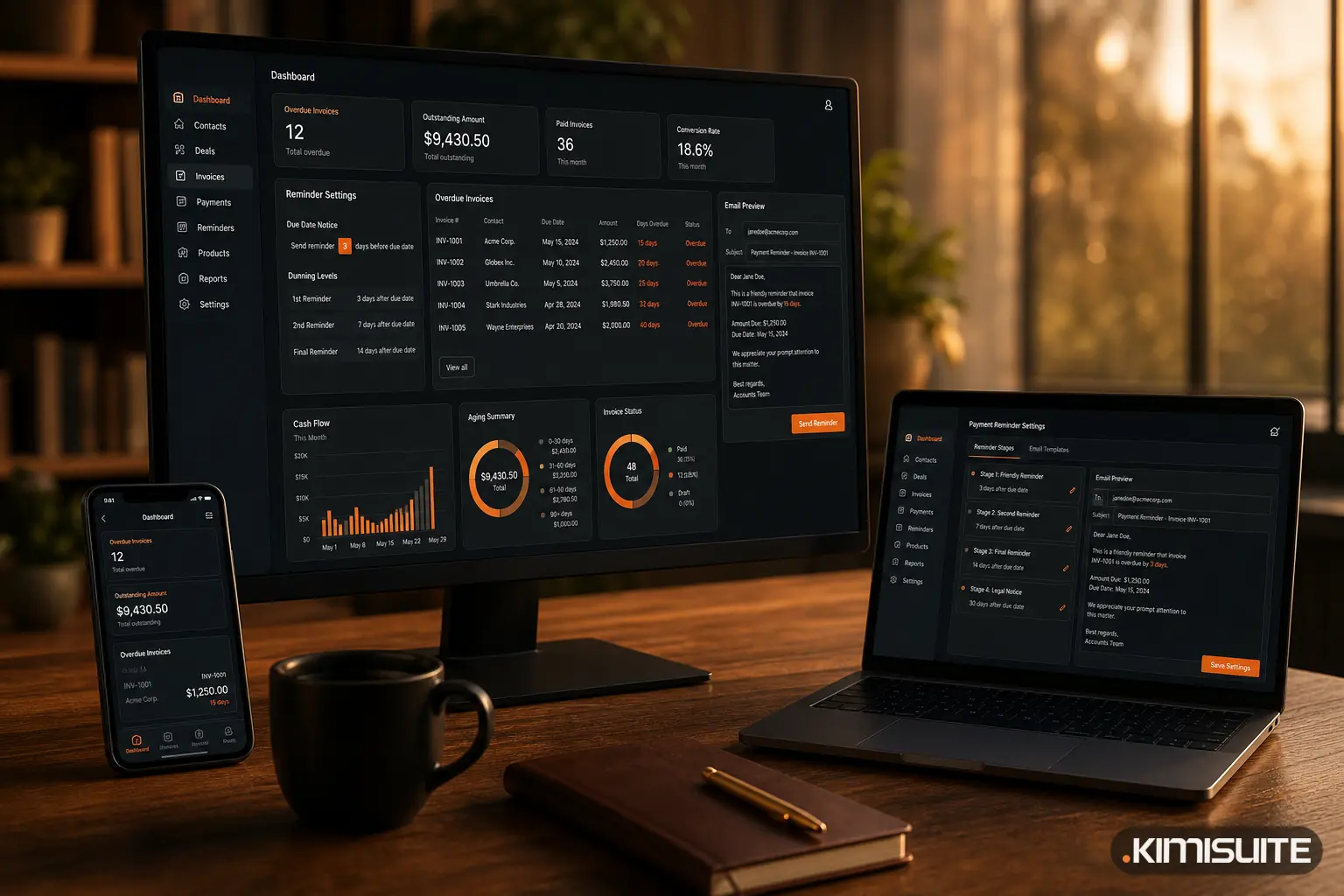
The schedule only works if it runs every time, not only in the weeks someone has time for it. In CRM Business Hub, you set it up once: a due-date notice before the due date, then either a simple overdue reminder with its own interval and repetition, or dunning levels with fees. Reminders run automatically or on your click, and you can pause them for a single invoice when there is a dispute or a payment plan. The e-mail templates exist per language, so each customer gets the reminder in the language of their documents.
To avoid reminding customers who have already paid, you can import your bank statement as a CSV. CRM Business Hub suggests which payment belongs to which invoice, matches the sure ones automatically above a confidence level you set, and the invoice turns partially paid or paid before the next reminder is due.
CRM Business Hub runs inside your KIMISUITE workspace, billed per workspace rather than per user. Cancel anytime · No minimum term · 14 days free.