An unpaid invoice costs more than its face value: it ties up cash you have already earned, it costs hours of your team's time to chase, and if it is never paid, it has to be replaced by many times its amount in new sales.
The payment due date calculator gives you one date per invoice. This post is about the day after that date, when the money has not arrived, and about putting a number on what that really costs.
One invoice, followed from due date to write-off
Take a realistic example: a small agency invoices a business customer €6,000 on net 30 terms. The due date passes. Here is what usually happens next, and what it means.
| Day after due date | What typically happens | What it means for you |
|---|---|---|
| 1 | The invoice is late. In B2B trade in the EU, statutory interest and a €40 recovery fee can be claimed from this day, without a reminder | Legally you are owed more. In practice, nobody has noticed yet |
| 3 to 7 | A friendly reminder goes out, if someone remembers | The first cost: someone checks the bank account and writes an e-mail |
| 14 to 21 | Second reminder, often a phone call | The customer mentions a missing purchase order number, or a wrong address on the invoice |
| 30 | Final notice with a firm deadline, interest and fees stated | The relationship gets tense; work for this customer is often paused |
| 45 to 60 | Collection agency or a court order procedure | External costs, and a customer you have most likely lost |
| 90 and later | The debt is written off | The full amount becomes a loss |
Most invoices never get past the second row. That is exactly the point: the cost of late payment is decided in the first two weeks after the due date, not at the collection agency.
Cost 1: the money you are financing
Until the customer pays, you are lending them €6,000, interest-free. If that gap is covered by your overdraft at 9% a year, 45 days of lateness cost €66.58:
€6,000 × 9% × 45 / 365 = €66.58
On one invoice that looks harmless. Across a whole business it is not. Finance teams measure it as days sales outstanding (DSO): how many days of revenue are sitting in unpaid invoices on average.
For a business with €720,000 annual revenue, one day of revenue is about €1,973. So:
| Customers pay on average... | Cash tied up in receivables |
|---|---|
| 10 days later than agreed | about €19,700 |
| 30 days later than agreed | about €59,200 |
| 45 days later than agreed | about €88,800 |
That is money you cannot spend on salaries, suppliers or stock, and which you may be paying interest on in the meantime. Getting paid ten days sooner frees the same cash as a small bank loan, without the loan.
Cost 2: the time spent chasing
Every late invoice creates work that nobody planned for: checking the bank statement, finding the invoice, writing the reminder, calling the customer's accounts team, re-sending a corrected copy, noting who promised what.
Assume three hours across the life of one late invoice, at an internal cost of €40 an hour. That is €120 per late invoice, before anyone has done any billable work. With ten late invoices a month, you are paying for a part-time role whose only job is asking for money you are already owed.
The less visible cost is the work that was not done in those hours, and the owner's attention, which tends to go to the one customer who has not paid instead of the ten who might buy.
Cost 3: the invoice that is never paid
If the €6,000 is written off, the loss is not €6,000 of revenue. It is €6,000 of profit, because you already paid for the work, the materials and the time. To earn that profit back, you have to sell far more than €6,000.
Sales needed to replace a bad debt = bad debt / net profit margin
| Your net profit margin | New sales needed to replace €6,000 |
|---|---|
| 5% | €120,000 |
| 10% | €60,000 |
| 15% | €40,000 |
| 20% | €30,000 |
| 30% | €20,000 |
At a 10% margin, one unpaid €6,000 invoice undoes the profit of €60,000 of normal business. That is the number worth remembering when you decide how early to send the first reminder.
In many countries you can correct the VAT you already paid on an invoice that is definitely uncollectable. The conditions differ from country to country, so check them with your accountant before you write anything off.
The full bill for the example
| Cost item | 45 days late, then paid | Never paid |
|---|---|---|
| Financing at 9% | €66.58 | €66.58 and ongoing |
| Staff time | €120 | €200 or more |
| External collection | none | fees vary, often a share of the amount |
| Lost profit | none | €6,000 |
| Sales needed to recover it at 10% margin | none | €60,000 |
What you can claim back
For business customers in the EU, the Late Payment Directive (2011/7/EU) gives you two things the moment an agreed due date passes, without having to send a reminder first:
- Statutory interest of at least the reference rate plus 8 percentage points a year. Germany sets it at 9 points above its base rate for B2B.
- A fixed €40 compensation for recovery costs, plus reasonable costs above that.
As an illustration only: if the reference rate were 2%, the EU minimum would be 10% a year, and 45 days on €6,000 would come to about €73.97 interest plus €40. That roughly covers the financing cost. It does not cover the staff time, and it does nothing for a written-off debt.
Most small businesses never claim it, because they want to keep the customer. That is a legitimate choice. Stating the interest and the €40 in your terms and conditions still helps: it shows the customer that your due date is meant as a date, and it gives you something to point to in a final notice if it ever comes to that.
Consumers are treated differently in every country. Do not apply B2B interest rates or the €40 to private customers without checking your national rules.
Why invoices actually go unpaid
Few late invoices are bad faith. Most fall into a handful of ordinary categories, and each has a different fix.
| Reason | How common | Fix |
|---|---|---|
| The invoice went to the wrong person or inbox | very | Ask for the accounts payable address when you take the order |
| Missing purchase order number or reference | very, with larger customers | Ask for it before you invoice, not after |
| An error on the invoice (amount, address, tax number) | common | Correct data in the customer record, one source for every invoice |
| The customer pays in monthly runs and just missed one | common | Align your terms with their run, or invoice earlier |
| A dispute about the work | occasional | Clarify within days, credit the disputed part, get the rest paid |
| Genuine cash trouble | occasional | Agree a payment plan early, stop extending credit |
Four of those six are solved before the invoice is even sent. The rest is solved by noticing quickly.
What actually reduces the cost
- Agree clear terms and put the due date on the invoice as a date. "Net 30" leaves room for interpretation; "due 2 October 2026" does not. How the common terms work, including what an early-payment discount really costs you, is explained in payment terms explained.
- Send a short note before the due date. It catches the wrong inbox and the missing PO number while there is still time.
- Follow up the day after, not the month after. Every row in the timeline above gets more expensive than the one before it.
- Ask for a deposit on large jobs and from new customers.
- Keep one list of what is open. Not in someone's head, not in a spreadsheet updated on Fridays.
Seeing what is open, every day
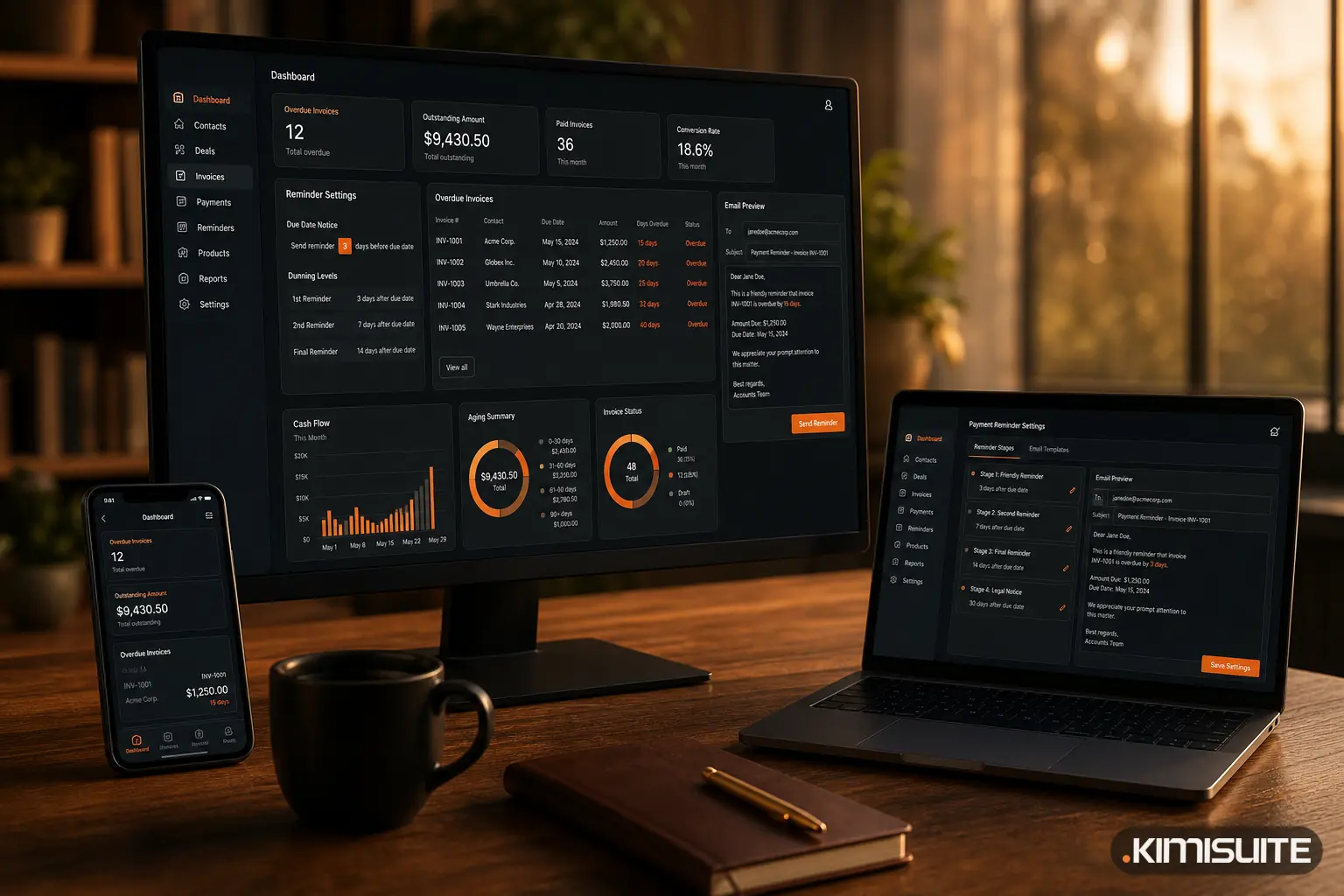
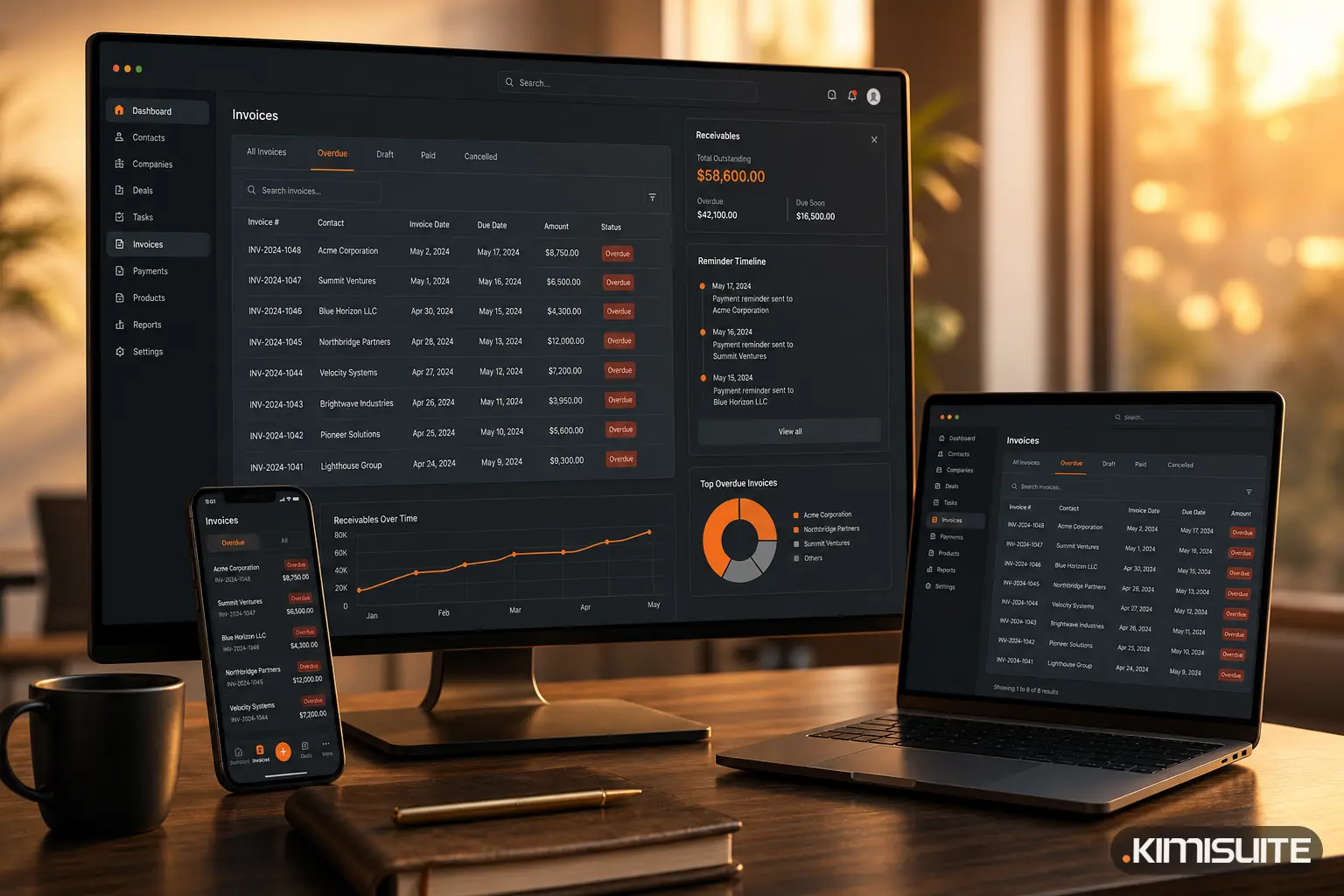
The last point is the one most small businesses struggle with, because the invoices live in one place, the bank statement in another and the reminders in someone's calendar. In CRM Business Hub, each invoice shows whether it is unpaid, partially paid, paid or overdue, partial payments are recorded against it, and payment reminders can go out automatically, so an overdue invoice is noticed on day one rather than day thirty. It runs inside your KIMISUITE workspace, billed per workspace rather than per user. Cancel anytime · No minimum term · 14 days free.