Revenue leakage is money a business has earned through work already done but never invoices, invoices too low or collects too late, and in small businesses most of it disappears between the quote and the invoice.
It rarely looks like a problem. Nobody steals anything and no single mistake is large. A forgotten extra hour here, an old price there, an invoice that goes out two weeks after the job. Added up over a year, it is often more than the business would ever accept losing in one go.
The path every sale takes
Whatever you sell, the path is roughly the same:
- Quote: you tell the customer what it will cost.
- Acceptance or order: the customer says yes, in writing, by phone or by e-mail.
- Delivery: you do the work or ship the goods.
- Invoice: you bill what was delivered.
- Payment: the money arrives and is matched to the invoice.
Every hand-over between these steps is a place where information can drop out. The more of them happen on paper, in someone's head or by retyping from one document into another, the more drops out.
Seven places the money gets lost
| # | Leak | How it happens | What you notice |
|---|---|---|---|
| 1 | Expired quotes | A quote from March is accepted in August, at March prices | Margin on the job is lower than planned, nobody knows why |
| 2 | Unbilled extra work | "While we were there" changes, done but never written down | The job took longer than quoted, the invoice matches the quote |
| 3 | Retyping errors | Lines copied from the quote into the invoice by hand | A missing line, a wrong quantity, an old tax rate |
| 4 | Undocumented discounts | Prices lowered in conversation or silently in the document | Discounts nobody can total at the end of the year |
| 5 | Late invoicing | The invoice goes out when someone finds time | Payment terms start weeks after the work was finished |
| 6 | No follow-up | The invoice is sent and forgotten until someone checks the bank | Overdue invoices discovered months later |
| 7 | Unmatched payments | Partial payments or a transfer without a reference | Invoices shown as open that were paid, or the reverse |
Some of these cost margin (1, 2, 3, 4). Others cost cash and time (5, 6, 7). Both matter, but they need different fixes.
What it adds up to: a worked example
Take a small installation business with 40 jobs a month at an average of €2,500, so about €100,000 a month and €1.2 million a year. The assumptions below are deliberately modest.
| Leak | Assumption | Per month | Per year |
|---|---|---|---|
| Unbilled extra work | 4 jobs a month with €150 of extras not invoiced | €600 | €7,200 |
| Undocumented discounts | 5 jobs a month rounded down by 5% | €625 | €7,500 |
| Expired quotes | 3 jobs a month at prices 4% below the current list | €300 | €3,600 |
| Retyping errors | Roughly one invoice a month €200 too low | €200 | €2,400 |
| Total margin lost | €1,725 | €20,700 |
That is about 1.7% of revenue. It sounds small until you compare it with profit: for a business with a 10% net margin, it is a sixth of the year's profit.
Late invoicing is not in the table, because it does not reduce the amount, only when it arrives. But it is not free either. If invoices go out on average 12 days after the job, then at €100,000 a month roughly €40,000 is permanently sitting in finished work that has not been billed yet. That is money the business pre-finances out of its own account, or its credit line.
Leak by leak: what fixes it
Expired quotes
A quote without an end date is a price promise without an end date. Put a validity date on every quote, typically 14 to 30 days, and decide in advance what happens after it: either the quote is reissued at current prices, or someone consciously decides to honour the old one. What should not happen is that an old PDF is accepted and nobody checks the date.
Unbilled extra work
The fix is a habit, not software: anything outside the quote is written down before it is done, even as a one-line note with a price, and the customer confirms it. That turns "while we were there" into a change order. At invoicing time, the invoice is built from the quote plus the change orders, not from the quote alone.
A useful weekly check: compare the hours actually spent on each job with the hours in the quote. A job that took 30% longer than quoted either had unbilled extras or was quoted too low. Both are worth knowing.
Retyping errors
Every time a line is typed a second time, it can be typed differently. The reliable fix is to not retype at all: the accepted quote becomes the invoice, with the same lines, quantities, prices and tax rates, and only the differences are edited. This is the single biggest improvement for businesses still working with a word processor or spreadsheet.
Undocumented discounts
If a price is lowered, it should appear as a discount line, not as a changed unit price. Then the discount is visible to the customer (who should see what they were given) and to you at the end of the month. The numbers are often surprising. A separate article covers how much a discount really costs.
Late invoicing
Invoice on the day the work is finished, or at a fixed rhythm for ongoing work: every Friday, or on the first of the month. Your payment term only starts when the customer has the invoice, so a two-week delay in invoicing is a two-week delay in payment, on top of whatever term you agreed. How those terms work, from Net 30 to early-payment discounts, is explained in Payment Terms Explained: Net 30, Net 60 and 2/10 Net 30.
For work that repeats every month at the same price, such as maintenance contracts or support packages, a recurring invoice removes the step entirely.
No follow-up
An invoice nobody checks on is the most expensive leak of all, because it can turn into a complete loss. Decide in advance when a reminder goes out, and make it routine instead of personal. What an unpaid invoice actually costs the longer it stays open is worked through in What Happens When an Invoice Goes Unpaid.
Unmatched payments
Ask customers to use the invoice number as the payment reference, and put it prominently on the invoice. Record partial payments against the invoice immediately, so the open amount is always correct. Match the bank account against open invoices at least once a week.
A weekly ten-minute check
Most of the leaks above can be caught with one short routine:
| Question | Catches |
|---|---|
| Which jobs were finished this week but are not invoiced yet? | Late invoicing |
| Did any job take noticeably longer than quoted? | Unbilled extras, underquoting |
| Which accepted quotes are older than their validity date? | Expired prices |
| What discounts were given this week, and on which jobs? | Discount creep |
| Which invoices are past due and have not had a reminder? | Missing follow-up |
| Which payments arrived without a matching invoice? | Unmatched payments |
If answering any of these questions takes more than a minute, that is itself the finding: the information lives in too many places.
One record from quote to payment
The common cause behind most of these leaks is that the quote, the invoice and the payment live in different places: a document on a laptop, an invoice in a separate tool, the payment in the bank account. Every hand-over between them is manual.
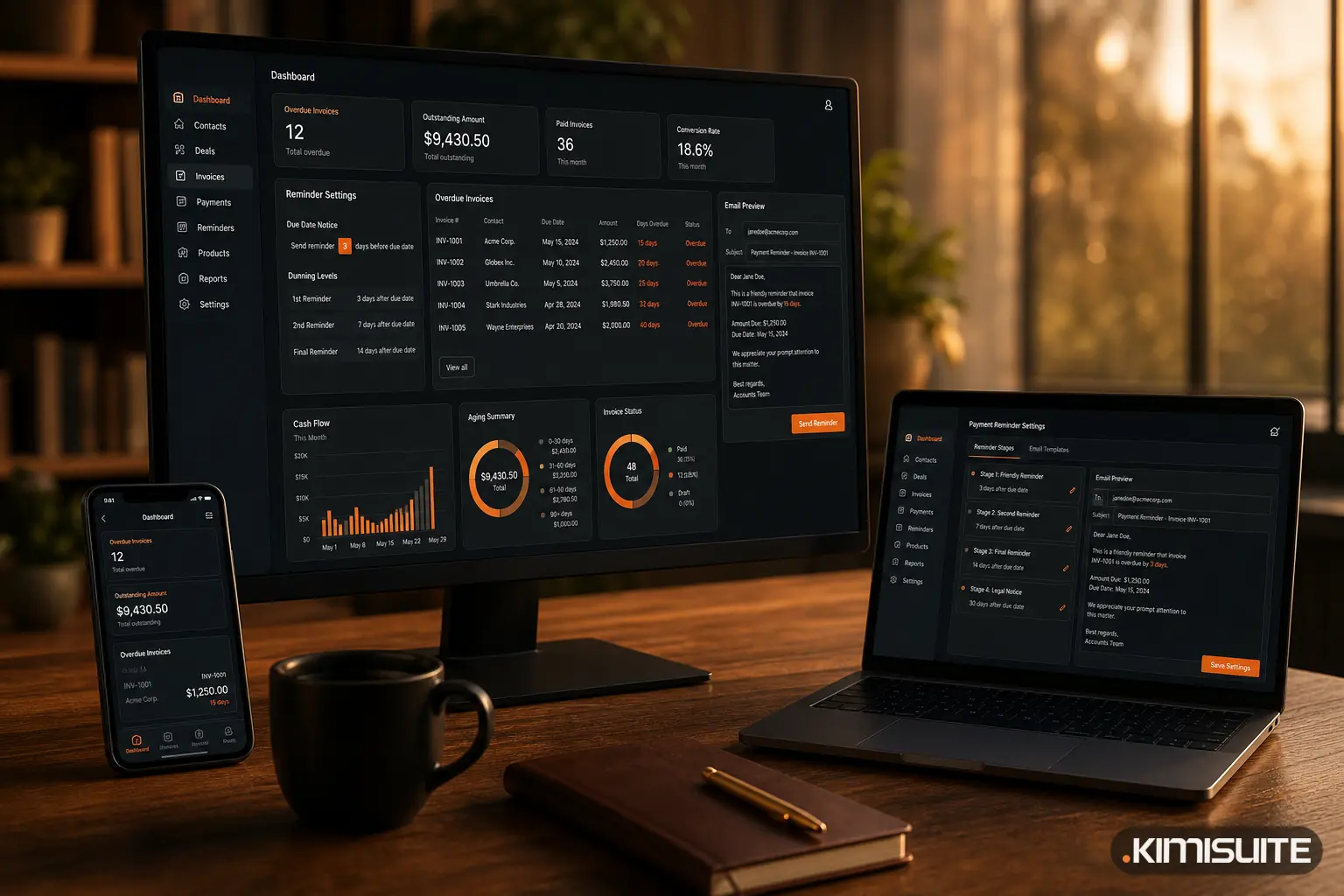
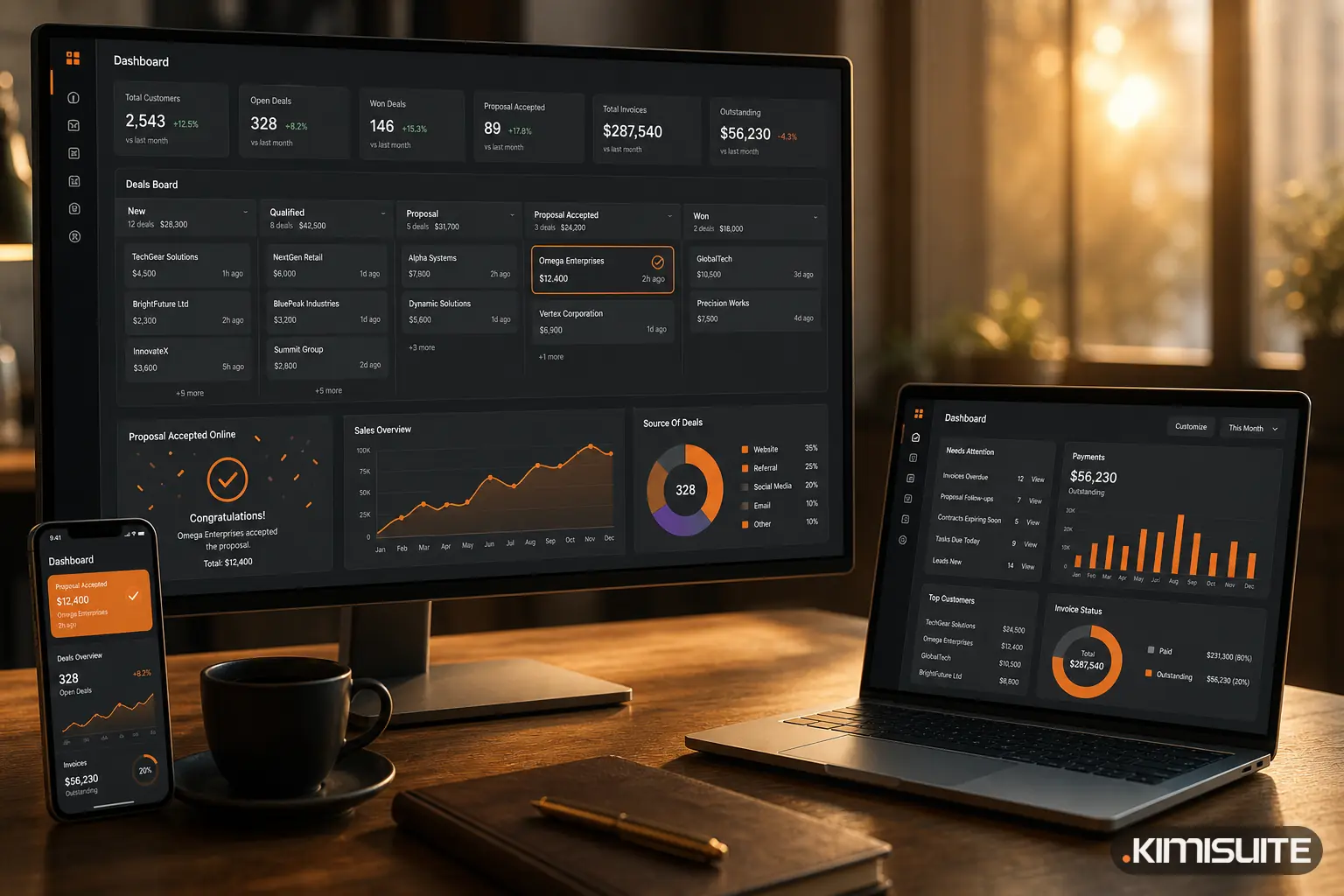
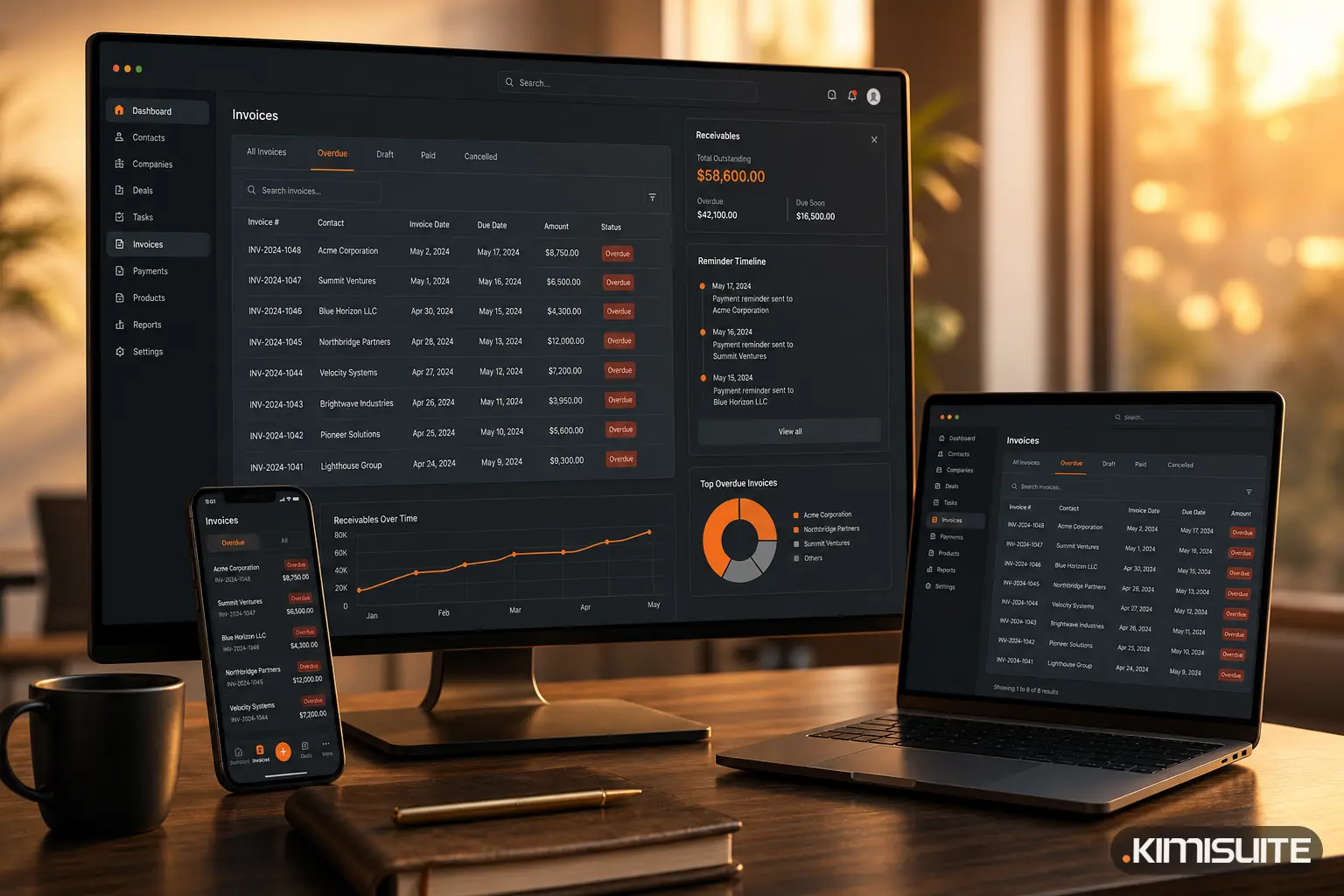
In CRM Business Hub, quotes and invoices sit on the same customer record in your KIMISUITE workspace. An accepted quote is turned into an invoice instead of being retyped, quotes carry a validity date, discounts are shown as discounts, and open invoices stay visible until they are paid. It does not remove the need for the weekly check, but it makes the check take ten minutes instead of an afternoon.
Find your own biggest leak first. For most small businesses it is either unbilled extras or late invoicing, and both can be fixed within a month. CRM Business Hub is billed per workspace, not per user. Cancel anytime · No minimum term · 14 days free.