Labour cost percentage is your total staff cost for a period divided by your revenue for the same period. It is the number that tells you whether your rota fits your sales. This article explains how to calculate it properly, what published benchmarks actually say, and how to bring it down without making guests wait longer.
The formula, done properly
Labour cost % = (gross wages + employer-side costs) / revenue x 100
Two details decide whether the number means anything:
- Employer-side costs belong in it. Pension contributions, social security and payroll taxes you pay on top of gross wages are real labour cost. Leave them out and your percentage looks better than your bank account.
- Wages and revenue must cover the same period. A month of wages against a month of sales, a week against a week.
Also decide once what counts as labour and stick to it: salaried managers and kitchen staff included, every week, the same way. If you work in the business yourself without a wage, your percentage will look lower than the real cost of running the place.
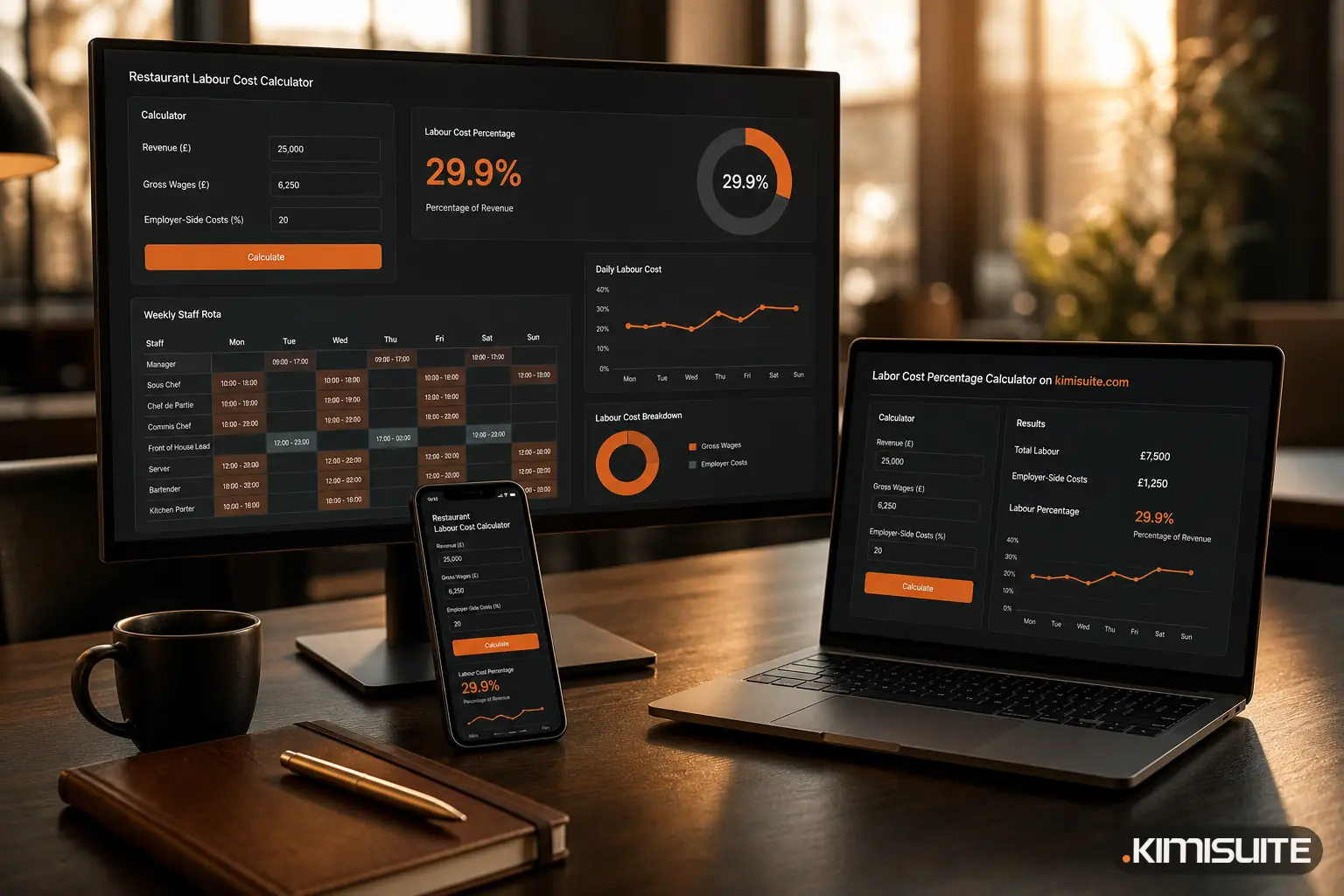
You can run the formula with the free Labor Cost Percentage Calculator. You enter revenue, gross wages and your employer-side percentage, and it shows the total labour cost, the employer-side amount and the labour percentage.
What is a healthy labour cost percentage?
There is no single correct number. It depends on your service style, your country's wage and contribution levels, and how much of the work is cooking from scratch versus assembling.
A benchmark with a named source and method comes from the US. The National Restaurant Association's Restaurant Operations Data Abstract, 2025 edition, surveyed more than 900 US operators about 2024. Salaries and wages, including benefits, came to these medians:
| US, 2024 data | Median labour cost as % of sales |
|---|---|
| Full-service, all respondents | 36.5% |
| Full-service with a pre-tax profit | 34.2% |
| Full-service with a loss | 42.9% |
| Limited-service, all respondents | 31.7% |
| Limited-service with a pre-tax profit | 30.0% |
| Limited-service with a loss | 34.1% |
Source: National Restaurant Association, "Elevated labor costs had a significant impact on restaurant profitability in 2024", 8 October 2025.
The useful part is the gap. Full-service operators who made a profit ran about 2 points lower than the median, and those with a loss ran more than 6 points higher. In a business with thin margins, a few points of labour is often the difference.
Outside the US, wage levels and employer contributions differ a lot, so treat these figures as a reference point, not a target. The best benchmark is your own number, tracked weekly, and compared with the same week last year.
The calculator rates your result against fixed bands: below 25% excellent, 25 to 30% healthy, 30 to 35% watch list, 35% and above outside the safe range. These bands are a demanding target. The median for profitable US full-service restaurants above, 34.2%, falls in the watch-list band, so read the rating as a nudge, not a verdict.
A worked example
A restaurant has one month with:
- revenue: 60,000 EUR
- gross wages: 16,000 EUR
- employer-side costs: 20% of wages (an example figure; use your own from your last payroll)
The calculator shows employer-side costs of 3,200 EUR, total labour of 19,200 EUR and a labour cost of 32.0%.
Now two changes, neither of which touches service at the busy hours:
- Remove 30 hours of slack. The rota had two people on from 15:00 to 17:00 on quiet weekdays where one was enough. At an example rate of 14 EUR per hour, that is 420 EUR less in wages. Total labour falls to 18,696 EUR and the percentage to 31.2%.
- Fill a quiet evening. A Tuesday offer brings 2,500 EUR more revenue a month with the same team on shift. With the original wages, labour becomes 30.7%.
Both together give 29.9%. Nobody's pay was cut, and the Friday and Saturday team stayed exactly as it was.
How to bring labour cost down without cutting service
1. Schedule against covers, not habit
Look at covers or sales by hour for the last four to eight weeks, from your POS or your reservation list. It is tempting to copy last month's rota. Staggered start times, for example one server at 17:00 and the second at 18:30, often save hours without anyone feeling short-handed at the peak.
2. Protect the peak, trim the shoulders
The hours that cost you are rarely the full ones. They are the slow hour after lunch, the early evening before the first tables, and the long close. Move prep, stock counts and deep cleaning into those hours so the people on shift are productive, or end some shifts earlier.
3. Cross-train
A server who can run the bar, or a cook who can cover two stations, lets you staff for the real number of guests instead of the worst case at each station.
4. Cut the time that is not service
Phone calls for bookings, rewriting the menu board, retyping price changes on the printed menu and the website: this is paid time that guests never see. Reservations that arrive as requests in one list, and a menu that you change in one place, give that time back to the floor.
5. Lift revenue on the same shifts
Labour cost is a ratio. Filling quiet services with the team you already pay lowers it just as surely as cutting hours. Before you spend money on a campaign, check whether it pays off with the Restaurant Marketing ROI Calculator, which counts repeat visits as well as the first one.
6. Look at prime cost, too
Prime cost is food cost plus labour cost, and the two move together. A menu that needs heavy prep may have a low food cost and a high labour cost. Check the plates with the Food Cost Calculator before you decide which dish to push.
7. Check the number every week
Labour creep is gradual: one extra shift here, an overtime hour there. A weekly check catches a 1-point drift before it becomes a quarter.
What not to do: cut hourly pay or run short at the peak. Both save money for a few weeks and cost you staff, reviews and repeat guests afterwards.
Where KIMISUITE helps
Restaurant Hub takes over some of that non-service time. You enter each dish once, and the same data feeds the QR menu, the printed menu as a PDF and the menu widget on your website, so a price change is one change instead of three. Guests can request a table through a booking widget on your website. The request lands in one reservation list, where you approve or decline it with a click, see the evening on a table plan, and can get a Telegram message for each new reservation. More on table reservations and on why a menu you enter once saves work.
For shift planning and time tracking, KIMISUITE is building HRM Hub, with shift templates, a shift schedule and clock-in punches. It is currently listed as coming soon.
FAQ
Should tips be included in labour cost?
If tips pass straight from guests to staff, keep them out of both revenue and labour. If tips or a service charge run through your payroll, ask your accountant how they are treated in your country. Whatever you choose, do it the same way every week.
Is a lower labour cost percentage always better?
No. A very low number can mean guests wait, staff burn out and leave, or you are doing unpaid shifts yourself. Aim for a stable number that fits your service style and still leaves a profit.
What employer-side percentage should I enter?
The one from your own payroll: employer pension, social security and payroll taxes as a share of gross wages. It varies by country and by contract, so take it from your last payslip run or ask your accountant.