Peppol is an international network and set of standards for exchanging business documents such as invoices electronically, in which every participant connects once through a certified service provider and can then reach every other participant.
The name originally stood for "Pan-European Public Procurement On-Line", a project co-funded by the European Commission that started in 2008. Since 2012 the network has been managed by OpenPeppol, a non-profit international association under Belgian law based in Brussels. Today Peppol is used well beyond Europe and well beyond public procurement.
How Peppol works: the four-corner model
Before Peppol, electronic invoicing networks were mostly closed. Buyer and supplier had to use the same provider, so a supplier with many customers often ended up on many portals. Peppol replaced that with the four-corner model:
| Corner | Who | Role |
|---|---|---|
| 1 | Sender (supplier) | Creates the invoice in its own software |
| 2 | Sender's access point | A Peppol-certified service provider that sends the document into the network |
| 3 | Receiver's access point | The receiver's certified service provider, which accepts the document |
| 4 | Receiver (customer) | Receives the invoice in its own software |
OpenPeppol describes the principle as "connect once, reach all": each sender connects to one service provider and can reach every receiver, and vice versa. It works like phone networks, where you can call someone on a different network without switching to it.
Three more building blocks make this work:
- Peppol ID. Every participant has an identifier, often based on a national company or VAT number, with a scheme code in front of it.
- SML and SMP. A central register, the Service Metadata Locator, points to the Service Metadata Publisher where each participant's details are stored: which access point receives for them and which document types they accept. Sending software looks this up automatically, much as a browser finds a website by its domain name.
- Security. Messages between access points travel over a public key infrastructure, so sender and receiver can trust that a document is genuine and unchanged.
What Peppol sends: Peppol BIS Billing 3.0
A network alone is not enough; both sides also need to understand the content. For invoices and credit notes, Peppol uses Peppol BIS Billing 3.0. According to the Peppol specification, it is a core invoice usage specification (CIUS) of the European standard EN 16931, and documents that comply with it also comply with EN 16931.
EN 16931 in turn comes from Directive 2014/55/EU, which requires public contracting authorities in the EU to receive and process electronic invoices that comply with the standard. Central governments had to do so from 18 April 2019, while member states could give sub-central authorities until 18 April 2020. That is why public-sector invoicing was the first large use of Peppol.
Who governs it
OpenPeppol sets the rules and certifies service providers. In individual countries it can delegate this role to a Peppol Authority, usually a government body, which oversees the network in its jurisdiction and can add national rules. That is how one international network can take into account local requirements.
Where Peppol is required
Peppol is voluntary in many countries and mandatory in some. One example: in Belgium, structured electronic invoices between Belgian VAT-registered companies have been mandatory since 1 January 2026, and according to the Belgian tax authority they are sent via the Peppol network, with Peppol BIS as the reference format.
Other countries take different routes. Some run central state platforms through which every invoice passes, others accept any structured format sent by email. Germany, for example, allows free choice of transmission channel for its B2B e-invoicing, which we explain in E-Invoicing in Germany: What Applies in 2025, 2027 and 2028.
What Peppol is not
- Not a tax authority system. Peppol transports documents between businesses. In countries with state clearing, invoices must also be reported to or approved by the authority, and Peppol alone does not do that.
- Not a format you choose instead of the law. Whether an invoice sent over Peppol meets your obligations depends on your country's rules.
- Not email. A PDF attached to an email is not a Peppol document, even if the PDF looks the same.
- Not only for large companies. Through a service provider or invoicing software, a business with 20 customers can use it as well as one with 20,000.
A worked example
A consultancy invoices 30 business customers a month. Five of them are large companies that each require invoices through their own supplier portal. Every month someone logs into five portals, retypes or uploads each invoice, and checks whether it was accepted: about 15 minutes per invoice, so a little over an hour a month, and more when a portal changes its rules.
If those five customers can receive via Peppol, the consultancy sends the invoice from its own software to their Peppol IDs. The software shows whether each invoice was delivered. The portal work disappears, and the remaining 25 customers can be added one by one as they register for Peppol.
Peppol in KIMISUITE
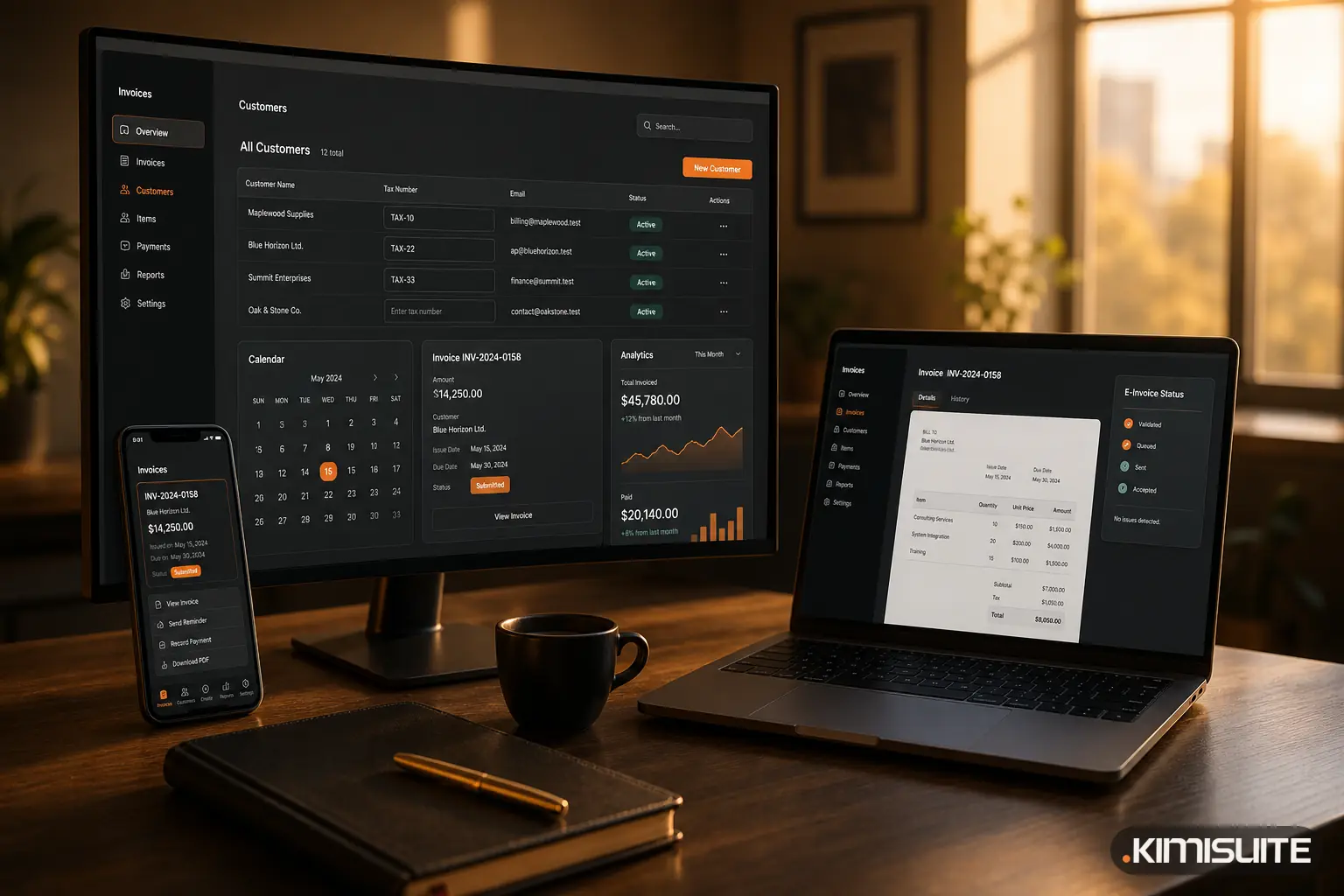
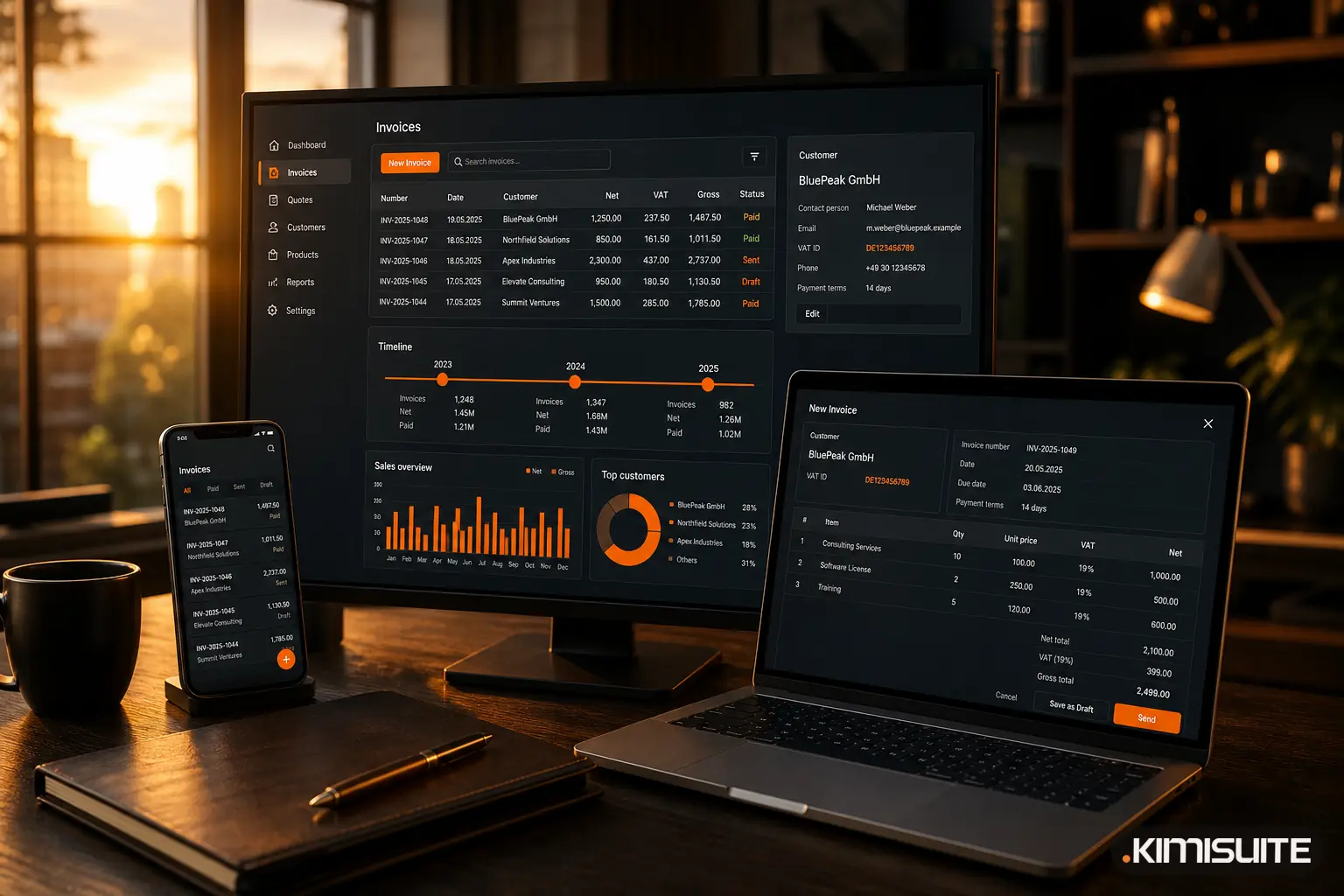
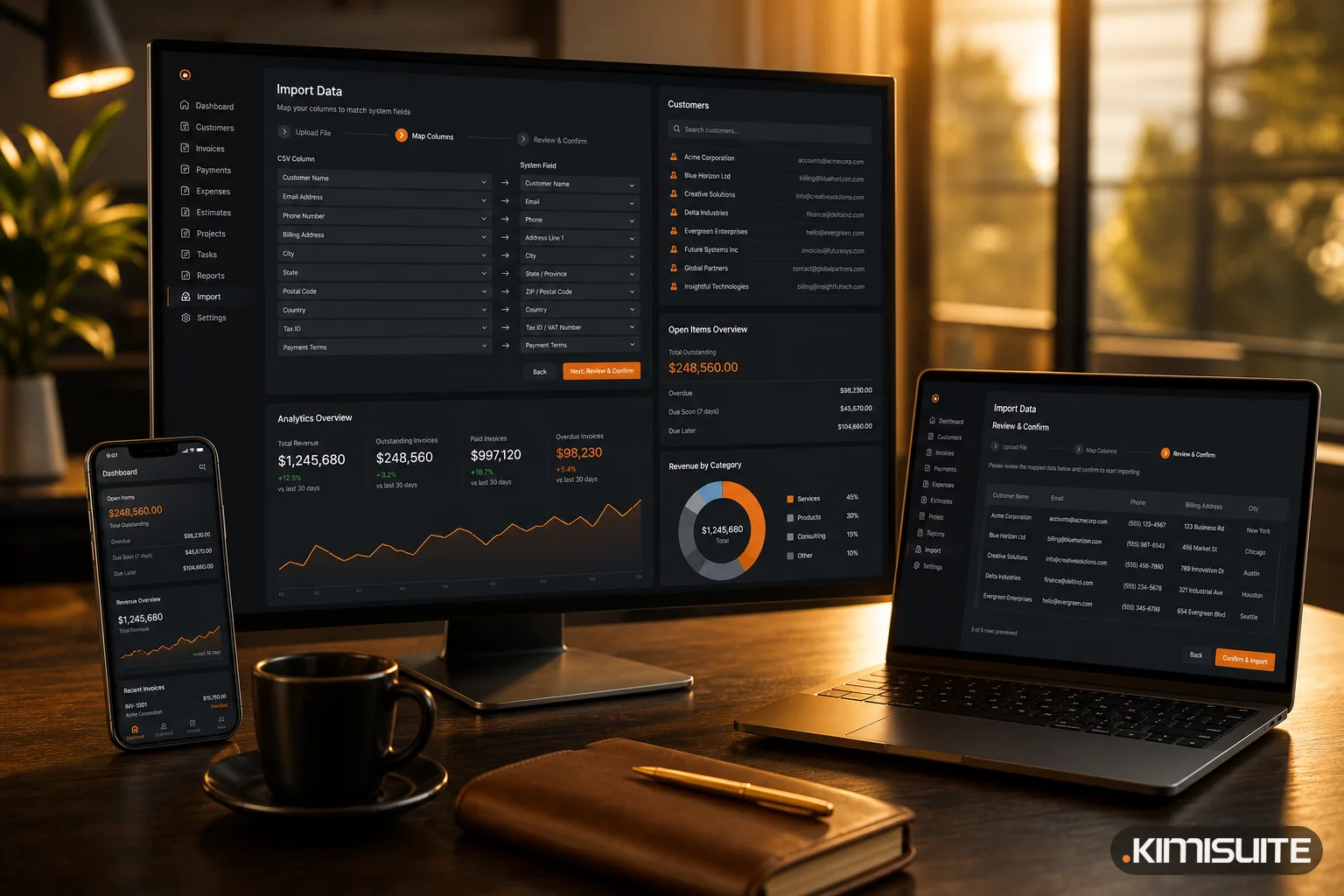
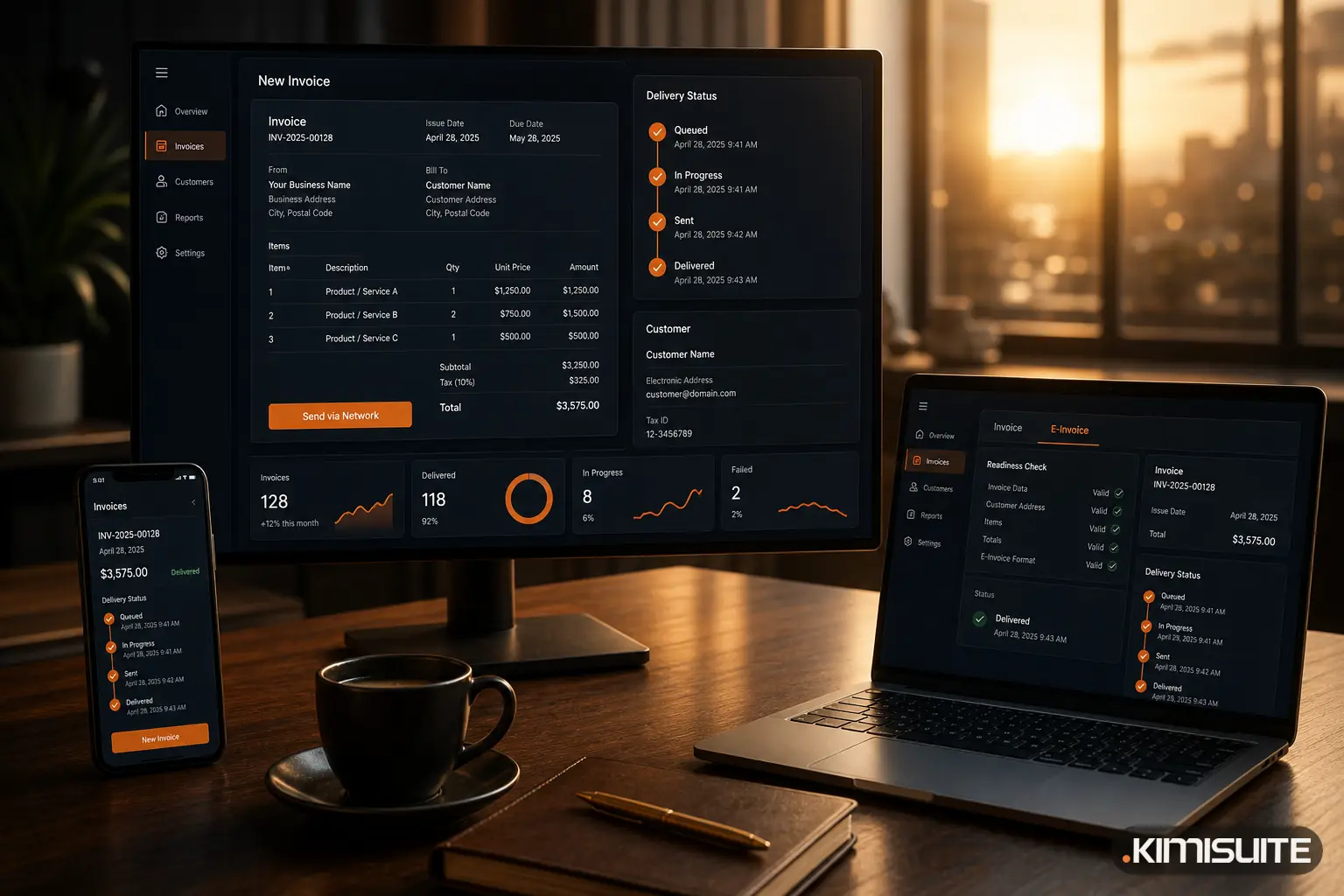
CRM Business Hub can send invoices and credit notes via the Peppol network in Peppol BIS Billing 3.0. You connect your workspace once with your country, electronic address and VAT ID, check a customer's Peppol ID on the customer record, and send from the invoice. The invoice then shows its status: queued, sending, delivered or failed. The number of Peppol documents per month depends on your plan.
What that means for your obligations depends on where you and your customers are based, so check the rules in your country before relying on any single channel.
Cancel anytime · No minimum term · 14 days free