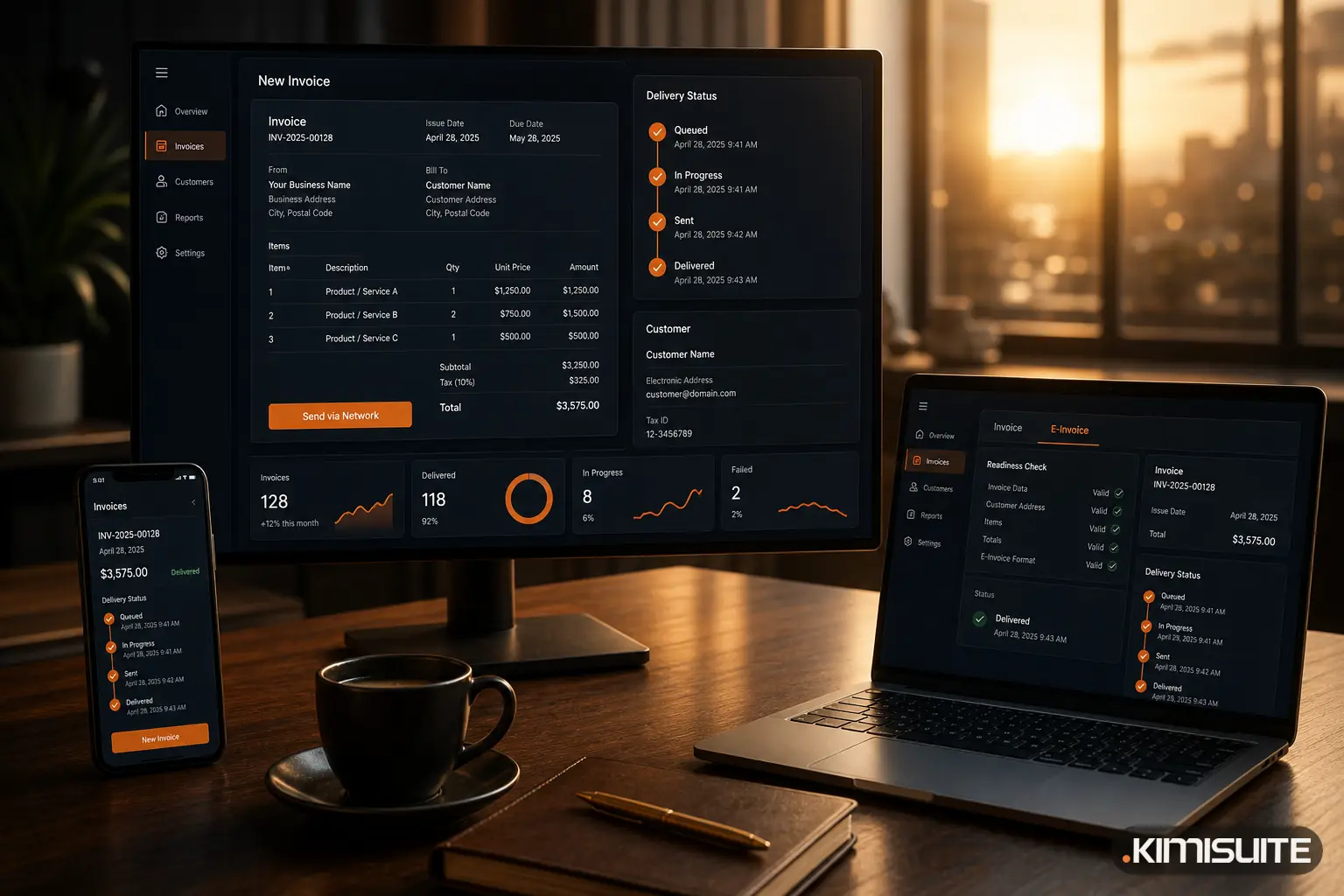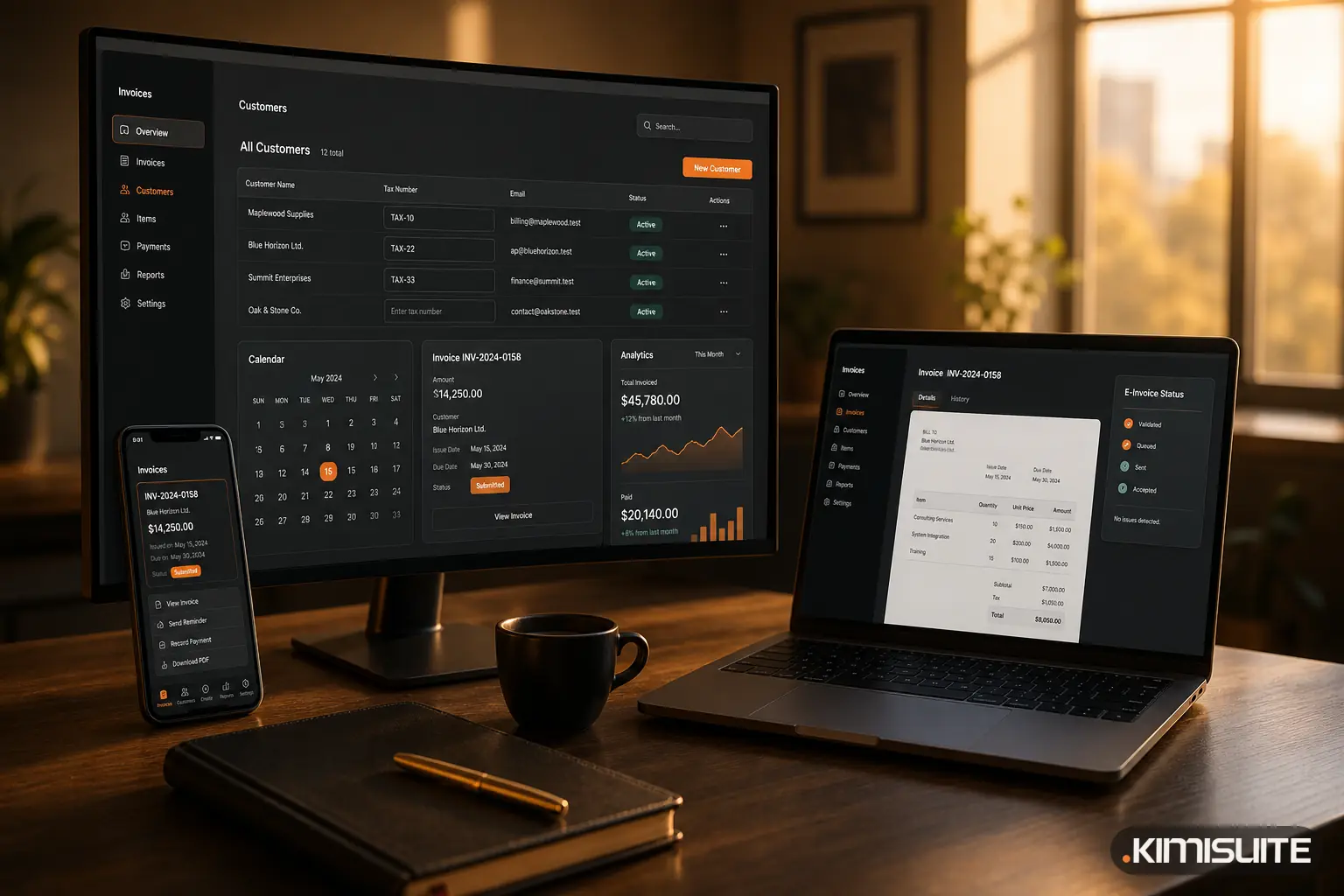
In Germany, every business has had to be able to receive structured e-invoices from other domestic businesses since 1 January 2025, and the obligation to issue them follows in two steps: from 1 January 2027 for most businesses and from 1 January 2028 for all.
The rule comes from the Growth Opportunities Act (Wachstumschancengesetz), which amended § 14 of the German VAT Act (UStG). The Federal Ministry of Finance (BMF) has explained the details in two letters, of 15 October 2024 and 15 October 2025, and in a public FAQ. Here is what applies when, who is affected, and what "e-invoice" means in this context.
The timeline at a glance
| Date | What applies | Who |
|---|---|---|
| Since 1 January 2025 | You must be able to receive e-invoices | All domestic businesses, including small businesses under the Kleinunternehmer rule |
| Until 31 December 2026 | You may still issue paper invoices, or other electronic formats such as PDF if the recipient agrees | All businesses |
| From 1 January 2027 | You must issue e-invoices for domestic B2B sales | Businesses with total turnover above EUR 800,000 in the previous year (2026) |
| Until 31 December 2027 | Paper or other electronic invoices remain allowed | Businesses with previous-year turnover of EUR 800,000 or less |
| Until 31 December 2027 | Existing EDI procedures that do not meet the e-invoice definition remain allowed | All businesses using EDI |
| From 1 January 2028 | E-invoices are mandatory for domestic B2B invoices | All businesses |
Receiving is the easy part: according to the BMF, an ordinary email inbox is enough to receive an e-invoice. The real work lies in issuing.
Who is affected, and who is not
The obligation applies to invoices between businesses established in Germany for domestic sales. It does not apply to:
- invoices to private consumers (B2C)
- small-amount invoices up to EUR 250 gross (§ 33 UStDV)
- tickets for passenger transport
- businesses using the Kleinunternehmer scheme, which are exempt from issuing e-invoices but still have to be able to receive them
If you sell mainly to consumers, little changes on the issuing side. If you sell to other German businesses, it affects almost every invoice you write from 2027 or 2028.
What counts as an e-invoice
This is where most misunderstandings start. Under the new § 14 UStG, an e-invoice is an invoice issued, transmitted and received in a structured electronic format that allows automatic processing. The BMF states that this is the case in particular when the invoice meets the European standard EN 16931.
| Format | E-invoice under § 14 UStG? |
|---|---|
| Paper invoice | No, "other invoice" (allowed only during the transition) |
| PDF sent by email | No, a PDF is an "other invoice", not an e-invoice |
| Scanned invoice | No |
| XRechnung | Yes, named by the BMF as meeting the requirements |
| ZUGFeRD from version 2.0.1 | Yes, except the MINIMUM and BASIC-WL profiles |
| EDI formats | Only under conditions; transition until end of 2027 |
A hybrid format such as ZUGFeRD combines a readable PDF with an embedded XML file. For tax purposes, the structured XML part is what counts.
How e-invoices are sent
The law does not prescribe a transmission channel. Email is expressly permitted, and the parties can agree on other routes such as a portal or an interface. Germany has no central clearing platform: invoices do not have to be reported to or approved by the tax authority before they reach the customer. This distinguishes Germany from countries such as Italy, where invoices pass through a state system.
E-invoicing is also not the same as fiscalisation. Fiscalisation concerns cash registers and receipts; e-invoicing concerns invoices between businesses. Germany regulates both, under separate rules.
A worked example
Two German businesses, both selling to other companies:
| Studio A (design agency) | Wholesaler B | |
|---|---|---|
| Total turnover 2026 | EUR 640,000 | EUR 2.1 million |
| Receiving e-invoices | Required since 2025 | Required since 2025 |
| Issuing e-invoices in 2027 | Not yet required, paper or PDF still allowed | Required from 1 January 2027 |
| Issuing e-invoices from 2028 | Required | Required |
Studio A has one more year of transition, but its customers may already prefer structured invoices during 2027. The practical advice for both is the same: do not wait for the last month.
The amounts on the invoice do not change. An invoice for EUR 4,200 net at 19 % VAT still shows EUR 798 VAT and EUR 4,998 gross, whether it arrives as paper or as XML. If you want to check net, VAT and gross quickly, the VAT calculator does that for any rate.
What to do now
- Check your receiving process. Can your bookkeeping read an XRechnung or ZUGFeRD file, or does someone open the XML by hand? This has been required since January 2025.
- Determine your group. Look at your 2026 turnover. Above EUR 800,000 you issue e-invoices from 1 January 2027; at or below, from 1 January 2028.
- Clean your customer data. Structured formats need complete data: VAT ID, correct legal names, addresses and, for public-sector customers, the routing ID (Leitweg-ID).
- Ask your software provider precisely. Ask not "Are you ready for e-invoicing?" but "Which format do you output, and does it meet EN 16931?". Have your tax adviser confirm the answer for your case.
- Plan the switch. Changing systems is easiest at the start of a month or quarter, with a short overlap. We describe the steps in how to switch invoicing systems without losing a single customer record.
Where KIMISUITE fits
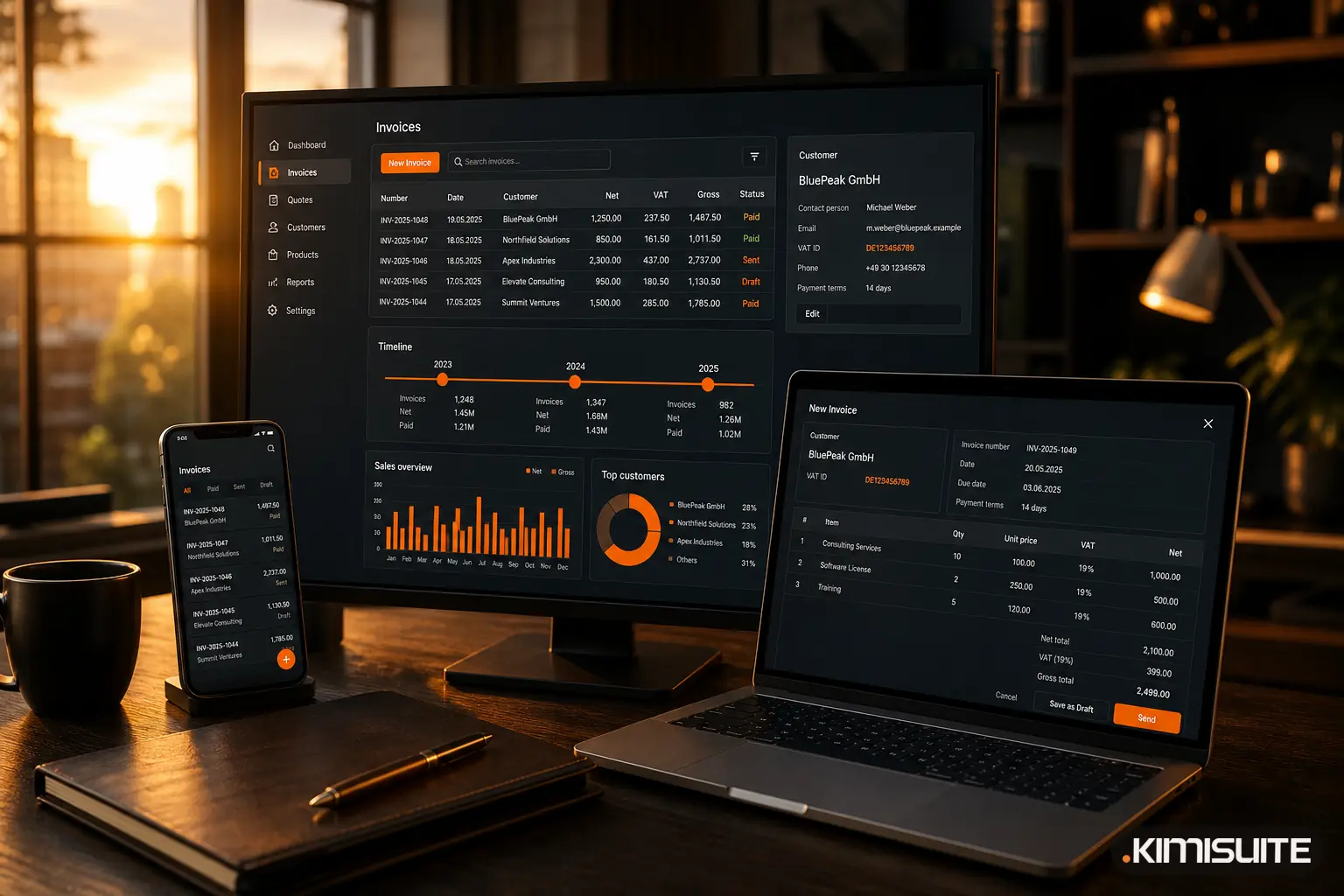
CRM Business Hub keeps customers, quotes, invoices and payments in one place, so the data a structured invoice needs lives on the customer record rather than in a spreadsheet. A German business can use it for its invoicing. Which e-invoice format your business must issue, and from when, depends on the rules above; confirm the format question with us and your tax adviser before 2027 rather than relying on a general promise from any provider.
Cancel anytime · No minimum term · 14 days free
This article summarises the legal situation as of September 2026 and is not tax advice.