An electronic signature is data in electronic form that is attached to or logically associated with other electronic data and that the signatory uses to sign, as defined in the EU eIDAS Regulation.
The definition is broad: a typed name, a signature drawn on a phone and a certificate-based signature from a smart card all qualify. What separates them is how much they prove about who signed and whether the document changed afterwards.
The three levels under eIDAS
The rules come from Regulation (EU) No 910/2014, known as eIDAS, which applies directly in every EU member state. It was amended in 2024 by Regulation (EU) 2024/1183, mainly to add the European Digital Identity Wallet; the three signature levels stay as they were.
| Level | Legal definition (eIDAS) | What it requires in practice | Legal effect |
|---|---|---|---|
| Simple electronic signature (SES) | Art. 3(10): electronic data attached to or logically associated with other data, used by the signatory to sign | Nothing specific. A drawn or typed signature, a click on "I agree", a scanned signature pasted into a file | Cannot be rejected as evidence just because it is electronic (Art. 25(1)); its weight is judged case by case |
| Advanced electronic signature (AdES) | Art. 3(11) and Art. 26: uniquely linked to the signatory, capable of identifying them, created with data under their sole control, and linked to the data so that any later change is detectable | Usually a certificate-based signature where the signer controls the key | Same as above, with much stronger evidence of who signed and that nothing changed |
| Qualified electronic signature (QES) | Art. 3(12): an advanced signature created by a qualified signature creation device and based on a qualified certificate | A qualified certificate from a qualified trust service provider, used on a certified device such as a smart card, USB token or a qualified remote signing service | Equivalent legal effect of a handwritten signature (Art. 25(2)); recognised in all member states (Art. 25(3)) |
First, no level is "invalid". Article 25(1) says an electronic signature shall not be denied legal effect or admissibility as evidence solely because it is electronic or not qualified. What differs is how easy it is to prove in a dispute.
Second, only the qualified signature is automatically equal to a handwritten one across the EU. The other two are weighed as evidence, which is why a good audit trail matters so much for them.
What makes a simple signature hold up
Because a simple electronic signature has no built-in proof, the evidence has to come from around it. In practice, that means:
- who was invited, by which email address, and whether an extra check such as a code by email was used
- when the document was opened and signed, with time zone
- from where, in the form of IP address and device
- that the file did not change, shown by a fingerprint (hash) of the original and the signed version and a seal on the finished PDF
- an independent timestamp, for example an RFC 3161 timestamp from a timestamp authority, so the signing time does not depend on your own server clock
- the signer's explicit consent to sign electronically
A simple signature with this record is far stronger evidence than an unlogged scanned signature pasted into a Word file, even though both are "simple" on paper.
Which level does a document need?
eIDAS defines the levels and their effect. Whether a document needs a particular form is decided by national law, and that differs from country to country. Some general patterns:
| Situation | Typical level | Note |
|---|---|---|
| Offers, order confirmations, quotes | Simple | No form requirement in most countries; the aim is proof of agreement |
| Service agreements, freelance and supplier contracts | Simple, sometimes advanced | Most commercial contracts can be concluded in any form |
| Customer consents, onboarding forms, internal approvals | Simple | Keep the log with the document |
| Rental agreements, employment contracts | Depends on country and clause | Some clauses may be subject to written form under national law |
| Anything where the law prescribes written form | Qualified, where electronic form is allowed | In Germany, for example, statutory written form can only be replaced electronically with a QES (§ 126a BGB) |
| Documents where the law excludes electronic form | Paper only | In Germany, notice of termination of an employment contract must be on paper; electronic form is excluded (§ 623 BGB) |
| Notarial deeds, many property transfers | Notary | Outside what any signing tool can replace |
The honest rule of thumb: most everyday business documents need no special form, and a well-logged simple signature is enough. Where written form is required by law, check whether electronic form is permitted at all and, if so, use a qualified signature. When in doubt, ask a lawyer in the country whose law governs the contract.
What an electronic signature is not
- Not a digital seal. A seal (Art. 3(25)) is created by a legal person, such as a company, to show the origin and integrity of a document. A signature is given by a natural person. A signing platform often seals the finished PDF so changes become visible, but that seal does not replace the signer's signature.
- Not a timestamp. A timestamp proves that data existed at a certain time. It strengthens a signature but is not one.
- Not the same as "digital signature". The term usually describes the cryptographic technique (keys and certificates) behind advanced and qualified signatures. A simple electronic signature often uses none.
A worked example
A small hotel with 12 rooms signs about 40 documents a month: 25 event and group booking confirmations, 10 supplier agreements and five employment-related documents.
- The 25 booking confirmations and 10 supplier agreements carry no form requirement. A simple electronic signature with a full signature log is appropriate.
- Of the five employment documents, most can be signed the same way, depending on national law. A termination notice in Germany would have to go on paper.
- Once a year the owner signs a shareholder agreement where their lawyer asks for a qualified signature. That one document needs a QES.
So in a normal month, practically everything runs on the simple level. The exceptions are rare and predictable: the occasional document the law keeps on paper, and the one contract a year where a qualified certificate is asked for. That pattern is typical for small businesses.
How this looks in KIMISUITE
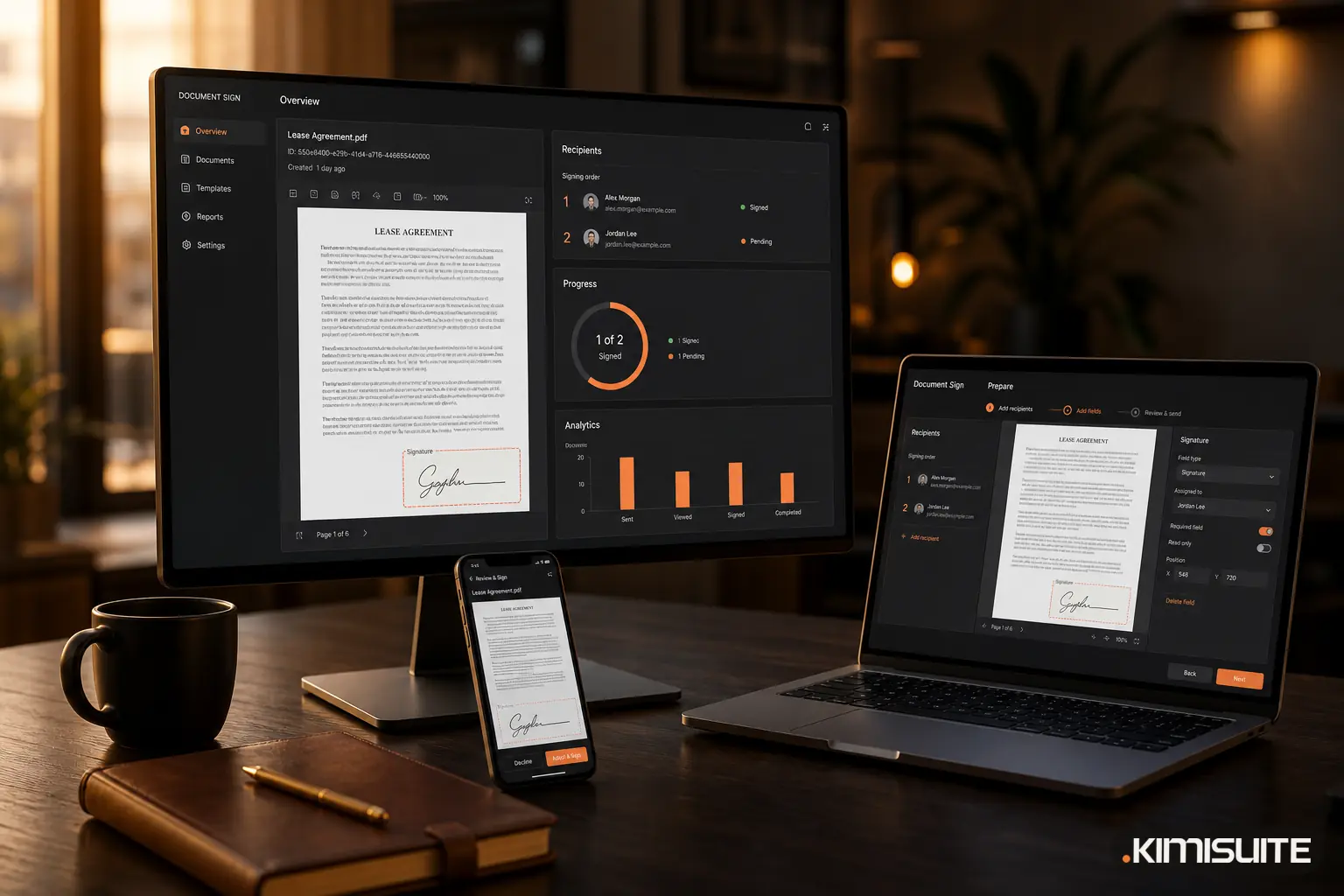
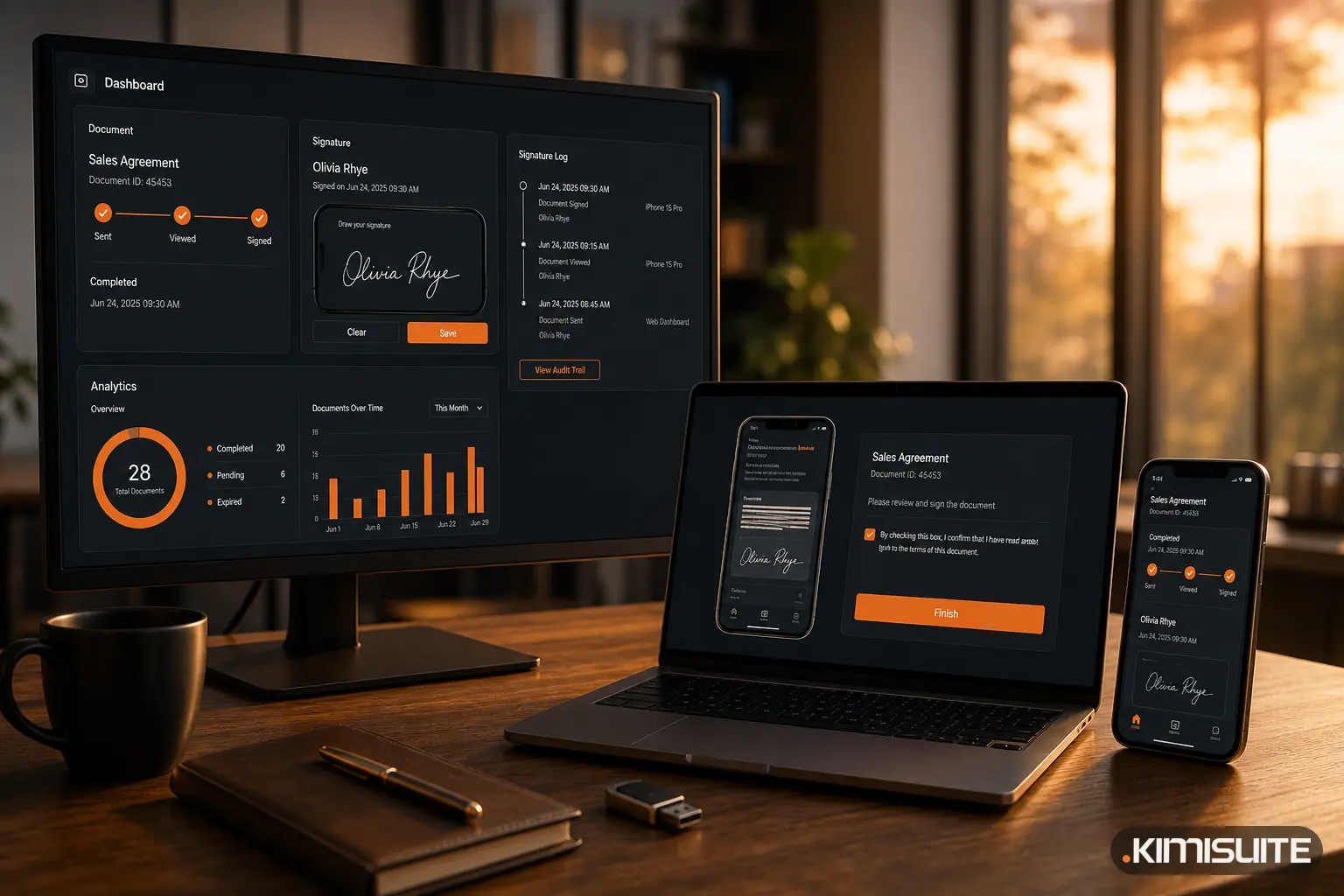
Document Sign uses a simple electronic signature under eIDAS as standard. Recipients sign without an account, every signer confirms that they agree to sign electronically, and the finished document is one sealed PDF with a signature log (names, times, IP, device, history) and an independent RFC 3161 timestamp. Where a qualified signature is required, from the Business plan a signer can sign with the certificate on their own USB token or smart card, using the KIMISUITE Signer for Windows.
The workflow step by step is in Document Sign Is Live: Send a PDF for Signature From Your Workspace.
If most of your documents are the everyday kind, you can start with the Document Sign app and send your first document in a few minutes.
Cancel anytime · No minimum term · 14 days free