Update, 24 September 2026: The mandatory start of e-Faktura on 1 October 2026 has been postponed. A draft Law on Electronic Invoicing, published for public consultation, proposes voluntary use from 1 October 2026 and mandatory e-invoicing for VAT payers from 1 April 2027. That date is under discussion and not final until the law is adopted, so the new mandatory date is still open. What is known so far is in E-Faktura in North Macedonia Postponed: What We Know and Why to Get Ready Now. e-Faktura (UJP) is integrated in CRM Business Hub and ready regardless of the date. The article below was written in August 2026; references to 1 October have been adjusted.
For months, a date was circled on a lot of calendars in North Macedonia: 1 October 2026. That was when e-invoicing — е-фактура — was expected to stop being a project for later and become part of how invoices are legally issued. The mandatory start has since been postponed, but the change itself is still coming.
If your reaction to that sentence is a small knot in your stomach, you are in good company. Most business owners we speak to are not worried about the law itself. They are worried about the switch: the data sitting in the old system, the accountant who has done it the same way for twelve years, the week of chaos everyone assumes is coming.
So let us take the drama out of it and look at what actually changes, what does not, and what a calm preparation looks like.
What e-faktura actually is
An e-invoice (е-фактура) is not a PDF you email. That distinction is the whole point, and it is where most of the confusion starts.
A PDF is a picture of an invoice. A human can read it; a system cannot, at least not reliably. An e-invoice is a structured digital document — the amounts, tax rates, party details and line items sit in defined fields that another system can read, validate and book automatically. It is issued, transmitted and archived electronically through an approved channel, and the tax administration — the UJP (Управа за јавни приходи) — can see it.
That is the change in one sentence: invoices move from being documents you send to being data you submit.
What actually changes for you when e-Faktura becomes mandatory
Less than you might think, if your invoicing already lives in software. More than you would like, if it lives in a spreadsheet.
Concretely:
- Invoices get issued in a structured format, not as free-form documents.
- They are transmitted through the official channel, not only to your customer's inbox.
- They are archived digitally in a form that stands up to an audit.
- Your numbering, tax rates and party details have to be clean — a structured format is unforgiving about missing fields in a way a PDF never was.
The rollout is phased. The draft law proposes starting with voluntary use on 1 October 2026 and a mandatory start for VAT payers from 1 April 2027, a date that is still under discussion, followed by other groups of businesses and the public sector later.
What does not change
This is the part nobody tells you, and it is the part that lowers the blood pressure:
- Your prices, your terms and your customer relationships stay exactly as they are.
- Your accountant does not become obsolete. Their work gets faster because the data arrives structured instead of as fifty PDFs at month end.
- You do not need a technical person on staff. If your invoicing software handles the submission, you keep clicking the same button you always did.
- Your old invoices remain valid. Nothing retroactively breaks.
The three ways businesses are handling it
From what we see, companies are landing in one of three groups.
Group one: waiting. They have heard about it, they intend to deal with it, and they plan to start in the last two weeks before the deadline. This is the expensive option — not because of penalties, but because you end up choosing a system under time pressure, migrating in a hurry, and discovering your customer data was messier than you thought at the worst possible moment.
Group two: bolting something on. They keep the current invoicing tool and add a separate e-invoicing service next to it. This works, and it is a legitimate choice. The cost is a permanent seam in the middle of your process: two systems, two logins, two places where a customer address can be wrong, and a monthly reconciliation nobody enjoys.
Group three: consolidating. They treat the deadline as the reason to finally put customers, offers, invoices and payments in one place — so that the e-invoice is simply the last step of a flow that already exists, not a separate errand.
There is no morally correct answer here. But group three tends to be the one that stops thinking about invoicing altogether afterwards.
What "being ready" actually looks like
Ignore the marketing for a moment. A business is ready for e-Faktura, whenever the mandatory date falls, when it can answer yes to five plain questions:
- Can I issue a structured e-invoice without exporting, reformatting or uploading anything by hand?
- Is my customer master data clean — tax numbers, legal names, addresses — for the customers I actually bill?
- Is submission automatic, or does someone have to remember a second step after clicking "send"?
- Are my invoices archived in a form I can produce during an audit without digging through email?
- Do I know what happens when something is rejected — who sees it, and how it gets corrected?
If you can answer those five, the date on the calendar stops mattering.
Where KIMISUITE fits
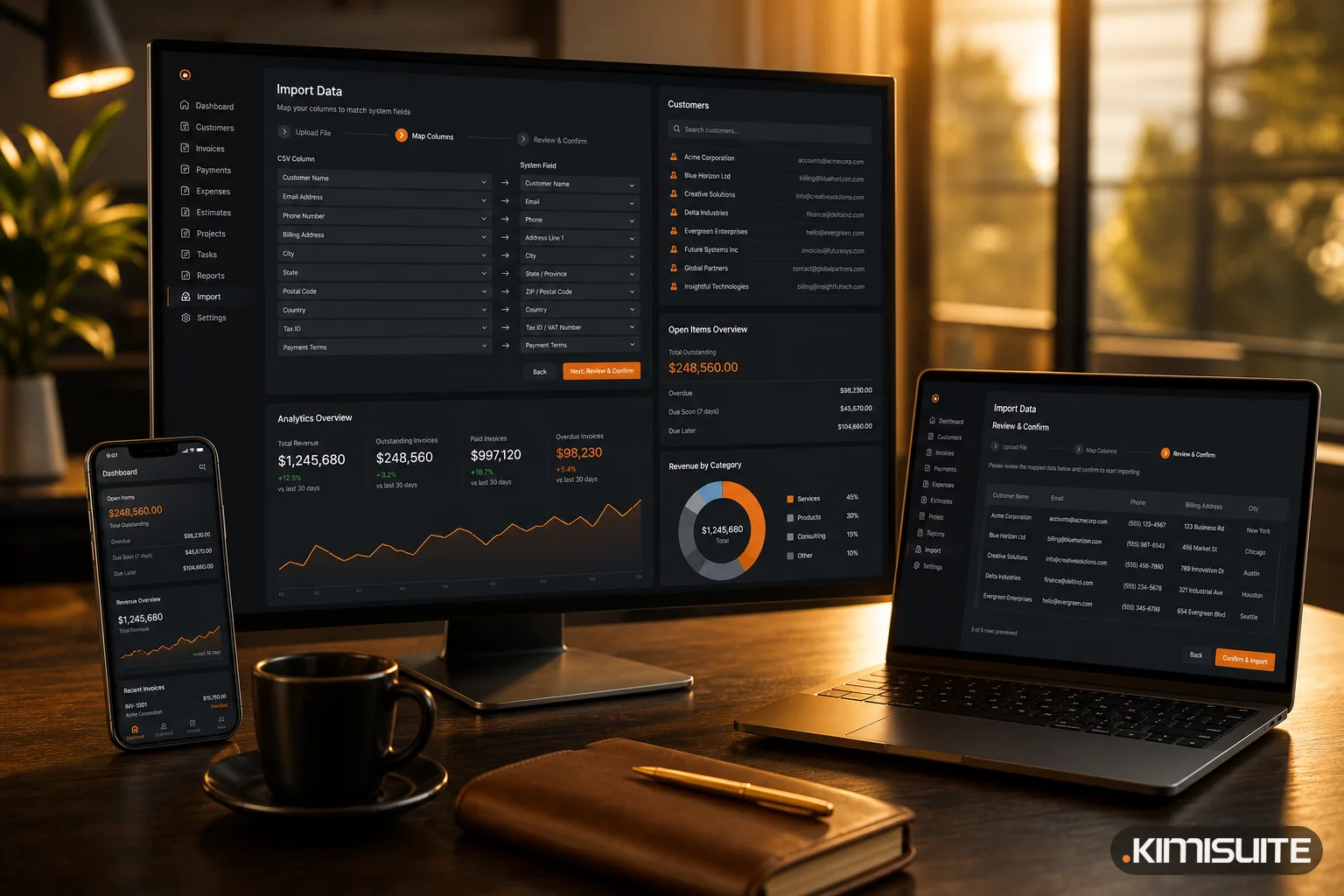
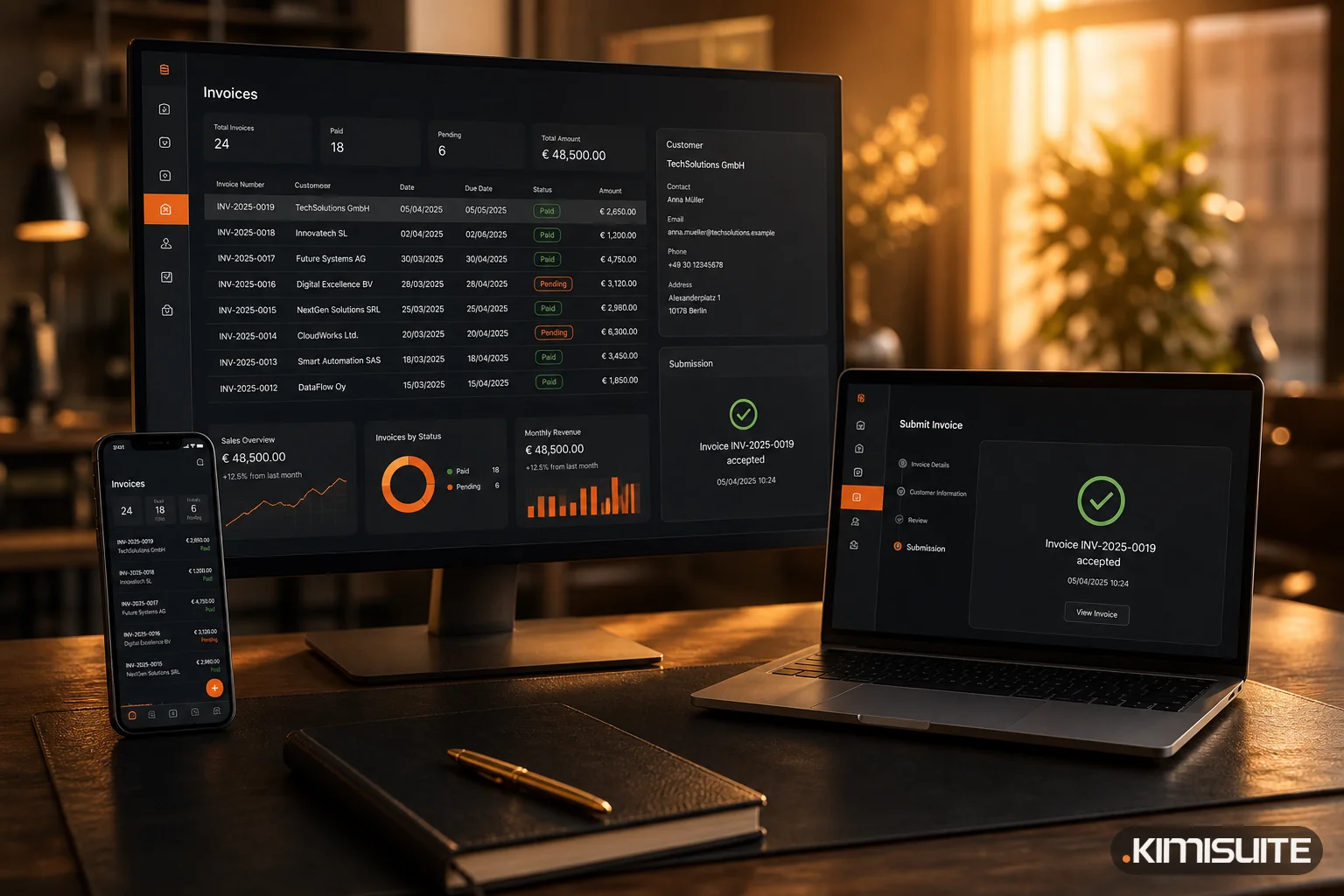
CRM Business Hub is the KIMISUITE app that handles invoicing, and it is where e-faktura lives — with direct UJP integration. You create the invoice the way you always have; the structured document is formatted and submitted for you, and the record is stored and audit-ready.
Because it sits in the same workspace as your customers, offers and payments, the invoice is not a fresh start every month. A lead becomes an offer, the offer becomes an invoice, the invoice becomes an e-invoice, and the payment closes the loop against the same customer record. One system, one customer, one number that has to be right.
That is also why the deadline is a reasonable moment to look at the whole flow rather than only the last step of it.
The part everyone is actually afraid of
Not the law. The migration.
"What happens to my existing customers, my invoice numbers, my open items?" is the question behind almost every conversation about e-Faktura — and it deserves its own answer rather than a reassuring sentence at the end of an article.
We wrote that one separately: how to switch invoicing systems without losing a single customer record — imports, parallel running, and the checklist for the first day on the new system.
The short version: bring your customer list, bring your open invoices, run both systems for a short overlap, and start clean at the top of a month. Nobody has to retype anything.
See how e-invoicing works in CRM Business Hub — or read the Macedonia e-faktura overview if you want the compliance detail first.