Calendar days count every day, including weekends and public holidays; working days count only the days on which business is normally done, usually Monday to Friday minus public holidays.
The difference sounds pedantic until it decides whether a payment is late, a delivery is on time or a deadline was missed. "Thirty days" and "thirty working days" are not a few days apart. They are about two weeks apart.
The four kinds of "day"
| Term | What counts | Typical use |
|---|---|---|
| Calendar days | Every day of the week, holidays included | Payment terms (net 30), EU late payment rules, many contract periods |
| Working days | Monday to Friday, excluding public holidays | Delivery times, processing times, internal deadlines |
| Business days | Usually the same as working days; the exact meaning depends on the contract | Contracts written in English, especially in the US and UK |
| Banking days | Days on which banks process payments | Transfer times, value dates |
Watch the language. In German, Werktag traditionally includes Saturday, while Arbeitstag usually means Monday to Friday. A contract that says "10 Werktage" can be shorter than one that says "10 Arbeitstage". If it matters, define it in the contract.
How far apart they really are
Without any public holidays, every 5 working days add up to 7 calendar days:
| Working days | Calendar days (no holidays) |
|---|---|
| 5 | 7 |
| 10 | 14 |
| 20 | 28 |
| 30 | 42 |
And the other way round: 30 calendar days contain about 21 or 22 working days, depending on where the weekends fall. A month like September 2026 has 22 working days in Germany; December 2026 also has 22, because Christmas Day falls on a Friday and Boxing Day on a Saturday.
Every public holiday inside the period pushes a working-day deadline one day further out. Calendar-day deadlines do not move for holidays, except at the very end (see below).
How a deadline is counted
Three rules settle most questions. They come from German law here, but many European legal systems follow very similar principles.
1. The starting day does not count. If a period starts with an event, such as receiving an invoice, the day of that event is not counted. An invoice dated 1 October with 30 days to pay starts counting on 2 October. (Germany: § 187 BGB.)
2. A deadline that ends on a weekend or holiday moves to the next working day. If the last day falls on a Saturday, Sunday or a public holiday at the place of payment, the next working day takes its place. (Germany: § 193 BGB.) Other countries have similar rules, but not all of them, and not for every kind of deadline.
3. Public holidays are national and often regional. Germany has holidays that apply only in some federal states. Switzerland differs by canton. Christmas Eve and New Year's Eve are not public holidays in Germany, even if your customer's office is closed.
Which count applies where
| Situation | Usually counted in | Note |
|---|---|---|
| Invoice payment terms (net 30, net 60) | Calendar days | Unless the contract explicitly says working days |
| EU Late Payment Directive (no date agreed) | Calendar days | 30 calendar days from receipt of the invoice |
| Delivery times ("ships in 3 to 5 days") | Working days | Say so, or customers will count weekends |
| Service level agreements | Working days or hours | Often "business hours", which is narrower still |
| Statutory notice and objection periods | Depends on the law | Always check the specific rule |
| Bank transfers | Banking days | A Friday afternoon transfer often arrives on Monday |
The EU Late Payment Directive (2011/7/EU) is explicit here: where no payment date is agreed between businesses, interest is due after 30 calendar days following receipt of the invoice, and agreed B2B payment periods over 60 calendar days are only allowed if expressly agreed and not grossly unfair to the creditor.
Two worked examples
Example 1: an invoice at the end of the month. An invoice dated Thursday, 1 October 2026:
| Terms | Last day | What actually applies (Germany) |
|---|---|---|
| 30 calendar days | Saturday, 31 October | Moves to Monday, 2 November |
| 30 working days | Thursday, 12 November | 42 calendar days after the invoice date |
Same number, ten days apart. A customer who reads "30 days" as working days is not being difficult. The invoice was ambiguous.
Example 2: a deadline across Christmas. A supplier promises delivery "within 10 working days" on Friday, 18 December 2026, in Germany:
| Counting | Deadline |
|---|---|
| 14 calendar days | Friday, 1 January 2027, a public holiday, so moves to Monday, 4 January |
| 10 working days, no holidays | Friday, 1 January 2027 |
| 10 working days, German public holidays | Tuesday, 5 January 2027 |
Christmas Day and New Year's Day each push the working-day deadline by a day. Christmas Eve and New Year's Eve do not, because they are normal working days in law, even if half the country is on leave.
The working days calculator does this counting for a start and an end date. It knows the national public holidays of twelve countries, including Germany, Austria, Switzerland, the UK, France, Spain, Italy, the Netherlands and North Macedonia. Regional holidays, such as those of individual German states, are not included, so add them by hand if they apply to you.
What working days are not
- Not your opening days. A bakery open on Saturdays still has a Monday-to-Friday working week in most contracts.
- Not the same everywhere. A deadline counted in Germany and one counted in the UK over the same dates can end on different days, because the holidays differ.
- Not automatic in payment terms. Net 30 means 30 calendar days. If you want working days, write "30 working days" and expect to be asked what you mean.
Getting it right on your own documents
The simplest rule for your own invoices and quotes: write the deadline as a date, not only as a number of days. "Payment due by 2 November 2026" cannot be counted two ways. How the common payment terms work, including net 30 EOM and early-payment discounts, is covered in payment terms explained.
Due dates without the counting
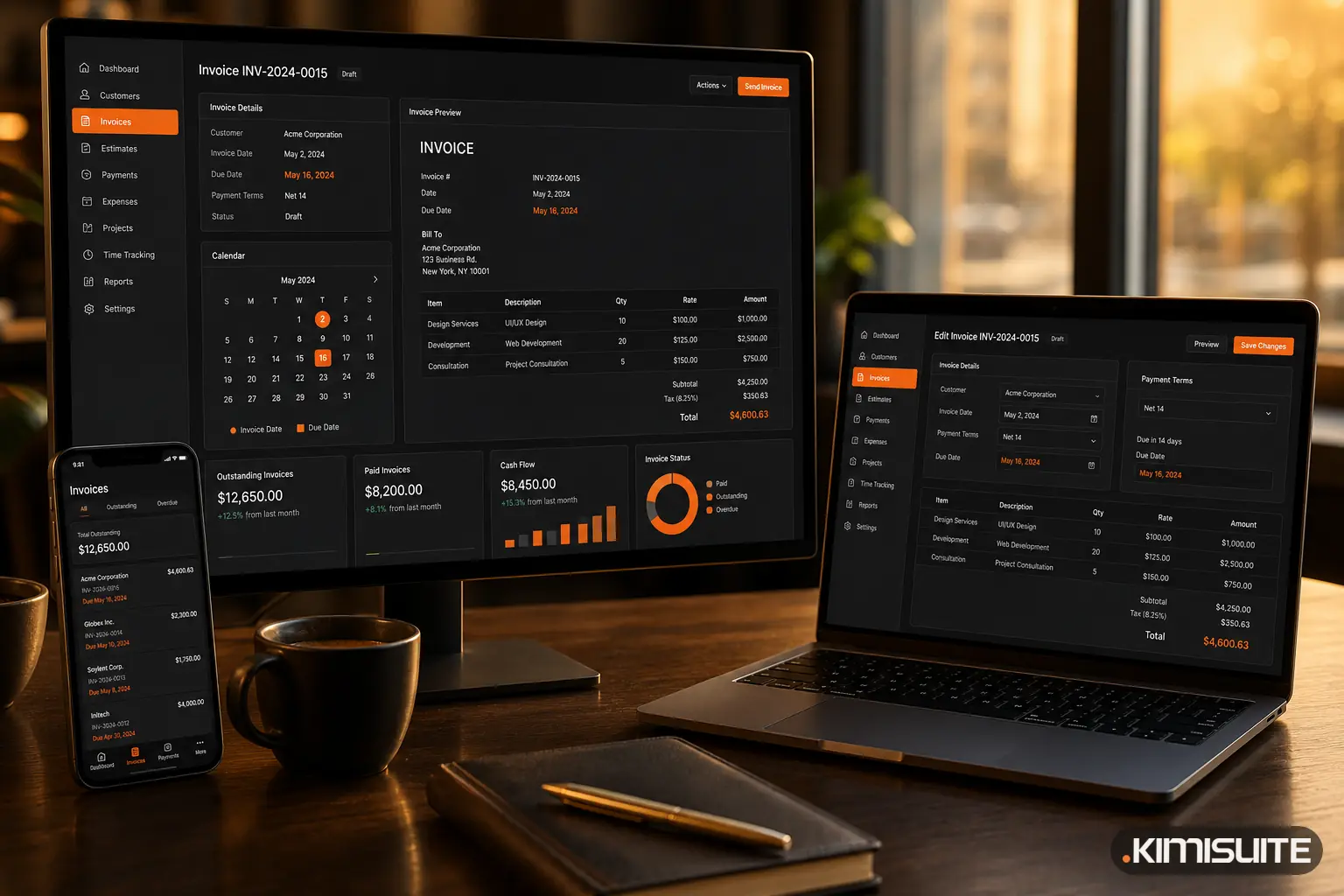
If you send more than a handful of invoices a month, the due date should be set once and then tracked for you. In CRM Business Hub, every invoice carries its due date as a date, and invoices that pass it are flagged as overdue instead of waiting for someone to count. It runs inside your KIMISUITE workspace, billed per workspace rather than per user. Cancel anytime · No minimum term · 14 days free.