Most hotel management software vendors don't show you the price until after a sales call. By then your team has sat through a demo, your operations manager has built mental commitment, and the quote arrives as a Frankenstein of "PMS module", "channel manager module", "booking engine module" and "support tier" — each line designed to drift upward over time.
That's the hotel software market most independent hotels have lived with for the last twenty years. It doesn't have to be the next twenty.
This guide unpacks how hotel software is really priced in 2026, what to actually look for in a modern PMS, and why workspace-based pricing is becoming the new default for hotels that want their bill to stop being a surprise.
The Five Pricing Models You'll Encounter
Walk into any hotel software comparison and you'll meet five common pricing patterns. Each has trade-offs you should understand before you sign.
1. Per-room, per-month
The most common — and most dangerous. Vendors charge €1 to €5 per room per month. Looks small. Does the math when you grow.
- A 30-room hotel paying €3 per room per month is €1,080 per year.
- A 60-room hotel is €2,160 per year.
- Add a second property and it doubles again.
The pricing scales linearly with your inventory, which means every room you add is a tax on your growth.
2. Per-user or per-seat
You add a receptionist, you add €25 per month. You add a night auditor, another €25. Your housekeeping supervisor needs read-only access? Still pay.
This model rewards understaffing — exactly the opposite of what hospitality needs.
3. Commission on bookings
The "free PMS" trick. Vendors take a percentage (usually 1–3%) of every booking that flows through the system. On a €200 booking that is €2 to €6. For a hotel running 5,000 bookings per year, that's €10,000 to €30,000 per year on top of any other fees.
It's free until your hotel succeeds.
4. Module-based pricing
The classic local-vendor pattern. You buy a base PMS. Want a channel manager? Extra module. Want a booking engine? Extra module. Want housekeeping on mobile? Extra module. Want reports? You can guess.
Each module is priced "to be discussed" — you will never see the full price publicly. By the time you have added the modules you actually need, the total has doubled.
5. Workspace pricing
The model that is quietly taking over: one monthly fee per hotel (workspace), with a fixed allowance of capacity (usually included room types) and every feature bundled. Users are included. Bookings are uncapped. There is no commission.
This is how SaaS pricing works in every other industry — and it has finally arrived in hospitality.
Ready to see what flat-rate hotel software actually costs?
What Modern Hotel Software Should Include — Without Add-On Fees
Whichever pricing model you accept, a modern hotel PMS should bundle these features by default in 2026. Anything sold as an "extra module" is a vendor that hasn't caught up.
Channel manager — built in
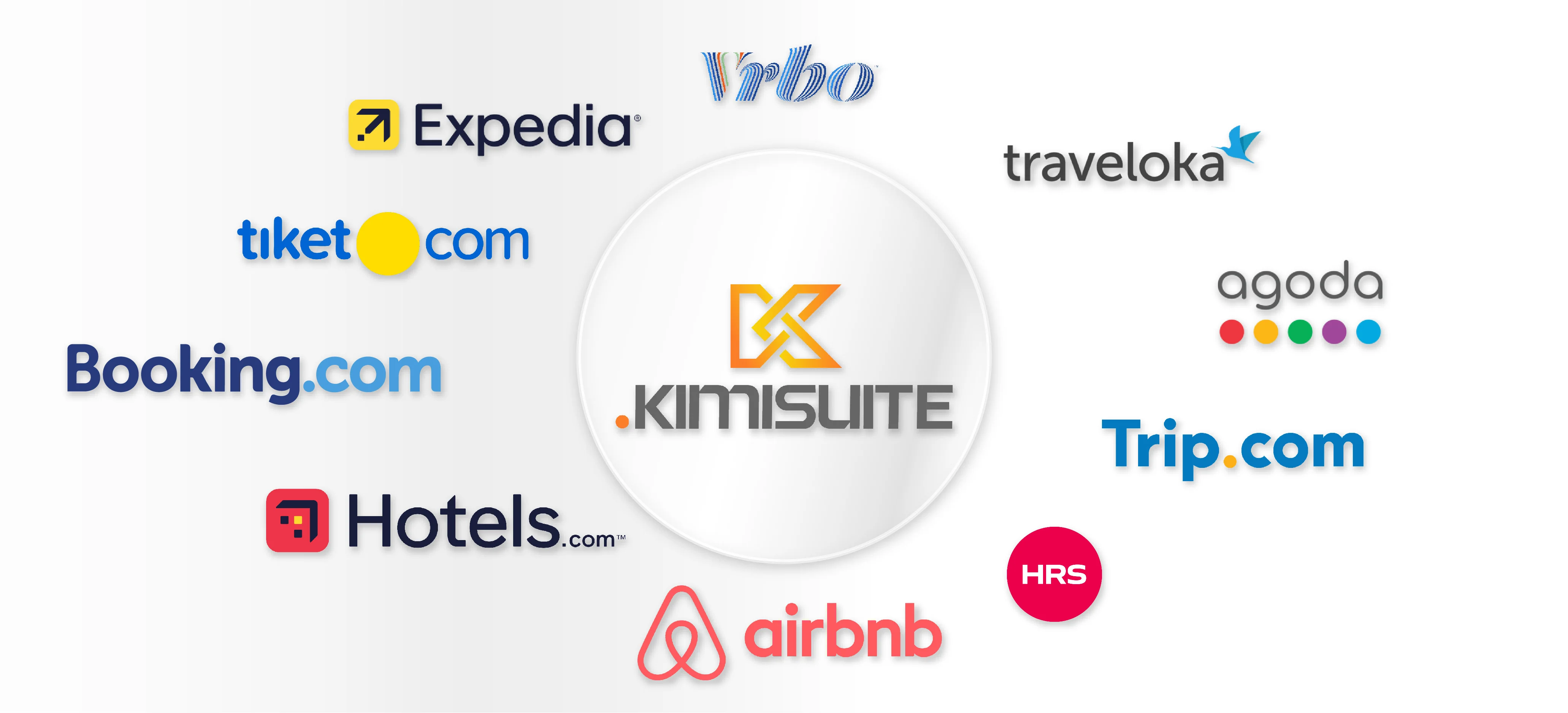
Synchronisation with Booking.com, Expedia, Airbnb, Agoda, Hotelbeds and the long tail of regional OTAs. Real-time, two-way, with zero per-channel fee.
Direct booking engine
Embed on your hotel's website. Convert visitors into reservations without paying OTA commission. For a hotel with 30% direct booking share, this single feature pays for the entire software bill.
Housekeeping app
Mobile, real-time. Your housekeepers update room status from the floor, report maintenance issues, log lost and found items. No more PDFs at shift handover.
Real-time room calendar
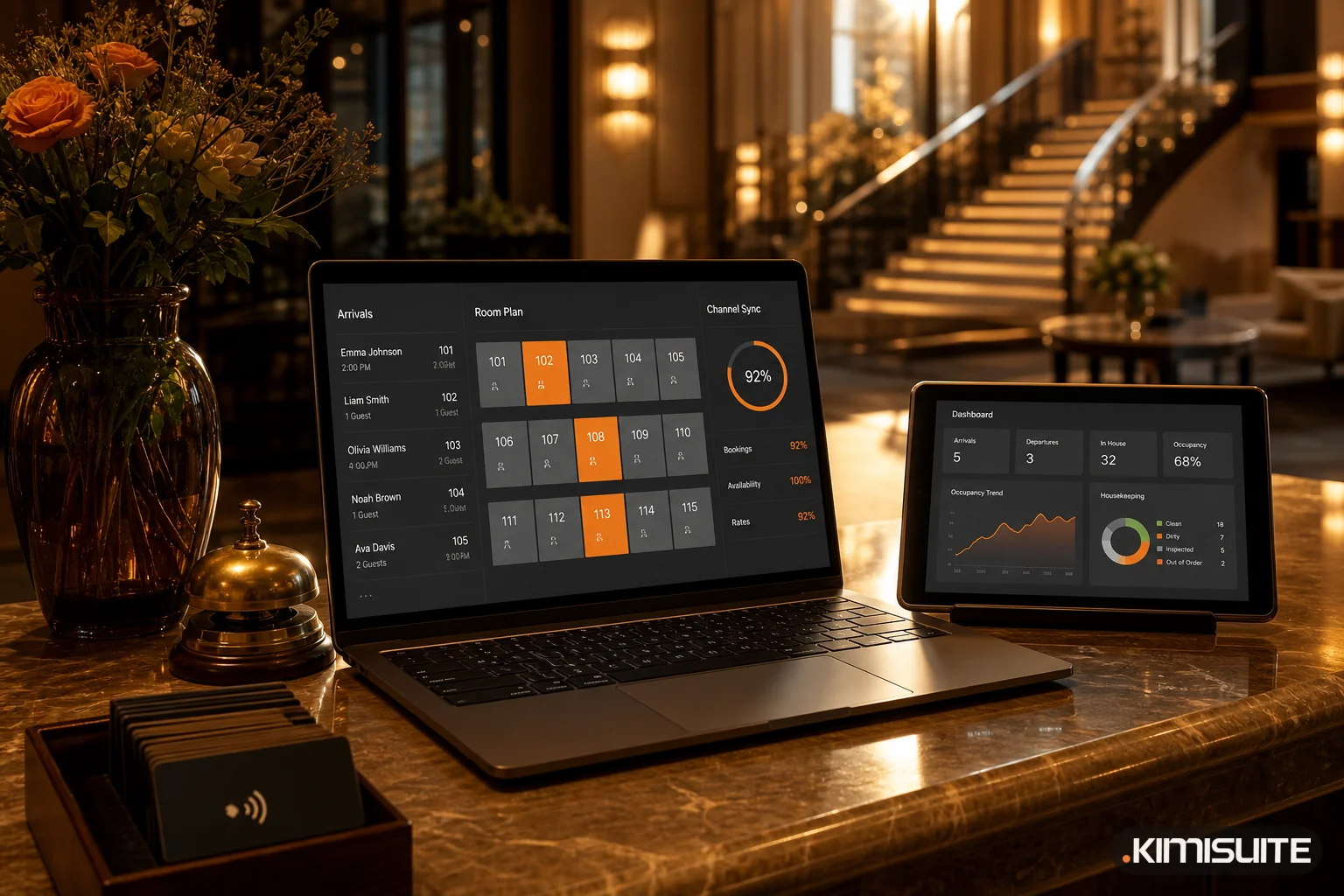
Drag-and-drop reservations across rooms, dates and rate plans. Instant availability sync to OTAs and your direct booking engine.
Multilingual reception
Modern hotels serve guests in five to ten languages. The software should serve in all of them — not just English and the vendor's native tongue.
Fiscal-compliant invoicing
Country-specific fiscal compliance (Macedonia, EU, UK, US), multi-currency, with audit-ready exports for your accountant.
Real-time analytics
Occupancy, ADR, RevPAR, source mix, pacing, pickup. Not yesterday's PDF. Today's live dashboard.
The KIMISUITE Booking Hub Approach
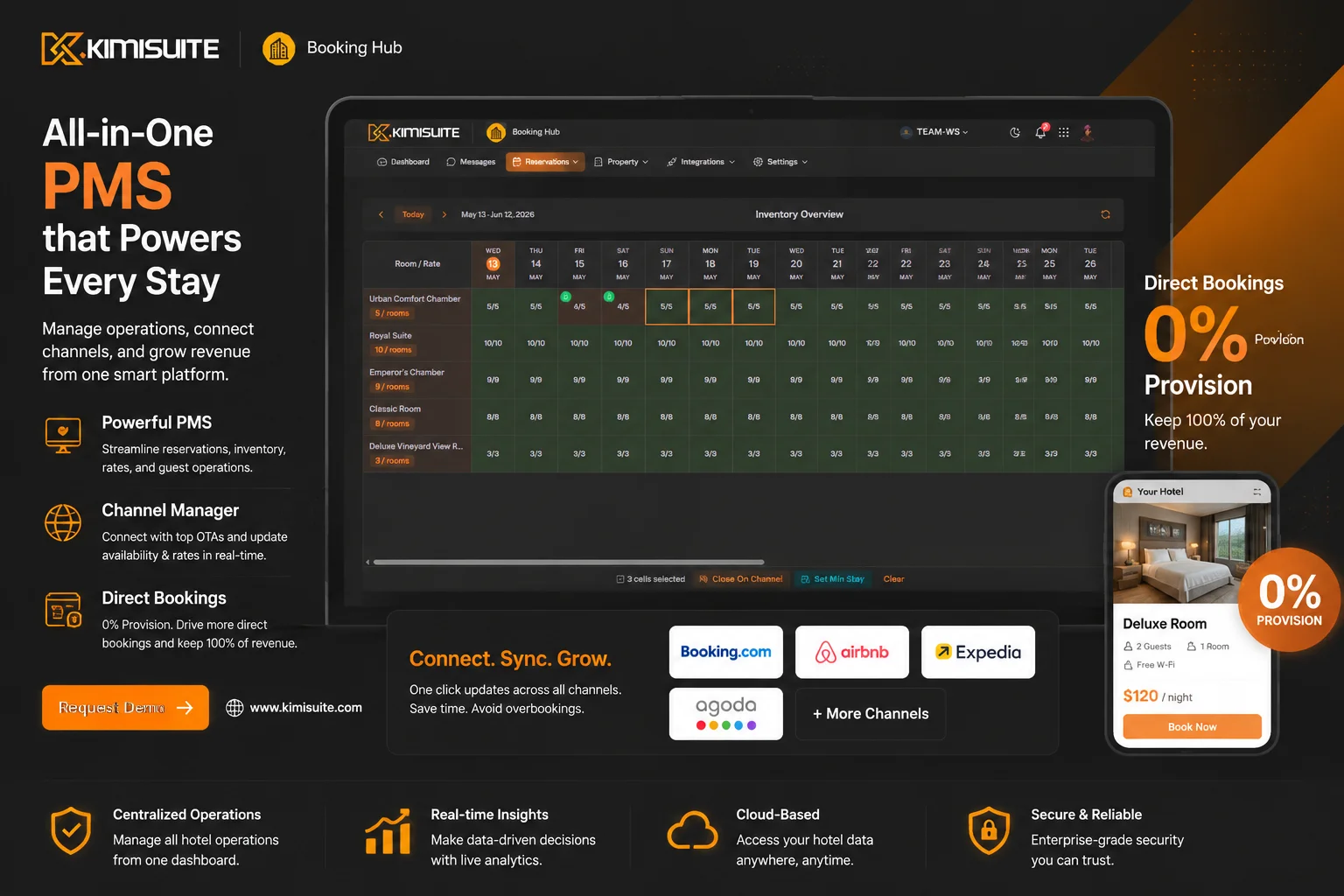
KIMISUITE Booking Hub is built on the workspace pricing model: one flat monthly fee, plans sized by included room types (3, 10 or 30 by tier), every feature included, every user included, zero commission on bookings.
- No per-room fees — adding rooms inside an existing room type costs nothing extra.
- No per-user fees — onboard a new receptionist, a night auditor, a housekeeper. The bill doesn't move.
- No commission — KIMISUITE never takes a cut of a booking. Ever.
- No module add-ons — channel manager, booking engine, housekeeping, reporting and analytics are all bundled.
- 16 languages — Macedonian, Albanian, Bulgarian, Serbian, Croatian, Turkish, German, French, Italian, Spanish and six more.
- EU-hosted, GDPR-compliant — daily encrypted backups, bank-grade security.
Whether your hotel runs 8 rooms or 80 rooms, the price is structural and predictable. You can plan a 3-year budget on a single line.
Start your free trial of KIMISUITE Booking Hub →
What to Ask Every Hotel Software Vendor Before You Sign
Before you commit to any PMS in 2026, demand answers to these eight questions. Vendors that dodge are telling you something.
- What is the total monthly bill for my exact hotel size? Email me the number in writing. If they need a sales call to answer, the price is engineered to be hidden.
- What's included versus sold as an add-on? Channel manager, booking engine, housekeeping, fiscal invoicing, reporting — get the list.
- Do you charge per user, per room or per booking? If yes to any of these, calculate growth scenarios.
- Do you take a commission on bookings? If yes, walk away.
- What's the contract term? Monthly billing is normal in 2026. Multi-year lock-ins are a red flag.
- Which languages does the interface support? Especially relevant for hotels serving cross-border guests.
- What's the migration path from my current system? "Manual re-entry" is unacceptable in 2026.
- Where is my data hosted? Can I export it any time? EU/GDPR-compliant hosting and full export rights are a hard requirement.
If a vendor can't answer all eight in writing within a day, that's the answer.
Migration Is Easier Than You Think
The biggest mental block keeping hotels on legacy systems isn't price — it's the fear of migration. The reality:
- Reservation history — every modern PMS imports CSV, XLS or SQL exports from the major systems. A standard 5-year history migrates in hours, not days.
- Room inventory and rates — usually pre-configured in onboarding before you cut over.
- OTA reconnection — Booking.com, Expedia and Airbnb let you re-authorise a new PMS without downtime. Typically a 24-hour transition.
- Staff training — modern cloud PMS interfaces are designed to be picked up in a single shift. The two-week training cycle from desktop-era software is no longer normal.
A typical migration to KIMISUITE Booking Hub takes two to three working days with our onboarding team. Most hotels go live the same week they sign.
Frequently Asked Questions
Is workspace-based pricing really cheaper than per-room?
For most hotels, yes — significantly. The break-even point against per-room pricing is typically 10 to 15 rooms. Hotels with 20 or more rooms see immediate savings. Hotels with multiple properties see structural savings.
What if my hotel grows?
Add rooms inside your existing room types — no price change. Need a fourth room type? Upgrade to the next tier (still one flat monthly fee). KIMISUITE Booking Hub plans go from 3 included room types up to 30 per workspace.
Will it work with my fiscal printer?
KIMISUITE Booking Hub supports the most common fiscal printers used across the EU and the Balkans. Tell our team your model during the demo and we'll confirm before you sign.
Can guests book directly on my own website?
Yes — embed the booking engine in one line of HTML. Bookings flow into your PMS with zero OTA commission. The same engine works on mobile, supports multi-currency and matches your site's branding.
Is there a long-term contract?
No. KIMISUITE Booking Hub is monthly billing, cancel any time. We earn the renewal every month — that's the business model.
Bottom Line
The hotel software market is splitting in two. On one side: legacy vendors with hidden pricing, per-room metering, commission cuts and add-on modules. On the other: workspace-based, transparent, all-included platforms that scale with your business instead of taxing it.
If you're paying a per-room fee, a per-user fee, a per-booking commission, or sitting through quarterly "module upgrade" calls — there is a better way.
Or skip the demo and try KIMISUITE Booking Hub yourself:
Start your free trial of KIMISUITE Booking Hub →