KIMISUITE Digital Business Card for United Arab Emirates
Deploy NFC business cards across UAE sales teams with consent-first contact exchange, central branding, and CRM-ready lead capture built for events and high-touch B2B selling.
14-day free trial · Cancel anytime
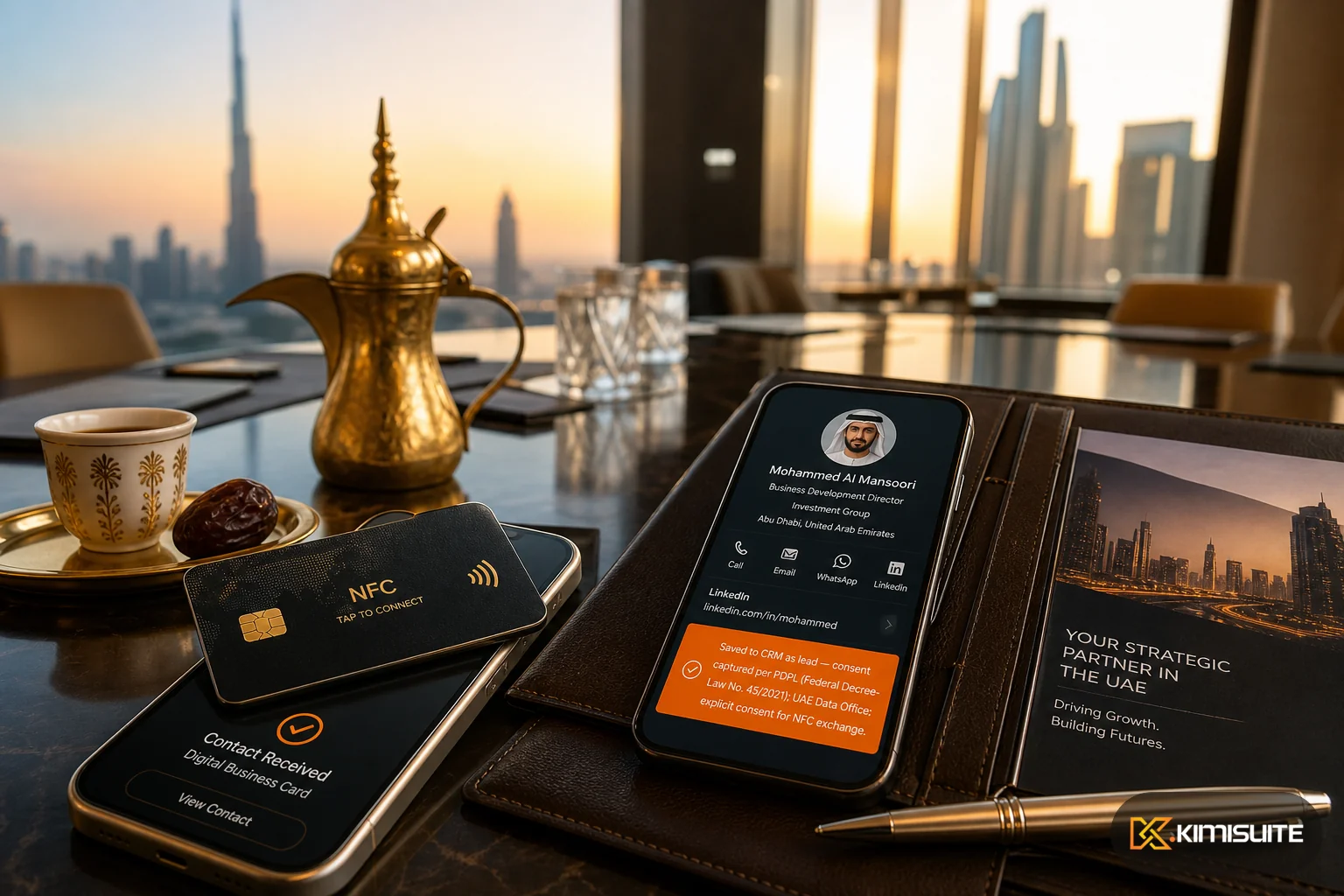

In the United Arab Emirates, a business card is still more than a contact detail. It is part of first impressions, professional status, and event etiquette. At GITEX, Arab Health, WTTC, industry breakfasts in DIFC, or partner meetings in Abu Dhabi and Dubai, teams still exchange details in a high-touch way. That is why a digital business card United Arab Emirates strategy cannot be reduced to a generic tap-and-share tool. It has to respect premium presentation, clean branding, and the reality that sales teams need contacts to reach the CRM quickly.
Many companies start with a standalone NFC business card United Arab Emirates vendor because the first order looks simple. Then the operational gaps appear. Per-card subscriptions multiply across a 5 to 50 person team. Captured leads sit in a vendor dashboard instead of the CRM. Marketing cannot keep every profile, title, logo, and campaign asset aligned. HR and sales ops struggle to replace cards when people join, move roles, or leave. Most importantly, consent for contact exchange is often treated too lightly for local practice. Under PDPL (Federal Decree-Law No. 45/2021); UAE Data Office; explicit consent for NFC exchange is not a side note. It should be designed into the workflow from the start.
KIMISUITE Digital Business Card takes a different approach. It is not just a smart business card United Arab Emirates tool for a single rep. It is a team system for companies that want one workspace, one bill, central rollout, and contact capture that moves into real sales processes. Because KIMISUITE is built around shared workspace pricing, the conversation changes from buying isolated cards to managing a proper sales asset across the whole company.
That matters in the UAE because local selling is relationship-led. Teams attend events, host meetings, revisit prospects, and coordinate across sales, marketing, and leadership. A digital card only becomes useful when the contact exchange is compliant, the branding is consistent, and the data flows into the CRM without manual retyping. KIMISUITE Digital Business Card is designed for exactly that: premium NFC exchange, consent-aware capture, CRM attachment, and reporting that sales leadership can actually use.
Where UAE sales teams lose time and money today
Per-card pricing looks small until the team grows
Mobilo lists pricing from AED 37 per card per year, while Linq Business is commonly priced at USD 8 per month. Add Popl, Blinq, HiHello, V1CE, and TapTagPro UAE into evaluations and the pattern is similar: a card product first, team operations second. For a 30-rep sales team, the card line may start modestly, but the wider stack keeps expanding with CRM seats and admin overhead.
Consent on NFC exchange is often undersold
In practice, many international tools optimise for speed and silent capture. In the United Arab Emirates, that is not enough. PDPL (Federal Decree-Law No. 45/2021); UAE Data Office; explicit consent for NFC exchange should be visible and intentional. When teams collect contact details at events or private meetings, they need a process that supports explicit consent rather than assuming it.
Local business-card etiquette still carries weight
High-touch B2B sales culture, events like GITEX / Arab Health / WTTC, premium business-card etiquette as status signal all shape how cards are perceived. A cheap-looking card or inconsistent digital profile can weaken a strong introduction. In the UAE, branded finish, clean presentation, and role-specific messaging matter because the card itself reflects the company standard.
Contacts land in dashboards instead of the CRM
Many NFC tools capture leads into their own platform first. Then reps or ops teams export CSV files, clean fields, and import them into Salesforce or HubSpot later. That delay reduces follow-up quality. It also makes event ROI harder to measure because meetings, taps, and pipeline activity are split across different systems.
The cost stack UAE teams should calculate properly
A 30-rep United Arab Emirates sales team pays today: Mobilo or Linq per-card-per-year + Salesforce or HubSpot per-seat + manual contact-export friction. Real prices from Mobilo (AED 37/card/year), Linq Business (USD 8/card/mo), Popl, Blinq, HiHello, V1CE (UK, popular in DIFC), TapTagPro UAE. On the visible card line alone, Mobilo at AED 37 per card per year equals AED 1,110 annually for 30 reps, roughly EUR 277 or about USD 302 at typical recent exchange ranges. Linq Business at USD 8 per month equals USD 2,880 per year for 30 reps, roughly EUR 2,650 or about AED 10,580. Then add CRM seat costs in Salesforce or HubSpot, plus the hidden cost of manual exports, duplicate records, delayed follow-up, and inconsistent branding updates. KIMISUITE Digital Business Card bundles NFC card + auto-CRM-attach + central branding rollout on workspace pricing, so the discussion moves from fragmented per-card purchasing to one operating model for the whole team.
Why KIMISUITE fits the UAE sales environment
KIMISUITE Digital Business Card is designed for companies that need more than a profile page. It gives sales directors, marketing leads, and HR ops one place to manage cards, branding, contact logic, and team-level consistency. Instead of relying on each rep to maintain their own digital presence, the company sets the standard once and rolls it out across the workspace.
For a UAE organisation, this is especially useful when teams work across multiple events, offices, and markets. Titles change. Campaign messaging changes. Product lines change. New starters need cards quickly. Departing staff should not leave outdated profiles behind. With a central workspace, the digital identity remains a managed business asset rather than a collection of individual subscriptions.
The consent-first design also matters. Under PDPL (Federal Decree-Law No. 45/2021); UAE Data Office; explicit consent for NFC exchange should be explicit, understandable, and tied to the contact capture moment. KIMISUITE supports a workflow where the exchange is clear to the recipient before data enters the pipeline. That is a stronger operational position than assuming a tap alone is enough. For regulated or reputation-sensitive sectors, that practical clarity reduces risk and internal hesitation.
Another advantage is CRM attachment. In many teams, the real bottleneck is not collecting a lead but connecting it to the correct account, owner, event, and follow-up sequence. KIMISUITE Digital Business Card is built around actual downstream work. The point is not to collect more names into another dashboard. The point is to create a usable CRM contact with context, ownership, and event source so the next action happens faster.
That is where event performance becomes measurable. A sales director can compare taps and captured contacts by rep, by event, or by campaign period. Marketing can see whether a GITEX push produced qualified follow-up. Leadership can connect card activity to deal velocity instead of counting scans in isolation. This is a much more useful frame for a smart business card United Arab Emirates deployment: not novelty, but operational accountability.
KIMISUITE also aligns with companies that want fewer software invoices. The KIMISUITE wedge is simple and practical: all apps share one workspace and one bill. For SMBs, that reduces vendor sprawl. For operations teams, it means less time reconciling standalone subscriptions. For management, it means the digital business card becomes part of a broader software environment rather than another disconnected point tool.
Finally, the EU-built and GDPR-default approach matters for companies that care about disciplined data handling. While the local legal anchor remains PDPL (Federal Decree-Law No. 45/2021); UAE Data Office; explicit consent for NFC exchange, many UAE businesses also prefer vendors with mature privacy operating habits. EU hosting, structured deletion handling, and right-to-erasure support create a clearer governance position for HR, legal, and commercial teams.
In short, KIMISUITE Digital Business Card is built for UAE teams that want premium presentation at the point of exchange, explicit consent in the workflow, central control across the team, and CRM-ready data that supports real selling. That combination is what turns an NFC business card United Arab Emirates rollout from a gadget purchase into a working sales system.
For companies evaluating Mobilo, Linq Business, Popl, Blinq, HiHello, V1CE, or TapTagPro UAE, the key question is not only card price. It is whether the full process from tap to CRM to follow-up is efficient, branded, and consent-aware. If that process matters to your team, contact us is the practical next step for a deployment discussion.
The Solution
KIMISUITE Digital Business Card is built for companies in the United Arab Emirates that need more than a stylish profile link. It addresses the full operating chain around digital contact exchange: premium presentation, explicit consent, central control, CRM connection, and measurable event performance. That is why it fits sales directors, marketing leads, and HR ops teams managing 5 to 50 field-facing employees.
The first problem it solves is fragmentation. In many companies, each rep ends up with a separate card subscription and their own settings. One person updates their job title, another keeps an old logo, a third forgets to remove a campaign message after an event. KIMISUITE moves this into a shared workspace so branding, profile standards, and ownership stay consistent. When a new rep joins, the company can issue a card and profile under the same system. When someone changes role, the update is immediate. When an employee leaves, access and card status can be handled centrally instead of chasing scattered vendor accounts.
The second problem is consent quality. In the UAE market, the tap itself is only part of the exchange. Teams need a workflow that reflects PDPL (Federal Decree-Law No. 45/2021); UAE Data Office; explicit consent for NFC exchange in a visible and practical way. KIMISUITE is designed around actual compliance behaviour, not just convenience. The exchange can be structured so the recipient understands what is being shared and why. For businesses that care about privacy posture, this is a significant difference from tools that treat every tap as automatic capture with minimal context.
The third problem is CRM delay. A digital card is most valuable in the minutes after a conversation, when the rep still remembers context and the prospect expects a follow-up. KIMISUITE Digital Business Card reduces the gap between exchange and action. Instead of leaving leads in an isolated dashboard, the contact can be attached into the CRM workflow with source information and ownership. This improves speed, reduces duplicate handling, and gives managers a clearer view of what came from which event or rep.
The fourth problem is pricing logic. Standalone vendors often look affordable because buyers compare only the visible card subscription. But UAE teams should evaluate the full stack: Mobilo at AED 37/card/year, Linq Business at USD 8/card/mo, plus CRM seats, plus admin work, plus the cost of slow exports and inconsistent data. KIMISUITE changes the economics by using workspace pricing. That means the conversation becomes broader than a card SKU. The company gets a managed environment that includes the digital business card function as part of one workspace and one bill.
This also improves event execution. At GITEX, Arab Health, WTTC, and private B2B meetings, sales teams need a professional object in hand and a clean digital flow behind it. KIMISUITE supports the premium business-card etiquette expected in the UAE while also making the exchange operationally useful. Marketing can roll out branded assets centrally. Leadership can compare activity by event. Sales ops can maintain standards without manual correction after every conference.
KIMISUITE Digital Business Card also adds practical AI where it helps with real work. For example, post-event lead enrichment and short summaries can support faster follow-up and cleaner CRM notes. The aim is not buzzword positioning. The aim is to reduce admin time after a busy event day and preserve context while it is still fresh.
For UAE companies that want a digitale Visitenkarte, carte de visite numérique, or biglietto da visita digitale approach adapted to local selling conditions, KIMISUITE offers a more complete model. It combines NFC exchange, explicit consent logic, central team management, event-level analytics, and CRM-ready execution in one system. That is a better fit for organisations that treat networking as a serious revenue channel rather than a novelty purchase.
Benefits
Consent-aware NFC contact capture
NFC tap can create a CRM-ready contact through a workflow built around explicit consent for exchange, supporting stronger PDPL handling in the United Arab Emirates.
Central branding for every UAE rep
Marketing and ops can keep titles, logos, messaging, and presentation consistent across the whole sales team without chasing individual card owners.
Event analytics tied to pipeline speed
Track rep and event performance beyond simple taps by connecting contact capture to CRM follow-up and deal progression.
Workspace pricing instead of card sprawl
Every rep is managed inside one shared workspace and one bill, reducing per-card subscription clutter and procurement overhead.
EU-hosted with privacy-default operations
EU-built hosting and deletion discipline support a more structured governance position for UAE companies handling professional contact data.
Useful AI for post-event admin
AI-assisted summaries and enrichment help teams process leads after events faster, with less manual note cleanup and better context retention.
Your Questions Answered
Take Your Business to The Next Level!
Stop paying for tools you barely use. Start running your business on KIMISUITE.
No long-term contract · Cancel anytime · 14 days free