KIMISUITE Digital Business Card for Germany Sales Teams
A digital business card Germany teams can deploy with NFC, explicit consent capture, CRM sync, and workspace pricing built for structured B2B selling.
14-day free trial · Cancel anytime
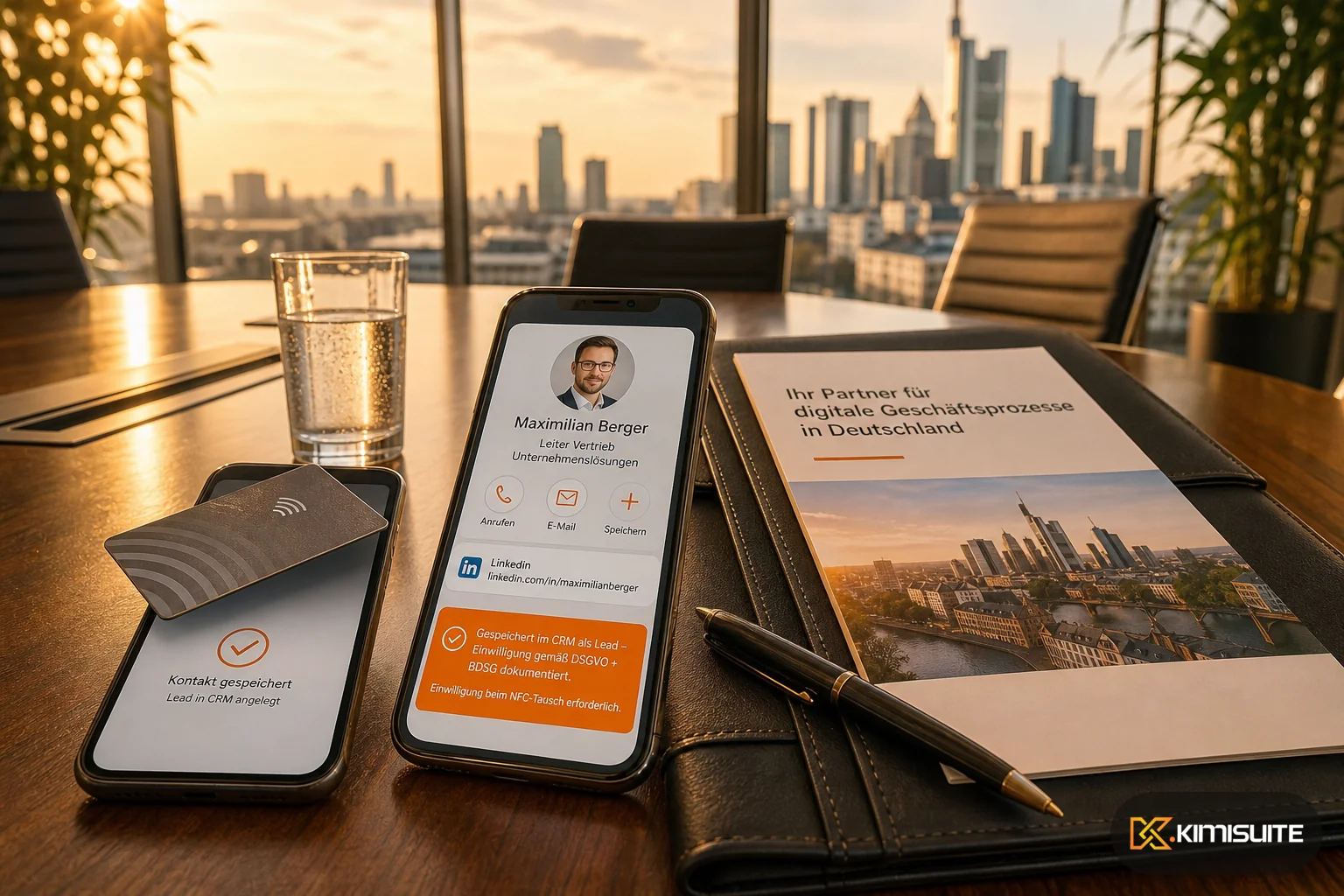

In Germany, a digital business card is not just a convenient way to share details at events. It sits inside a very specific sales context: structured outreach, formal introductions, and a strong expectation that contact exchange is deliberate, branded, and professionally documented. For companies with 5 to 50 sales reps, the question is no longer whether NFC business cards are useful. The real question is whether the rollout fits Germany's B2B etiquette, CRM process, and compliance expectations.
KIMISUITE Digital Business Card is built for that reality. It gives Germany-based sales, marketing, and HR operations teams a practical way to issue branded NFC cards, capture explicit consent, and move new contacts into the CRM without manual export work. Because it runs inside the wider KIMISUITE workspace, teams get one workspace, one bill, and one operational standard instead of another isolated vendor dashboard.
That matters in a market shaped by Strukturierte B2B-Vertriebskultur, Messen-Networking (CeBIT-Erbe, HANNOVER MESSE), Visitenkarten-Tausch nach Handshake. In Germany, the exchange itself still carries meaning. The quality of the card, the order of the interaction, and the clarity of follow-up all signal reliability. A smart business card Germany teams use at trade fairs has to support that, not cut across it with awkward flows or silent data capture.
Many international vendors sell speed, but undersell the local operating detail. One issue is cost. Another is consent. Another is the gap between a tap on a phone and a usable CRM record that sales leadership can trust. If your team leaves an event with 200 new contacts but half of them sit in a separate app waiting for CSV export, the process did not really get simpler.
There is also a branding problem. In a 30-rep team, inconsistent card pages, outdated titles, mismatched logos, and different profile formats create avoidable friction. Germany buyers often notice those details. Central rollout matters because the card is part of your commercial identity, not a side tool the rep manages alone.
The strongest deployment model is therefore not just a card provider. It is a system for contact exchange, compliant consent, event analytics, and CRM attachment under one operational roof. That is the angle KIMISUITE takes: practical NFC exchange for real teams, with measurable process value after the event, not just during the tap.
Where Germany teams lose money and control
Per-card pricing scales badly at 30 reps
Many vendors price per card or per user, which looks small until a Germany field team grows. Mobilo lists EUR 10/Karte/Jahr, while Linq Business is commonly presented at USD 8/Karte/Mo. Add vendors such as Popl, Blinq, HiHello, V1CE, TapNGo, or ABV-Card, and procurement ends up comparing fragmented card costs instead of total workflow cost.
Consent is often treated too lightly
For Germany teams, DSGVO + BDSG; Einwilligung beim NFC-Tausch erforderlich is not a footnote. Contact exchange should be explicit and documented. Many international tools are designed around quick capture and assume implied acceptance, which can be a poor fit for companies that need a clearer consent trail and erasure handling.
Local business etiquette still matters
Germany networking is not purely digital theatre. In a market shaped by handshakes, trade fairs, and formal introductions, premium finish and controlled brand presentation still signal seriousness. A generic landing page after a tap can feel thin if it ignores the expectations around polished presentation and orderly follow-up.
Contacts get trapped outside the CRM
A common failure point is operational. Contacts are captured in the card vendor's own dashboard, then exported later by sales ops or by each rep individually. That breaks speed, reporting, and accountability. If the lead is not attached to Salesforce or HubSpot quickly, event follow-up quality drops within days.
A 30-rep Germany sales team pays today: Mobilo or Linq per-card-per-year + Salesforce or HubSpot per-seat + manual contact-export friction. Real prices from Mobilo (EUR 10/Karte/Jahr), Linq Business (USD 8/Karte/Mo), Popl, Blinq, HiHello, V1CE (UK), TapNGo, ABV-Card (deutscher Anbieter). Using only the public figures named here, Mobilo for 30 reps is about EUR 300 per year just for cards. Linq Business at USD 8 per card per month is about USD 240 per month, or roughly USD 2,880 per year before CRM seat costs and admin time. Add Salesforce or HubSpot seat pricing already in your stack, plus the hours spent exporting, cleaning, and attaching contacts after each event, and the real cost is much higher than the card line item suggests. KIMISUITE Digital Business Card bundles NFC card + auto-CRM-attach + central branding rollout on workspace pricing, so Germany teams buy the workflow as one operating model instead of stacking separate card, sync, and admin costs.
That difference becomes visible after every event cycle. When a rep taps, the contact sees a branded profile, provides details with clear consent language, and the information is attached to the CRM in a controlled way. Marketing gets cleaner attribution. Sales leadership gets rep-level and event-level visibility. HR ops or enablement can roll out title changes, logo updates, and brand consistency centrally rather than chasing individuals.
KIMISUITE also fits the procurement logic many SMBs in Germany prefer. Instead of paying for one more standalone tool with its own billing logic, the digital card lives inside a broader workspace environment. That means one workspace, one bill, and shared governance across apps. For companies trying to reduce software sprawl, this matters as much as the NFC card itself.
There is also a practical AI layer, but the emphasis is deliberately narrow: real post-event tasks. KIMISUITE can help summarise captured notes, standardise lead context, and enrich records for follow-up preparation. The point is not abstract automation language. The point is that a sales rep returns from HANNOVER MESSE with a manageable, prioritised contact list and cleaner CRM records by the next morning.
For Germany-based teams, the result is straightforward: a digital business card Germany buyers are comfortable receiving, sales reps are comfortable using, and operations teams are comfortable governing. It respects local etiquette, deals with consent in a more explicit way, and turns the card exchange into a CRM-ready process rather than another disconnected app.
Questions about rollout, card stock, or CRM setup can be directed via contact us during evaluation and procurement planning.
The Solution
KIMISUITE Digital Business Card is built for companies that need more than a shareable profile link. In Germany, the digital business card has to work across etiquette, compliance, and revenue operations at the same time. That means a rep should be able to exchange details naturally after a handshake, a contact should understand what they are consenting to, and the company should receive a usable CRM record without waiting for exports after the event.
The solution starts with controlled presentation. Every rep receives a branded digital card experience that matches the company's identity, title standards, and market positioning. For Germany teams exhibiting at HANNOVER MESSE or similar events, that consistency matters. It reduces ad hoc formatting, outdated job titles, and off-brand personal pages that can weaken trust at the exact moment a new contact is evaluating professionalism.
Next comes the compliance layer. KIMISUITE is designed around the reality that DSGVO + BDSG; Einwilligung beim NFC-Tausch erforderlich should be handled explicitly. Rather than treating NFC as a silent capture mechanism, the exchange flow can present clear consent language before details are processed. For internal stakeholders, this creates a better basis for documentation and downstream governance. For prospects, it creates a more transparent interaction, which is especially important in Germany's more formal B2B environment.
The third layer is operational: CRM attachment. Capturing a contact is only the first step. The real business value appears when the lead is attached quickly to the right record, owner, or follow-up sequence. KIMISUITE reduces the lag between exchange and action, helping sales teams move from event conversation to qualified follow-up with less manual handling. Marketing benefits because campaign and event attribution become cleaner. Sales ops benefits because data does not remain trapped in a separate card platform.
Cost control is the fourth layer. Many teams initially compare only the visible card fee, but Germany SMBs usually feel the full cost in admin time, inconsistent rollout, and fragmented billing. KIMISUITE takes a workspace pricing approach. Instead of adding one more vendor whose value stops at the tap, the digital card sits inside a shared operational environment with one workspace and one bill. That makes procurement simpler and gives leadership a clearer view of software spend.
Finally, KIMISUITE adds practical post-event support. Notes and captured context can be summarised and standardised so reps do not return from a fair with a pile of half-structured memories. The emphasis stays grounded in real tasks: cleaner records, better prioritisation, and faster follow-up. For a Germany sales director or marketing lead, that means the digital business card becomes part of a disciplined event pipeline, not a novelty item.
In short, KIMISUITE Digital Business Card fits the way Germany teams actually sell: structured, brand-conscious, compliance-aware, and focused on turning every contact exchange into a trackable commercial process.
Benefits
Consent-ready NFC exchange for Germany
Each tap can support explicit consent handling aligned with DSGVO + BDSG expectations, giving teams a clearer and more defensible contact-capture process.
Central branding across every sales rep
Roll out titles, logos, card layouts, and presentation standards from one place so the whole team shows up consistently at meetings and trade fairs.
Event analytics linked to CRM outcomes
See which reps and events generate contacts that actually move into follow-up and pipeline, not just raw tap counts.
Workspace pricing instead of card sprawl
Avoid stacking another standalone vendor bill by managing digital cards inside one KIMISUITE workspace shared across apps and teams.
Contacts move into the CRM faster
Reduce manual exports and disconnected dashboards so leads can be attached, owned, and acted on while event conversations are still fresh.
Practical AI for post-event follow-up
Summarise notes and standardise captured context so reps return from events with cleaner records and a more manageable next-step list.
Your Questions Answered
Take Your Business to The Next Level!
Stop paying for tools you barely use. Start running your business on KIMISUITE.
No long-term contract · Cancel anytime · 14 days free