Every business system reaches a point where it stops fitting. A new regulation appears. A new sales channel emerges. A new reporting requirement lands on the finance team's desk. The system that has run the business for the last five years suddenly has a visible gap — and someone in the room says "maybe it is time to replace it."
Most of the time, the answer is: no, it is time to bridge it.
What "bridging" means
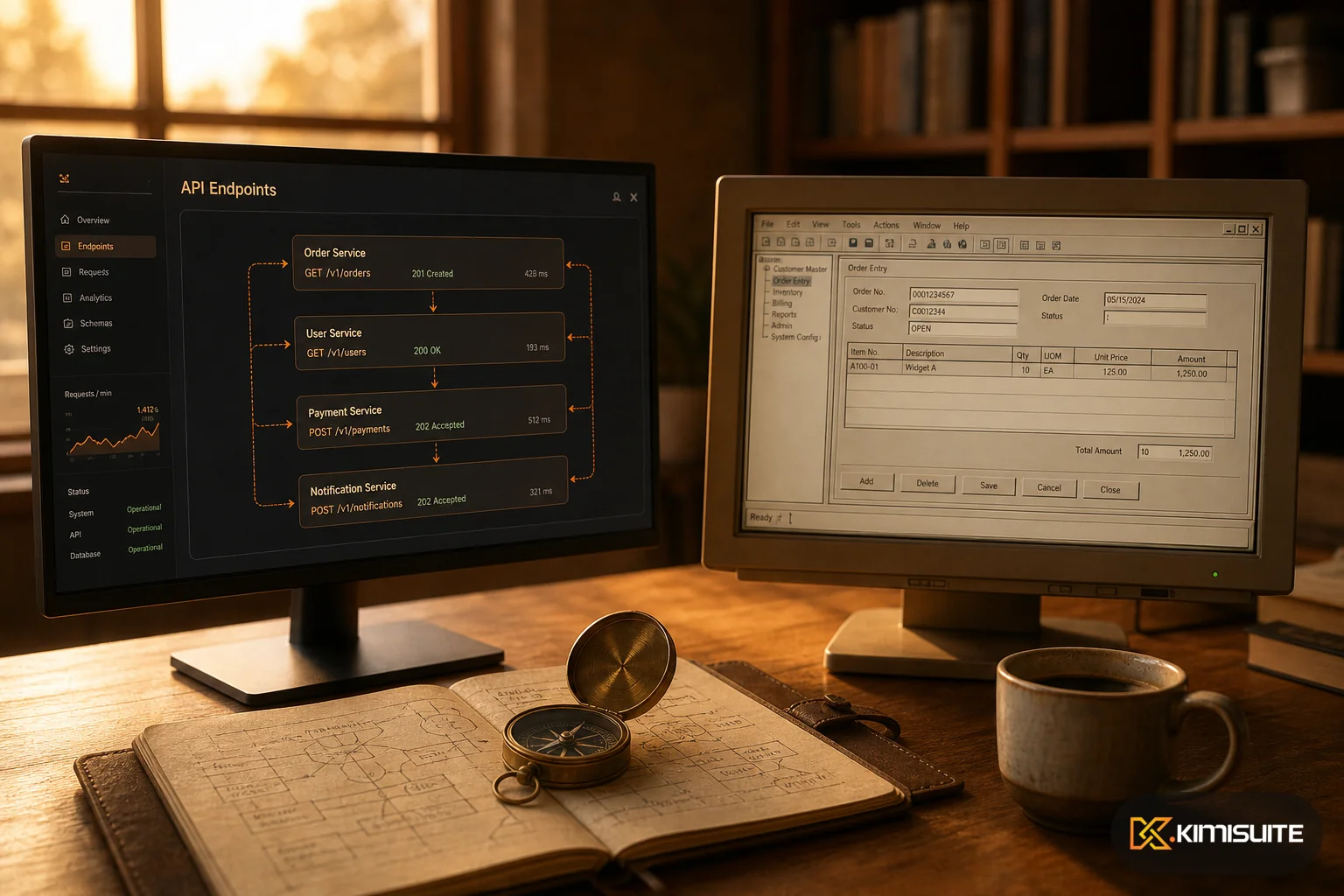
Bridging is what happens when you extend a working business system through APIs and integrations instead of replacing it. The core stays. The gap is filled. The team does not retrain. The historical data stays where it is. The migration risk stays at zero.
At scale, this is what API integration services actually deliver — not shiny new dashboards, but the boring, high-value work of connecting the system you have to the capability you need.
Why replacement is almost always the wrong first move
Replacing a functional business system carries costs that do not show up in the vendor pitch:
- Team retraining. Weeks of reduced productivity, often longer.
- Historical data migration. Never fully clean. Some fields are lost. Some fields are misinterpreted. The team spends six months finding the discrepancies.
- Process rewrites. Every SOP the business has documented is now wrong.
- Vendor lock-in on the new side. Whatever forced you to leave the old system will happen again in a few years. You just moved the problem.
- Opportunity cost. The team is running a migration instead of running the business.
Migration makes sense when the core system is genuinely broken — end-of-life, no support, security-compromised, or fundamentally unable to represent the shape of the business. That happens. It just happens less often than the sales cycle suggests.
When bridging is the right move
Bridging wins when the trigger for change is one of these patterns:
- A new external system needs to talk to yours. A regulator requires e-invoicing. A new payment provider needs a webhook. A partner wants order data pushed to their API. All bridging jobs.
- Two internal systems do not sync. Your CRM and your accounting system disagree about who paid what. Your booking system and your PMS do not share guest profiles. Also bridging.
- A capability is missing but the core is fine. You need better reporting, or a customer portal, or mobile access to a desktop system. The right answer is usually an integration or a small custom UI layered on top, not a whole new stack.
- Regulatory compliance under time pressure. When a deadline lands — e-invoicing mandates are a common example — a bridge can be built in weeks. A replacement cannot.
What KIMISUITE Connect does
KIMISUITE Connect is our API integrations service. It has one specific job: connect the systems you already run to the systems you need them to talk to, with production-grade reliability and full observability.
A typical engagement involves three components: the API bridge itself (built to the target's spec — REST, SOAP, XML-RPC, whatever the endpoint requires), the transformation layer (mapping your data model to theirs, or vice versa), and the operational surface (logs, retries, alerting, so the team knows immediately if something breaks).
We handle both sides: outbound integrations from your system to a third party, and inbound integrations from a third party to yours. We also build the "compliance bridges" that regulated industries increasingly need — connecting old accounting software to new e-invoicing endpoints, connecting on-premise systems to cloud services, connecting one country's regulatory API to another's data model.
Frequently asked questions
How is this different from a Zapier-style automation?
Zapier and similar tools work well for casual automation — desktop-scale, low-volume, no compliance requirements. KIMISUITE Connect handles the cases they cannot: production-grade reliability, signed data flows, compliance logging, custom transformations, and any endpoint that is not already on the automation platform's supported list.
Can you integrate with legacy systems?
Yes. Some of our most valuable work is around ten-to-twenty-year-old business systems that were never designed to be integrated but must be, now, for compliance or partnership reasons.
Do you maintain the integrations after launch?
Yes — every integration ships with monitoring and is included in a managed IT support plan. When third-party APIs change (they do), we adapt the integration before it breaks in production.
Can we own the code?
Yes. Every KIMISUITE Connect deliverable ships with source code, documentation and a working local dev environment.
Bottom line
Replacement is expensive, risky and slow. Bridging is cheap, safe and fast. Most business system conversations that start with "we should replace it" end better if they start instead with "what if we bridged it?"