The most expensive part of any software project is not the build. It is the years after it, when the system needs to be kept alive — updated, secured, monitored, adapted to changing dependencies — and the original vendor is nowhere to be found.
Managed IT support is the boring, unglamorous work that makes the difference between a system that stays operational and one that quietly rots for eighteen months before failing spectacularly. It is also the part of an engagement most vendors sell casually and deliver worse than they promised.
The three questions
Before signing any support agreement — including one from us — ask these three questions.
1. Who exactly answers when I raise a ticket at 4 PM on a Friday?
The right answer names a specific team, in a specific time zone, with a specific SLA. The wrong answer is a link to a support portal and vague reassurances. Any support offering that cannot name the humans who will actually respond, and their working hours, is closer to marketing than to service.
2. What does "support" cover — and just as importantly, what does it not?
Real support agreements are specific: security patches, dependency updates, breaking-change adaptation, monitoring, incident response, root-cause analysis. Vague agreements let the vendor bill "additional" work whenever anything interesting happens.
Ask for the exclusion list. The exclusion list tells you what the support agreement really is. If the exclusion list is missing or evasive, the support agreement is a hunting license — the vendor gets to bill hourly the first time anything unusual happens.
3. What is the escalation path when the front-line responder cannot fix it?
Every support organisation has a good team and a great team. The great team costs more and gets used less. If the escalation path from the ticket-triage tier to the senior engineer is unclear, incidents that need the senior engineer will sit in the triage tier for days.
The right answer names a specific escalation trigger and a specific senior. The wrong answer is that "the team handles it collaboratively" — which is a polite way of saying no one owns it.
What we cover
Managed IT support at KIMISUITE is the ongoing engagement that runs after we have built or migrated a system for you. It has a specific scope:
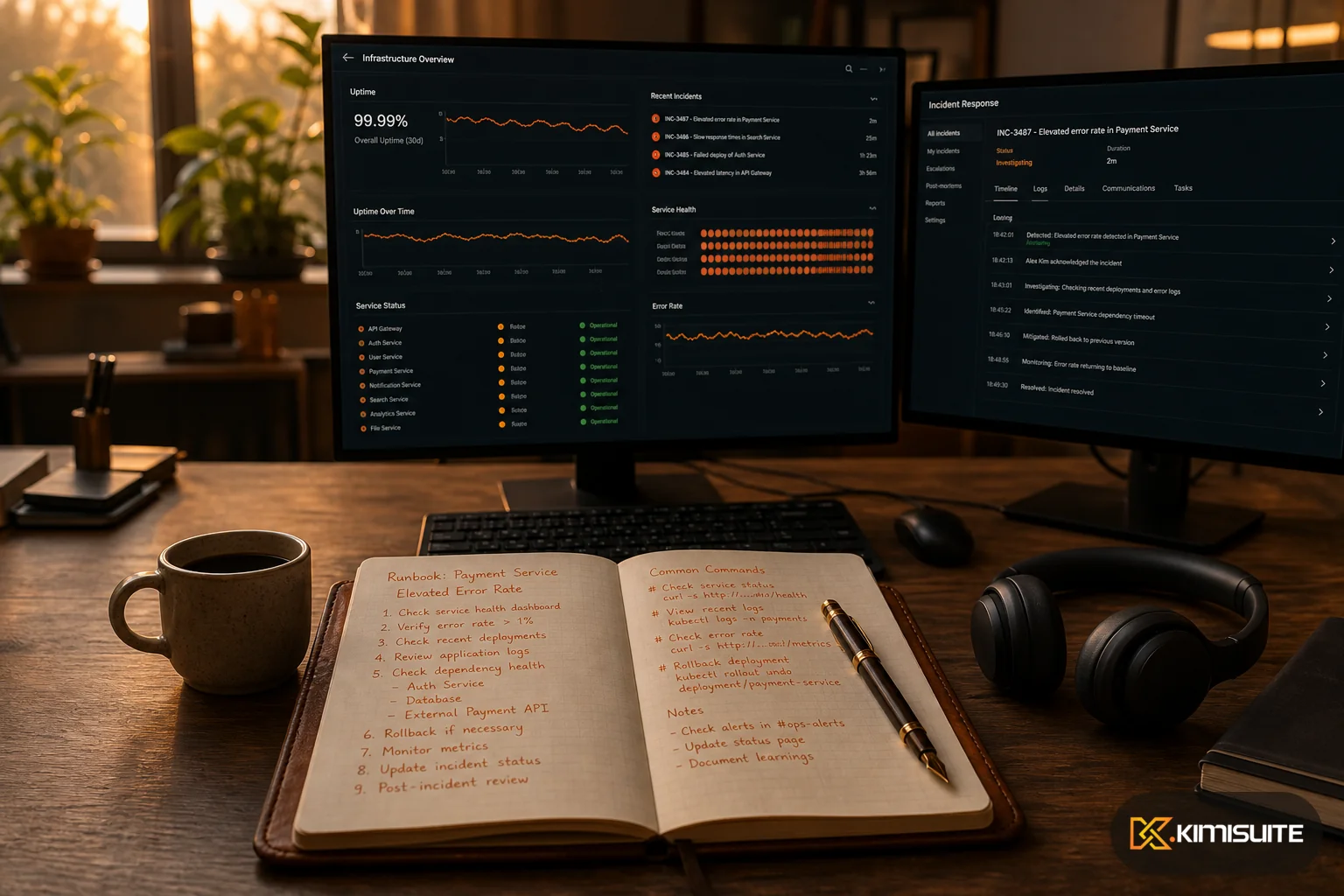
- Uptime monitoring — every system we run has active monitoring with alerting to on-call engineers, not just to a dashboard nobody watches.
- Security patching — dependency updates on a defined cadence, plus emergency patches for CVEs that affect the stack.
- Compliance drift monitoring — the regulatory environment keeps changing. Our support engagement includes flagging the changes that affect your systems before they become audit findings.
- Incident response — with an SLA on first response, an SLA on resolution, and a written post-mortem after every significant incident.
- Adaptation to third-party changes — when the payment provider changes its API, when the OS ships an update that breaks an integration, when the browser deprecates something you were relying on. The category of work that nobody sees until it is not done.
We do not cover: new feature development (that is a separate engagement), significant scope changes to how the system works (also separate), or user training (we can provide, but as scoped work).
Frequently asked questions
Is this a subscription or a retainer?
A defined monthly plan tied to specific coverage. Not a retainer where hours get burned on ambiguous work — we tell you exactly what the plan includes.
Do you support systems you did not build?
Case by case. We can take over support for systems built by other vendors if the code and infrastructure are in a state we can responsibly commit to. If the system is undocumented and fragile, we may recommend a stabilisation project before entering support.
What about on-call for emergencies?
Every plan includes an on-call number for genuine production emergencies. Response SLAs vary by tier.
Do you handle end-user IT support — laptops, email, printers?
Not typically. Our support scope is around the systems and applications we or others have built — not general office IT. For general IT we can recommend local partners.
Bottom line
Building software is the small part. Keeping it alive for the next decade is the big part — and it is the part vendors love to shortcut. Ask the three questions above of any support offering, including ours. If the answers are not specific, the coverage is not real.