There are two AI automation stories being told to businesses right now, and they are almost impossible to tell apart before you sign the contract.
The first story is real. AI automation, done properly, removes hours of repetitive work per week per employee, at a fully-loaded cost that is a fraction of the labour it displaces, with results that are measurably as good as or better than the human baseline.
The second story is theatre. An LLM wired into a dashboard, a Slack notification, and a demo video that shows something impressive happening. Under the hood, the same team is still doing the same work — often with an extra step to "review the AI's output." The pitch deck says automation. The operational reality is a longer workflow.
The two look nearly identical in a proposal. Here are the four tests that separate them.
Test 1: Does it remove a task or add oversight?
Real automation removes the human from a step of the workflow. Theatre inserts a human as a reviewer of an AI's output.
The question to ask: after this system ships, will the team spend fewer hours per week on this task, or more? If the honest answer is "about the same, but with a copilot," you are being sold theatre. If the answer is "half as many hours, because the AI handles cases X, Y and Z without review," you are being sold real automation.
Copilots have value — they are not dishonest. But they are not automation. They are assistance. Do not confuse the two on your P&L.
Test 2: Is there a fallback for when the AI fails?
Every production AI system fails. Sometimes rarely, sometimes frequently, always eventually. Real automation is designed with an explicit failure mode: what happens when the model's confidence is low, when the input does not match training, when the third-party API changes.
The systems that are quietly saving businesses money in 2026 have three things in common: they log every decision, they route uncertain cases to a human before shipping, and they have a specific person who owns the retraining cycle when accuracy drifts.
The systems that are quietly costing businesses money have none of the three. They fail silently. Errors accumulate. Nobody notices for weeks. The apparent savings dissolve into rework.
Test 3: Is the ROI measurable in a specific number?
Real automation projects can show you a specific number before they start: hours per week saved, cost per task reduced, throughput multiplied by X. Theatre projects show you demos.
If a proposal cannot answer "what will this specifically change in our operational costs, measured in hours or euros, in the next quarter?", the proposal is not a business case. It is a technology preview.
Test 4: Does the automation touch the actual bottleneck?
Most businesses have one or two operational bottlenecks that actually constrain revenue. Automation applied anywhere except those bottlenecks feels productive but does not change the top line.
Before automating anything, name the specific bottleneck. If a proposal does not reference it explicitly, the automation will land somewhere else and produce activity without impact.
Our approach
AI automation and workflows at KIMISUITE start with the four tests above and end with a working system that reports its own performance. Every engagement begins by naming the specific process, the specific bottleneck, and the specific measurable outcome. We do not ship AI that "helps." We ship AI that removes a task from the team's weekly workload — and we prove it in the numbers before we call the engagement complete.
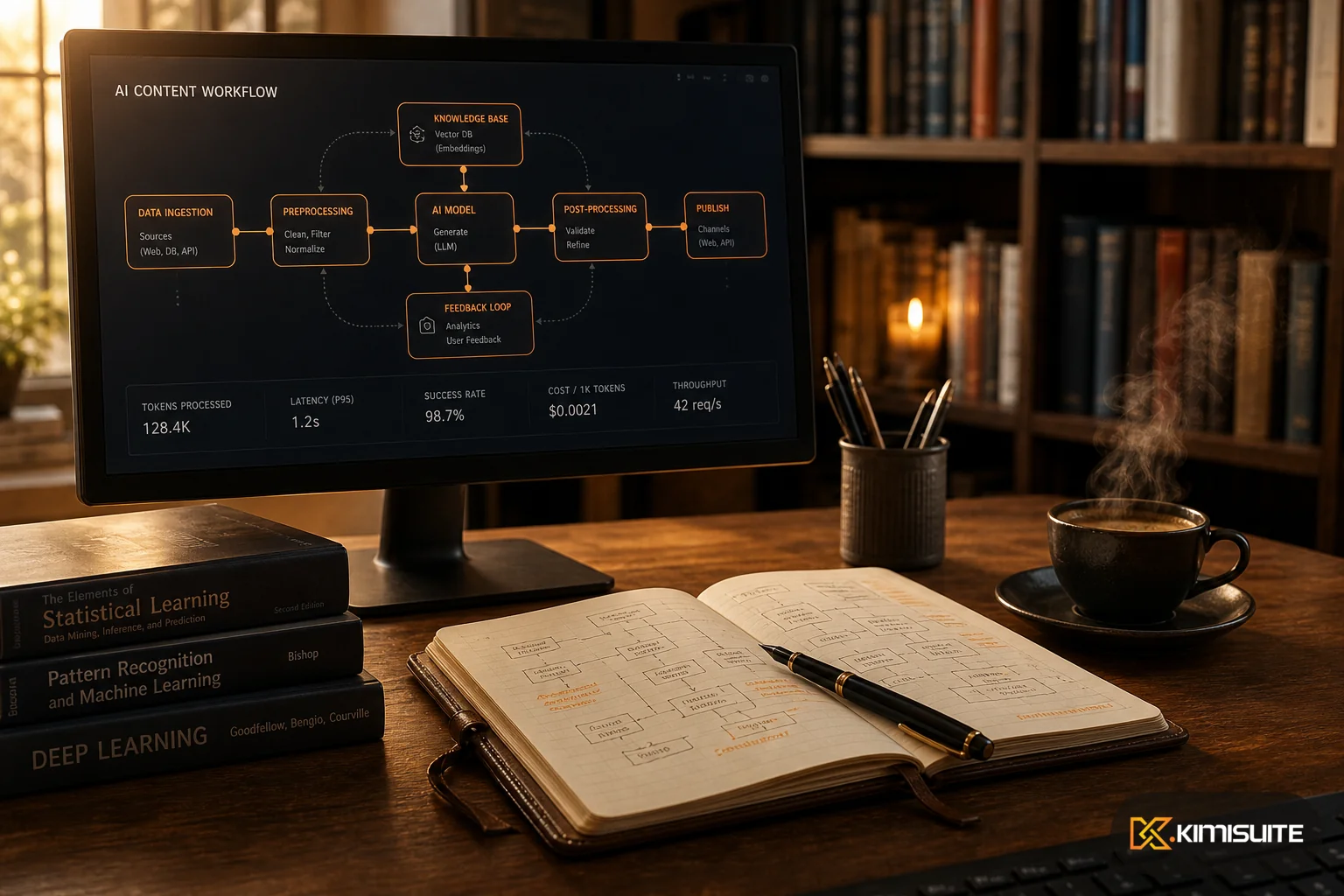
We build automations that operate at three levels of confidence: full auto (high-confidence cases handled without review), assisted (medium-confidence cases surfaced to a human with a proposed answer), and escalated (low-confidence cases routed to a queue). Every case is logged. Every drift is monitored. Every quarter has a retraining cadence.
Frequently asked questions
What kinds of processes are worth automating?
Repetitive, structured, and high-volume. Sales lead enrichment, invoice categorisation, customer email triage, content moderation, first-pass document review — all common wins. One-off creative work rarely is.
Do you use OpenAI, Anthropic, or something else?
We pick per project, based on the specific accuracy, cost, latency and data-handling profile. We are not tied to any single vendor.
What about data privacy?
For most engagements we can route AI calls through EU-hosted endpoints or run smaller models on-premise. GDPR and sector-specific privacy requirements are scoped from day one, not retrofitted.
Can you integrate with our existing systems?
Yes — usually via KIMISUITE Connect. The AI does the reasoning; Connect handles the plumbing.
Bottom line
The AI automation market is loud. Most of it is theatre. Ask the four questions above before you sign anything, and you will cut through most of the noise.