Hotel Software Without Per-Room Pricing
KIMISUITE Booking Hub uses one workspace flat rate for your property, not a room-based bill that rises every time you add capacity.
Common Challenges
Per-room pricing punishes growth
Cloudbeds, Little Hotelier and RoomRaccoon commonly price by room count. At roughly EUR 4-6 per room per month, a 40-room hotel already pays EUR 160-240 monthly. Grow to 60 rooms and the software bill rises by 50%, before your new capacity has fully paid back.
Seasonality does not lower the bill
Independent hotels often close a floor, reduce inventory in winter, or run a smaller seasonal setup. Under a per-room model, the invoice usually stays tied to listed capacity, not actual operating reality. Your software cost remains high even when parts of the property are inactive.
Second properties mean extra contracts
Multi-property expansion is where room-based pricing becomes especially expensive. A second guesthouse, apartment building or sister hotel often means a new property subscription, another onboarding process, and sometimes another setup fee. Family-run groups end up paying several times for the same operational logic.
The Solution
For independent hoteliers, software pricing should be easy to understand before the month begins. That is the practical idea behind KIMISUITE Booking Hub. Instead of charging you for every room you open, list or add, KIMISUITE Booking Hub charges by workspace. In plain terms: one flat workspace tier covers the operating environment for your hotel, with the whole team included and no per-seat fees on top.
That changes the economics in a way that matters to real owners. A room-based model looks manageable when you first sign. Then you renovate ten rooms, convert attic space into suites, reopen a closed floor, or add a small annex for summer demand. Revenue potential rises, but so does the software invoice. The very act of growing your property triggers a recurring penalty. With a workspace price, the logic is different. Your monthly cost is tied to the workspace tier, not to every room count adjustment you make across the season.
Ein 40-Zimmer-Hotel auf Cloudbeds zahlt heute typischerweise EUR 4-6 pro Zimmer pro Monat = EUR 160-240/mo. Wächst es auf 60 Zimmer, sind es EUR 240-360/mo. Mit einer zweiten Liegenschaft (20 Zimmer) kommen weitere EUR 80-120/mo dazu — manchmal mit Onboarding-Fee. Insgesamt ein Wachstum-Strafzuschlag. KIMISUITE Booking Hub berechnet pro Workspace, nicht pro Zimmer: ein flacher Tier-Preis deckt das ganze Hotel ab. Eine zweite Liegenschaft wird auf dem Business-Tier mit-bewirtschaftet, ohne Pro-Zimmer-Aufschlag.
This is especially relevant for Alpine hotels, Mediterranean seasonal properties, boutique city hotels and family groups with mixed inventory. Many operators do not run a single static building all year. They adapt. They close sections in low season, open extra units for summer, and test new accommodation formats such as apartments or small villas. A per-room billing model is rigid in exactly the area where hospitality operations are not. KIMISUITE Booking Hub gives you a more stable cost base while your property mix changes through the year.
The benefit is not only lower software inflation. It is also better planning. If your bill rises every time capacity rises, it becomes harder to model expansion properly. A new wing may look profitable in the investment spreadsheet, yet your software stack quietly adds another recurring cost line. Owners often notice this too late because room-based pricing feels small when shown as a per-room figure. In aggregate, it becomes a meaningful monthly overhead. A workspace price is easier to budget because the rule is clear from day one.
KIMISUITE Booking Hub also fits the way smaller hotel teams actually work. Reception, reservations, owner-management, back office and seasonal staff share one workspace under a single bill. There is no separate seat-count discussion every time responsibilities shift between people. For a business where staff structures change between high and low season, that matters. The platform is designed to simplify the cost stack, not to create another moving target.
There is also the operational advantage of keeping more of the booking process in one place. KIMISUITE Booking Hub is built as an all-in-one workspace so you are not forced to stitch together multiple disconnected subscriptions just to manage daily hospitality work. The result is less vendor fragmentation, a simpler billing structure and fewer hidden pricing escalations as the property grows. Instead of one PMS bill, one channel tool bill, another booking engine add-on and extra user charges, the workspace model aims to replace several separate tools with one operating layer and one invoice.
For European hotels, compliance and localisation are not side issues. KIMISUITE Booking Hub is EU-built, GDPR-default, available in 16 languages out of the box, and supports multi-currency including EUR, USD and MKD. That matters when your front desk team is multilingual, your guests book from different markets, or your ownership wants a system shaped around European operating expectations rather than imported assumptions. You get practical software for real hospitality administration, not a pricing model designed to monetise every incremental room.
If you are currently on Cloudbeds, Little Hotelier, RoomRaccoon, Mews or SiteMinder-linked setups and you are tired of seeing room count drive your monthly bill, the switch in logic is straightforward: stop paying a tax on inventory growth. Move to a workspace model where the cost stays predictable while your property develops. For many hotels, that is the difference between software as a controllable operating expense and software as a recurring penalty for success.
And where AI is concerned, KIMISUITE takes a practical line. This is AI for real tasks such as draft invoices, follow-up reminders and helpdesk routing, not buzzword decoration. Hoteliers do not need another grand promise. They need faster routine work, clearer processes and a monthly cost they can explain in one sentence.
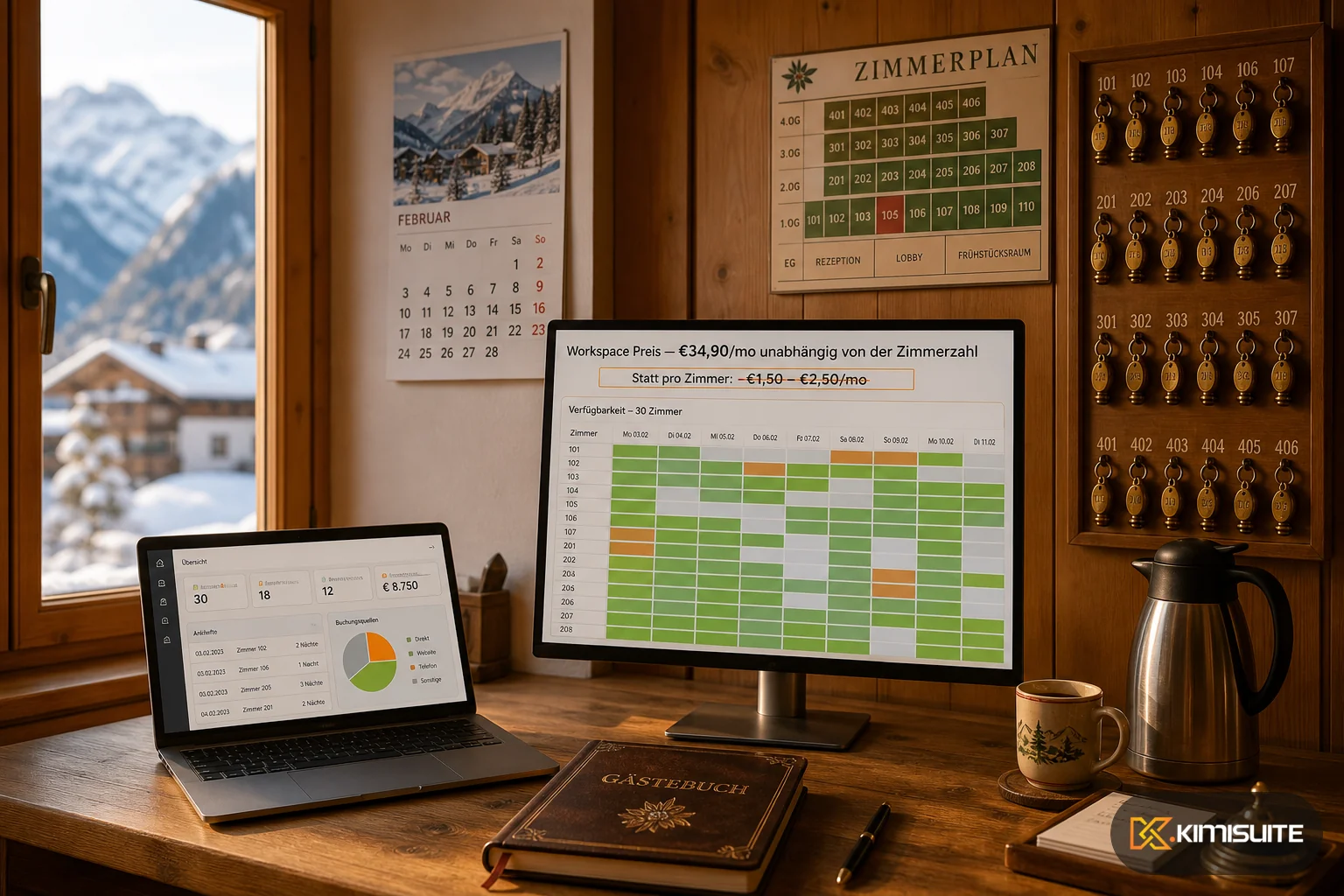
See the workspace model in context below.
If you want to compare your current room-based setup with a flat workspace price for one or more properties, contact us and we will walk through the numbers with you.
Benefits
One workspace rate, not room counting
Your monthly price is based on the workspace tier, so adding rooms does not automatically create a higher recurring software bill.
Grow without a software penalty
Open new capacity, renovate inventory or expand gradually without watching every additional room turn into another monthly charge.
Multi-property under one tier
On the Business tier, additional properties can be managed without a per-hotel surcharge that duplicates costs across the group.
Seasonal closures stay commercially sensible
If you shut a floor or reduce sellable inventory in low season, your pricing logic does not keep punishing dormant capacity.
Budgeting becomes predictable
You know what you will pay each month because the price changes with the tier, not with every operational fluctuation.
EU-built and GDPR-default
Run your hotel on a platform designed for European businesses, with 16 languages, multi-currency support and compliance built in.

Your Questions Answered
Take Your Business to The Next Level!
Stop paying for tools you barely use. Start running your business on KIMISUITE.
No long-term contract · Cancel anytime · 14 days free