Hotel Software That Actually Works Together
KIMISUITE Booking Hub gives independent hotels one EU-built platform for reservations, channel sync, direct bookings, payments and front-desk work without per-room pricing.
Common Challenges
Too many tools, too many gaps
Many hoteliers discover that 'hotel software' really means buying separate systems for reception, OTA sync, website bookings and reporting. When availability or guest data fails to sync, the hotel ends up troubleshooting between vendors.
Per-room pricing grows with your costs
A system that looks affordable at 20 rooms often becomes expensive at 40 or 60. Vendors such as Cloudbeds, Mews and RoomRaccoon commonly price by room, so expansion increases software cost before occupancy gains catch up.
Old systems create operational risk
Legacy desktop hotel systems often depend on one installer, one old PC or one outdated printer setup. Moving away can feel risky, but staying put means manual work, fragile workflows and limited visibility across bookings and payments.
EU requirements are treated as extras
Independent hotels in Europe need GDPR-default handling, multilingual guest communication, practical invoicing and multi-currency support. With many US-led platforms, these needs are secondary, gated behind add-ons or enterprise-level setup.
The Solution
When someone searches for hotel software, they usually are not looking for technical jargon. They are looking for a practical answer to a simple business problem: how do I run reservations, room availability, front-desk work, guest records, website bookings and payments without stitching together five different systems?
KIMISUITE Booking Hub is built for that exact moment. It is an all-in-one hotel management software platform for independent hotels that want one operational system instead of a stack of disconnected tools. For a 15-room boutique property, a 40-room family hotel or a growing regional group, the goal is the same: fewer manual steps, fewer sync failures, clearer reporting and a software bill that stays understandable.
What hotel software should actually do
At a practical level, a hotel platform should help you sell rooms, keep availability accurate, take payments, manage arrivals and departures, store guest history and show you what is happening in the business. That sounds obvious, but in the market it is often split across separate products: a PMS for the front desk, a channel manager for Booking.com and Expedia, a booking engine for your own website, a payment provider, and then another reporting layer on top.
The problem is not only cost. The deeper problem is operational dependency. If one tool updates late, your availability can be wrong. If one integration fails, the reception team starts checking multiple dashboards. If one vendor changes a connection, your staff carries the burden. For independent hotels, this is where software stops being support and starts becoming overhead.
KIMISUITE Booking Hub brings those core jobs into one workspace: reservations, room availability, channel sync to Booking.com, Expedia and Heycar, direct booking on your own website, payment integration, guest records and reporting. One team works in one place. One property or group works from one source of truth. One bill covers the workspace.
Why the all-in-one model matters for independent hotels
Large chains can afford specialists for revenue systems, channel logic and integration management. Independent hotels usually cannot. The owner, general manager or front-office lead ends up covering software decisions on top of daily operations. That is why the all-in-one model matters more in the independent market than in enterprise hospitality.
With KIMISUITE Booking Hub, the all-in-one claim is not a slogan. It means the reservation data, guest profile, payment status and channel availability are connected by design. A direct booking on your site does not need to be pushed from one tool into another and then reconciled in a third. A payment status can sit next to the reservation record. Reporting can reflect what actually happened across channels because the activity lives in the same workspace.
This also changes training and handover. New staff do not need to learn a patchwork of logins and tabs just to manage a booking lifecycle. Your reception team can work from one operational flow instead of memorising where each piece of information lives. For first-time hoteliers, that lowers the barrier to adopting proper hotel operations software EU without becoming software administrators.
Cost-stack math: what independent hotels often pay today
A 40-room independent hotel running today typically pays: a PMS such as Cloudbeds at roughly EUR 4-6 per room × 40 = EUR 200/mo, plus SiteMinder Channel Manager around EUR 169/mo, plus a third-party booking engine like SiteMinder Booking Engine around EUR 149/mo, plus payment-gateway fees per transaction. Real-world stack: about EUR 520/mo before transaction costs — three separate tools that need to talk to each other reliably. KIMISUITE Booking Hub bundles the PMS, channel manager (Booking.com, Expedia, Heycar), direct booking engine, Stripe + SEPA + TWINT payment integration and guest record on a single workspace tier.
This is where KIMISUITE’s pricing logic matters. The workspace is priced per workspace tier, not per seat and not per room. Your full team can use it without seat-count penalties. If your staff changes seasonally, you are not renegotiating user fees. If occupancy grows, you are not automatically punished by a room-based software bill before you have realised the commercial upside.
That matters especially for owner-managed hotels watching every monthly fixed cost. Replacing multiple subscriptions with one workspace and one bill is not abstract simplification. It is easier bookkeeping, easier forecasting and less margin leakage.
Built for Europe, not adapted to Europe later
Many hotel platforms were built around US market assumptions and then localised outward. That often shows up in the details: awkward invoicing, limited language coverage, compliance handled as a support ticket and payment methods that do not reflect how guests and businesses pay in Europe.
KIMISUITE Booking Hub is EU-built and GDPR-default. It supports 16 languages out of the box and multi-currency workflows in EUR, USD and MKD. For hotels serving domestic guests, regional travellers and international visitors, that matters in daily communication as much as in reporting. It also matters when handling business customers, travel partners and the legal expectations around guest data.
For independent hoteliers, compliance is rarely a competitive differentiator, but getting it wrong is expensive and time-consuming. A platform should not make you choose between usability and EU practicality. KIMISUITE is designed around both.
Migrating from a legacy hotel system without chaos
One of the biggest barriers to change is not price. It is fear of disruption. Many hotels still run an old on-premise installation from a vendor relationship that barely exists anymore. The software may still technically run, but only on one machine, with one printer setup, and one person who knows the workaround. That is not stability. That is hidden fragility.
Moving to cloud software should not mean rebuilding the hotel from scratch. In practice, the transition needs to focus on continuity: current reservations, room setup, rates, guest records, payment workflows and staff adoption. The right migration path is usually phased and operational, not theoretical. The objective is to move the business forward while keeping check-in, checkout and daily reservation handling intact.
KIMISUITE Booking Hub is well suited to hotels replacing older systems because it reduces the number of moving parts. Instead of migrating into one new PMS and then reconnecting a separate channel manager and booking engine, you move into one platform that already covers the connected workflow.
Compared with common hotel software vendors
Cloudbeds, Mews, RoomRaccoon, Sirvoy, Little Hotelier and SiteMinder are all known names in the market, and each can fit certain properties well. The difference is usually not whether they can handle reservations at all. The difference is how the commercial model and product structure fit an independent European hotel.
Cloudbeds, Mews and RoomRaccoon are often evaluated first by growing independents, but room-based pricing can become a real issue as capacity expands. SiteMinder is widely recognised for channel distribution, yet many hotels still need to combine it with a separate PMS and booking engine. Little Hotelier and Sirvoy can be attractive for smaller properties, but many hotels eventually look for a platform that covers broader operational depth as complexity increases.
KIMISUITE Booking Hub is positioned for owners who want one serious system rather than a collection of point solutions. It covers the operational basics to professional depth while keeping the commercial structure simple: one workspace, one bill, whole-team access, EU-first foundations.
And where AI is concerned, the position is practical. KIMISUITE uses AI for real tasks such as invoice drafts, follow-up reminders and helpdesk routing where useful, not as a layer of vague promises around hotel operations.
If you are evaluating all-in-one hotel software for the first time, the decision is not just about feature lists. It is about reducing manual work, avoiding sync risk, keeping costs legible and choosing a platform that fits how independent hotels in Europe actually operate.
That is what KIMISUITE Booking Hub is for.
For pricing details and workspace options, see the table below.
If you want a migration review or a fit check for your property, contact us.
Key Features
PMS, channel sync and booking engine together
Run front-desk work, OTA availability and direct website bookings from one workspace instead of juggling disconnected hotel systems.
Per-workspace pricing, not per-room
Your software cost stays predictable as your hotel grows, and the full team can use the platform without per-seat fees.
EU-built for real hotel operations
GDPR-default hosting, 16 languages and multi-currency support help independent hotels serve European and international guests more practically.
Direct booking with integrated payments
Take direct reservations on your own website with Stripe, SEPA and TWINT integration, reducing dependence on external booking paths.
Real-time operational clarity
Reservations, guest history, payment status and channel updates stay connected, cutting manual checks and reducing front-desk friction.
Guest records that stay useful
Keep reservation history per stay in one place so your team can answer faster, recognise returning guests and avoid scattered notes.

Recommended App
Booking Hub
Hotel Booking System Built for Direct Growth
Discover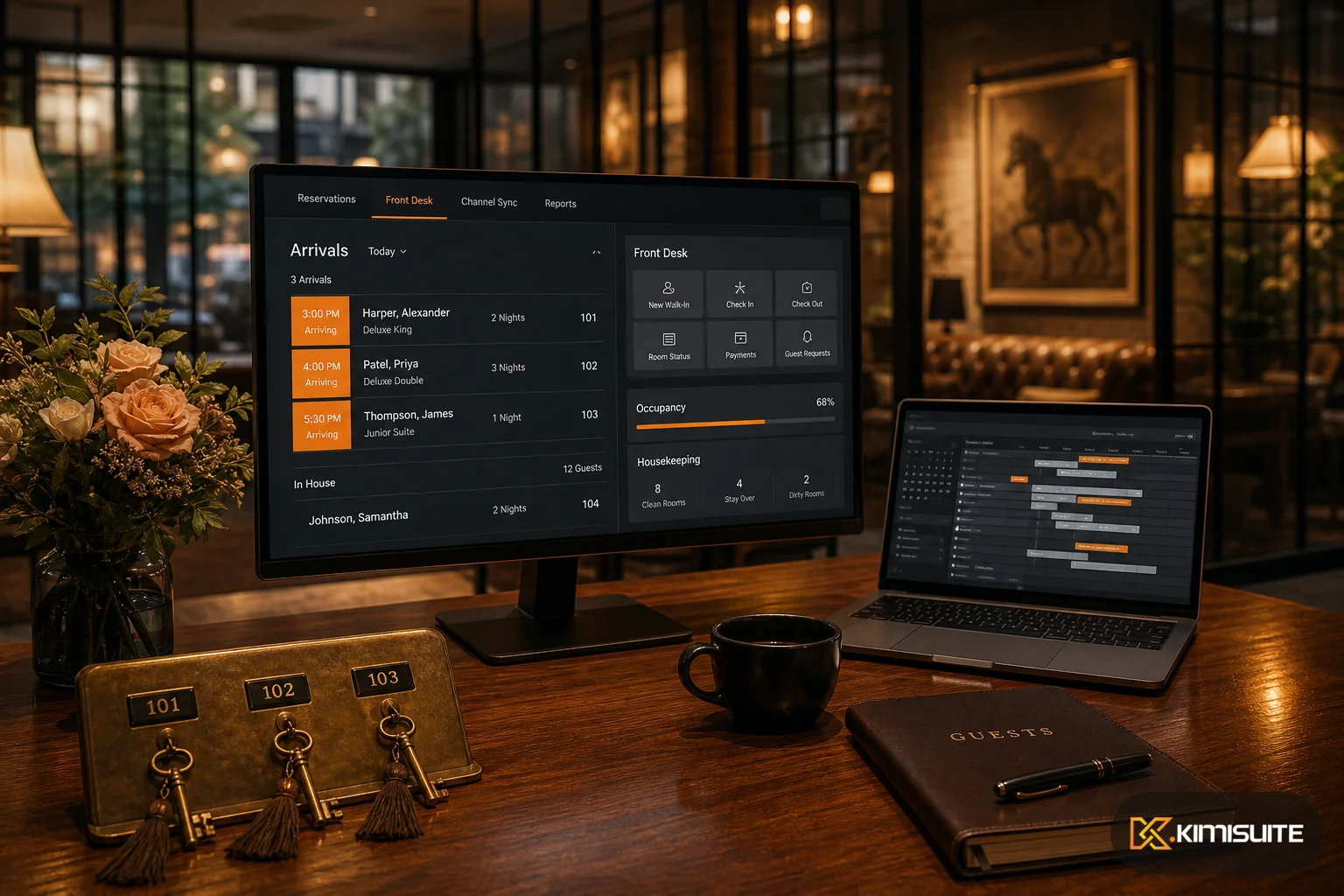
No long-term contract · Cancel anytime · 14 days free
Your Questions Answered
Take Your Business to The Next Level!
Stop paying for tools you barely use. Start running your business on KIMISUITE.
No long-term contract · Cancel anytime · 14 days free